
KOTA KINABALU – The barrage of negative news and information related to Covid-19 fed to people on a regular basis could give rise to fears that lead to depression, warned an expert.
“Even those who do not have a history of mental health issues can develop phobias, what more, those who have existing mental health problems like anxiety,” Prof Murnizam Halik of Universiti Malaysia Sabah’s Faculty of Psychology and Education told The Vibes.
“While I understand that Covid-19 is bad, and it is unavoidable that all the bad news is highlighted, there must be something positive that follows as well.
“We have to balance the positive and negative information. The media can play their part in this,” he said when explaining factors that have contributed to the high number of suicides in the country this year.
Police statistics showed that there were 266 suicides from March 18, when the movement control order came into force, to October 30 – an average of 30 cases a month, or one a day.
Murnizam said studies conducted in 64 countries, including Malaysia, have pointed to a link between the unemployment rate and suicides.
The research found that among those who have lost their jobs, people who are family breadwinners are the most affected, he said.
“The pandemic has also created problems, such as financial constraints due to a bad economy, high levels of debt, failure to fulfil commitments and so on.
“These have heightened existing mental health problems among the community. It is also a major factor contributing to the high suicide rate.”
While the Health Ministry, Sabah Health Department and non-governmental organisations have hotlines for over-the-phone counselling, he said, community support is also key to prevent suicides.
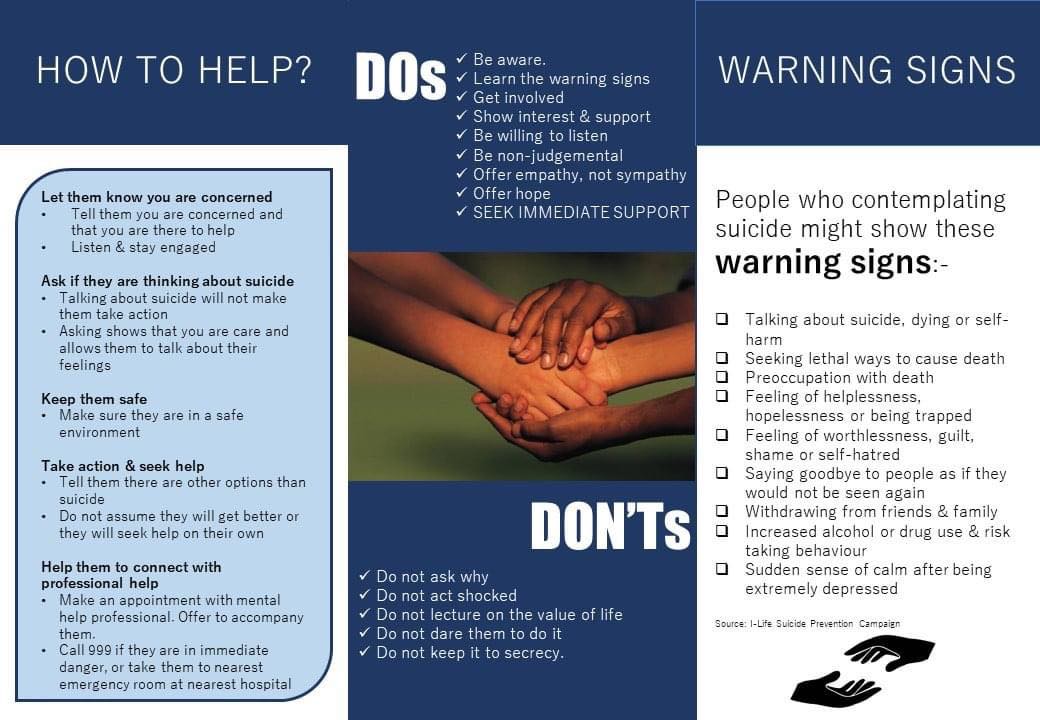
“Community members can identify warning signs in those close to them.”
He said among the signs to look out for are when someone talks or writes about ending their life; they feel hopeless or think there is no reason to live; they suffer from depression, anxiety and agitation; and, they start to withdraw from regular, daily activities.
“However, the signs are not definite. It is difficult to predict suicides. It can happen to anyone.
“From a psychological point of view, the most important thing is community support.
“People in a group, like family or friends, can provide those who are prone to suicidal thoughts with an unofficial support system.”
Those who detect worrying signs in their loved ones can then aid them in seeking professional help, he said.
Consequences of support system failure
On October 21, a suspected Covid-19 patient jumped to her death from the eighth floor of Queen Elizabeth Hospital here.
Just two weeks ago, a 62-year-old man fell from the sixth floor of Likas Hospital. He landed on the roof of a lower level, and survived.
Befrienders Kota Kinabalu, which operates a suicide helpline, received 1,375 calls from across the state, from March to October. About 30% of the calls were from people with suicidal ideation.
The group’s publicity director, Jessie Ting, said callers include individuals who have lost their jobs, are in financial difficulty, experience family problems, feel isolated due to lockdowns, fail to further their studies, lack social support, and suffer from depression.
“When someone commits suicide, it is because all their support systems have failed, or the person did not get assistance, or did not know that help was available.”
She urged the public to be mindful of the signs exhibited by someone who intends to take their own life.
The Mental Health and Psychosocial Support (MHPSS) service under the Sabah Health Department has come out with an infographic to inform people on the ways they can help individuals who are psychologically and emotionally vulnerable, and how to identify warning signs and communicate effectively with those suffering in silence.
Outreach programme for Covid-19 patients
The MHPSS initiative addresses the mental health of coronavirus patients, who have to be isolated while undergoing treatment, away from their friends and family.
Some also feel stigmatised due to their infection.
The MHPSS service was initiated in March, with a team appointed for several districts in Sabah.
The team members this month started an outreach programme, involving art, music and dance therapy, for patients at low-risk quarantine and treatment centres.
Videos of one such session, with singing and dancing, at the Penampang Cultural Centre, which has been converted into a quarantine facility, have made the rounds online.
A clip of health personnel in Lahad Datu leading a dance routine to the song Dance Monkey has also gone viral. –The Vibes, November 29, 2020