KOTA KINABALU – The ball is now in Datuk Seri Hajiji Noor’s court on whether to accept Prime Minister’s Datuk Seri Anwar Ibrahim proposal to form a unity government and end the political uncertainty plaguing the Sabah government.
Although the chief minister has received the “blessing” from Anwar to continue leading the state government, two questions remain unanswered.
The first is whether Hajiji’s hold on the state’s top post is still legitimate – those in opposition circles (Warisan, KDM and Barisan Nasional (BN)) argue that it is not.
This involves who has the support of most assemblymen.
The second question is whether Hajiji will heed the prime minister’s advice to form a unity government, including those in the current opposition, given that the Sulaman assemblyman already announced a cabinet reshuffle.
The political crisis in Sabah started when BN decided to end its cooperation with Gabungan Rakyat Sabah (GRS), which Hajiji leads.
However, the prime minister can only advise but has no formal authority to intervene in Sabah’s political affairs.
This means that the political crisis in Sabah is still very much active.
Political analyst Lee Kuok Tiung told The Vibes that Hajiji should form his new cabinet based on the 44 assemblymen who support him, including the seven reps from Pakatan Harapan and the five reps from BN (specifically, Umno).
“The BN or Umno assemblymen who are against him, along with those in Warisan and KDM should be excluded.
“(Sabah BN chairman) Datuk Seri Bung Moktar Radin and the other 12 assemblymen with him should not be in cabinet, while the party’s five dissidents should remain or be included when the state cabinet is reshuffled, with one of them appointed as the deputy chief minister to replace Bung Moktar,” he said.
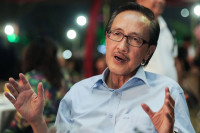
Lee said the absence of Warisan president Datuk Seri Mohd Shafie Apdal, Bung Moktar and KDM president Datuk Peter Anthony at the recent special assembly sitting indicates that they are still fuming at Hajiji.
“So, there’s no point if they should be included in the state cabinet or be part of the unity government in Sabah,” said Lee.
He added that the special sitting’s deliberations were closely related to the Malaysia Agreement 1963, but sadly the opposition chose not to be present to support the gas legislation.
Warisan’s 19, KDM’s three and Barisan Nasional’s 12 assemblymen were not present during the tabling of the bill but have indicated their support for two bills regarding the devolution of gas authority to the state – the Gas Supply and Energy Commission Bills 2023.
PH reps having their own agenda?
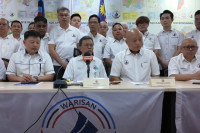
Warisan’s head of parliamentary liaison officer Benedict Mansul, meanwhile, said that the political turmoil in Sabah is not a question of numbers but about the legitimacy of Hajiji as the chief minister.
According to him, the seven PH assemblymen’s backing of Hajiji is aimed at winning state cabinet posts.
“What they did in legitimising an unconstitutional chief minister speaks volumes… They are doing this for their own self-agenda, regardless of what the state constitution says,” he alleged.
Mansul was referring to Article 6(7) of the state constitution, whereby the position of the chief minister must be held by a leader of a political party, and Article 6(1) which states that the appointment of the chief minister is done on the belief that he has the support of the majority of assemblymen.
Hajiji, at present, enjoys majority support in the Sabah assembly only due to backing from various other parties, as his own outfit, GRS, only has 29 assemblymen – well short of a majority.
PH’s backing of Hajiji, along with the GRS reps and other parties like Harapan Rakyat Sabah, brings Hajiji’s numbers to 44 assemblymen.
To remain in power, the chief minister needs the support of 40 of the total 79 assemblymen, including six nominated ones. – The Vibes, January 10, 2023




.jpg)