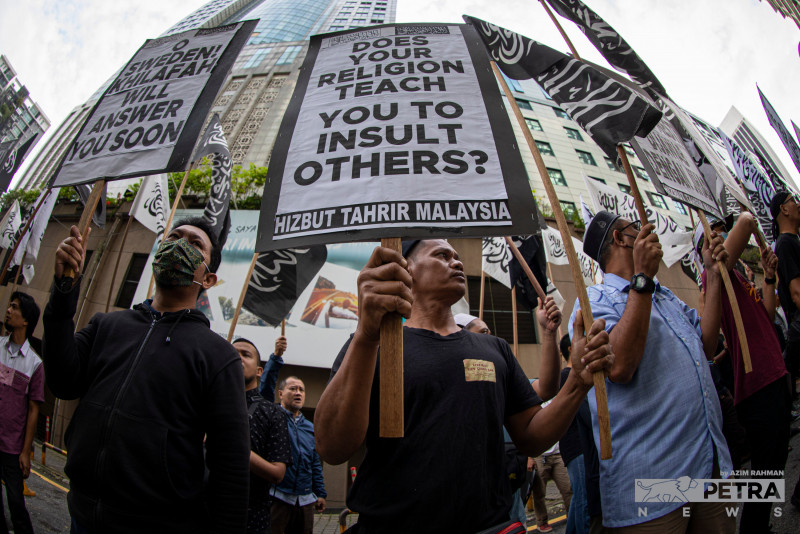

JOHOR BARU – According to counterterrorism experts, Malaysia should not take the presence of Hizbut Tahrir (HT) in the country lightly, following their appearance at a protest in front of the Swedish and Dutch embassies in Kuala Lumpur.
HT has been described as a fundamentalist Islamist group seeking to restore an Islamic caliphate via the unification of all Muslim countries.
The group has been banned by a number of nations including Bangladesh, China, and Indonesia, as well as most Arab states with the exception of Lebanon, Yemen, and the United Arab Emirates.
However, unlike most fundamentalist Islamist organisations, HT rejects the use of violence to pursue its political mission.
University of Indonesia forensic terrorism expert Zora A. Sukabdi warned Malaysia to remain cautious of the group, despite its so-called rejection of violence.
Zora explained that despite HT’s rejection of violent acts, Indonesia made the call to outlaw the organisation as its goals threaten the country’s constitutional foundations.

“People don’t know there are two types of violence. Namely, symbolic, which is passive and covert, as well as physical, which involves active and overt violence.
HT may not be physically violent, but it is against democracy, that’s symbolic violence,” Zora told The Vibes.
She also pointed out that there were inconsistencies within the HT movement, as it opposes democracy but is not against using platforms available in democratic countries to further its cause.
Further, Zora said that she finds HT’s presence in Malaysia baffling, given that there is already a sharia legal system in place in the country.
“Indonesia is seen by many Muslims as a secular nation, but Malaysia and Brunei have a sharia system alongside their civil one.
“Despite that, there is still a HT presence there (in Malaysia) which is what we Indonesian experts don’t understand,” Zora said.
However, she notes that an outright ban against the organisation may lead to its members going underground.
She said that following the Indonesian government ban, the group has been frustrated and started developing underground and collecting weapons, which the nation’s intelligence agencies are currently monitoring.
“But it is better to ban them from expressing their missions on the streets than to jeopardise the sociopolitical and economic stability of the country,” she added.
Meanwhile, despite HT’s stance on never using physical violence, Rakyan Adibrata, Indonesian director of the International Association for Counterterrorism and Security Professionals, said that the group’s ideologies share similarities with other terrorist organisations.
He further points out that Indonesian authorities have caught individuals linked to HT for acts of terrorism.

“From records, there are 25 names involved in acts of terror and 10 of them are foreign nationals who have been deported.
“All of them are linked to HT’s ideology,” Rakyan told The Vibes.
He warns that based on his country’s experience with HT, the group would potentially have a similar modus operandi in Malaysia.
Especially since Indonesia has disbanded and revoked their licence as an organisation in the country, there’s a potential strategy that it moves its operations to Malaysia,” Rakyan added.
Many Hizbut Tahrir members hold important positions in Malaysia
According to the director of the Nordic Counterterrorism Network (NCTN) in Finland Andrin Raj, HT’s Malaysian chapter has recruited members from public universities.
Having educated members, Andrin says, allows the organisation to hold some form of credibility and appear relevant.
Nevertheless, just like his Indonesian counterpart Rakyan, Andrin cautions that HT can very well be a potential national security threat to Malaysia, adding that the Counterterrorism Project by NCTN has labelled the group as a radical organisation.
“In Malaysia, the (circumstances surrounding) HT’s registration have been to not link the organisation to a transnational Islamist group, but a political party.
“This allows HT to be registered and thus avoid being banned by the Malaysian government,” Andrin said.
Originally, Andrin added, HT’s members fled from the Middle East to Europe, where they received European Union passports that allowed them to travel freely and propagate their radical ideologies.
HT can be a potential security threat to Malaysia if it garners support to change the current democratic system to one based on radical Islamist ideologies.
“The Malaysian government needs to monitor the group constantly,” Andrin added.
Despite HT’s presence in Malaysia, several state Islamic bodies declare the group’s ideology to be in conflict with the Sunni branch of Islam practised in the country.
The Johor government had in September 2020 declared HT an illegal organisation while the Selangor Islamic Religious Council issued a statement in February 2021 explaining why the public should reject the group. – The Vibes, January 29, 2023