
KUALA LUMPUR – Economy Minister Rafizi Ramli’s recent suggestion to avoid restaurants that mark up their prices amid reductions in raw material costs is not necessarily the only answer to inflation, economists say.
Veteran economist Tan Sri Ramon Navaratnam discouraged Rafizi’s suggestion for consumers to stop patronising such eateries, warning that it would have macroeconomic consequences.
“Rafizi does not have to urge consumers to avoid dining at eateries. That would dampen economic activity and cause stagflation,” he told The Vibes.
“It can depress economic growth and employment, among other things,” he added.
The Vibes recently reported that consumers have noticed the “shrinkflation” phenomenon in restaurants and supermarkets.
The term “shrinkflation” is a portmanteau of the words “shrink” and “inflation”, and is used to describe reduced size, quantity, or quality in products and food portions, while prices are increased or maintained.
In other words, consumers are finding themselves paying more but receiving less, compared to previous times.
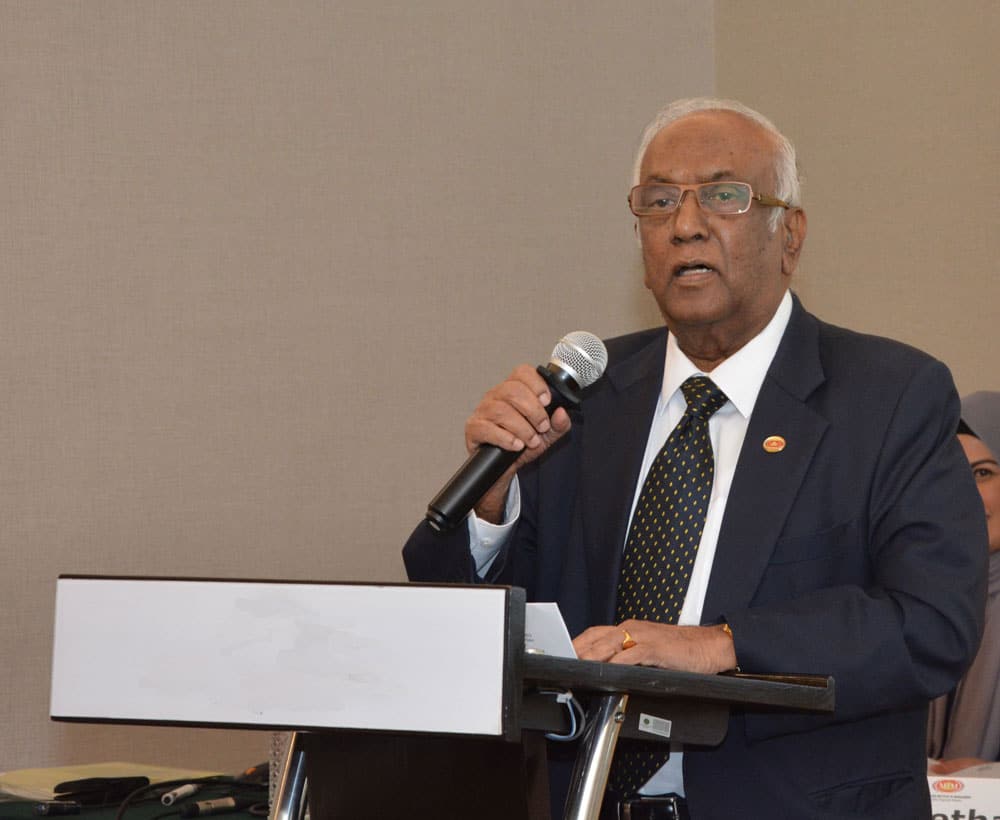
As shrinkflation falls under the umbrella of inflation, Ramon remarked that it cannot be solved bit-by-bit and in an ad hoc manner.
“Shrinkflation is a way of countering inflation and lower profits,” he said.
“This unsavoury practice has always prevailed during inflation.
“It cannot be tackled effectively in an ad hoc and piecemeal approach. It is part of the problem of inflation and must be resolved as a major structural issue.”
According to Ramon, a way to counter shrinkflation is to increase supply and reduce demand to get a new market equilibrium.
As such, he opined that market forces should be allowed to operate. Cartels, monopolies, and New Economic Policy restrictions be minimised, Ramon added.
Enforce anti-profiteering legislation
Meanwhile, economist Yeah Kim Leng stated that avoiding restaurants is a method that focuses on consumers, while there are more approaches to reduce costs on the producers’ side.
“Lowering demand pressure by avoiding outlets that raise prices (to an) unjustifiably high (level), as alluded to by the economy minister, is one consumer-oriented approach to combating high inflation,” said the Sunway University Business School’s economics professor.
“Increasing competition, ensuring adequate supply, and lowering costs – for raw ingredients, inputs, labour, overhead, and regulatory burden – are some ways to reduce cost pressures afflicting the food and beverage industry,” he added.

In order to prevent predatory pricing practices, Yeah suggested the government monitor and enforce the Price Control Anti-Profiteering Act 2011.
He also said the government could facilitate entry into the market through the provision of entrepreneurship training as well as start-up grants and loans.
In the meantime, Yeah mentioned that consumers affected by shrinkflation could either increase their number of purchases or shop around for better deals.
However, consumers can only hope that the high prices in the sector attract more market entrants and competitors, resulting in an increased supply and maintaining competitive prices without compromising food quality and quantity.
Probe into why prices are changed
Similarly, Malaysian Institute of Economic Research senior fellow Shankaran Nambiar opined that it is unlikely for prices of foods in restaurants to decrease in the future, but it would be sufficient if they are maintained.
In response to Rafizi’s recommendation to consumers, Shankaran stated that it is one of several options to overcome inflation. He mentioned that another option is to investigate why producers change their prices so much and address their issues.
Although boycotting could possibly force producers to bring their prices down, he clarified that it could instead lead to eateries shutting down in the event they are unable to lower their prices.
“If the eateries are not able to bring prices down (because the cost is high), and there is nothing they can do, then they may be forced to close down,” he said.
“With high costs and low demand, they will be forced into closure,” he added.
To overcome this conundrum, Shankaran stressed that the government must attend to basic questions, including how to increase production rates of materials and how to make agriculture more attractive to producers.

Meanwhile, Malaysian Muslim Restaurant Owners’ Association president Datuk Jawahar Ali Taib Khan said that simply boycotting every restaurant and going cold turkey on dining out is not good for the economy.
“Boycotting is not good for the economy,” he commented.
“But, we (consumers) can choose whichever shop (we wish to dine in). If they are selling (at) high (prices), then we can report to the Domestic Trade and Cost of Living Ministry, (which is) our right as consumers,” he added.
Nonetheless, he wonders why consumers do not complain about price disparities in other industries, following their lamentations on the food and beverage sector.
“Why (aren’t people complaining when) BMWs and Mercedes are expensive here, as compared to our neighbouring countries?” he asked.
He further illustrated his point by providing a hypothetical example where an 800 sq ft apartment in Sentul would cost RM500,000, while another apartment located only half a kilometre away may be priced at RM650,000, but people still would not find fault in it. – The Vibes, January 31, 2023