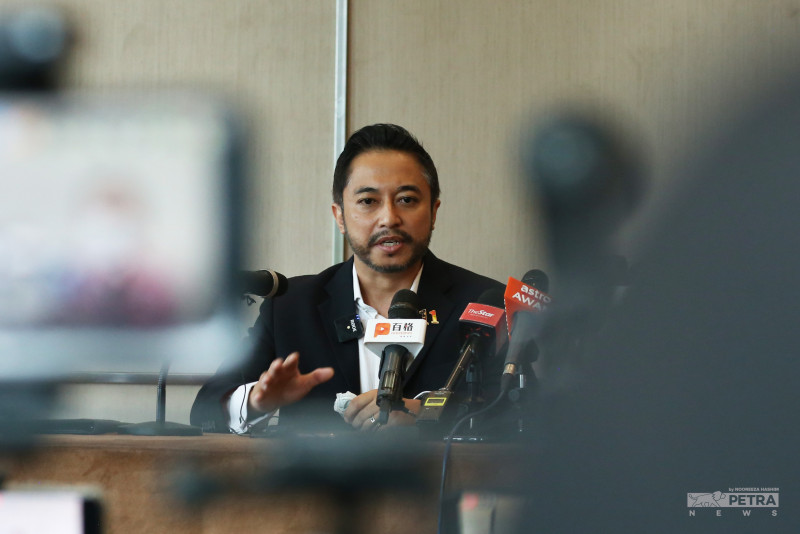
KUALA LUMPUR – No individual is above the law or more powerful than national legislation, including judges, said Umno information chief Isham Jalil.
As such, he opined that when a judge commits a crime, it is not a matter of work ethics that can be brought to the tribunal among fellow judges.
He said that the offence should be investigated by the authorities, such as the Royal Malaysia Police or the Malaysian Anti-Corruption Commission (MACC).
“Judges who are suspected of committing crimes are not exempt from investigation procedures as imposed on other people.
“They have no immunity or privilege in criminal matters. No one is above the law, this includes judges.
“I have written at length about this before,” he said via a post on Facebook.
On Friday, Chief Justice Tun Tengku Maimun Tuan Mat, who chaired the panel of seven federal court judges, issued a judgement that MACC’s investigation into former high court judge Datuk Mohd Nazlan Mohd Ghazali was not done according to protocol.
The panel also expressed its view that the public prosecutor has the authority to initiate criminal proceedings against superior court judges.
However, the panel is of the opinion that the investigation must be carried out according to certain protocols to preserve the independence of the judiciary, among which the investigative body must first consult with the chief justice before initiating an investigation against the judge.
In addition, the investigation body cannot publicise the facts of the investigation without the permission of the chief justice.
Prosecutors must also consult with the chief justice during the investigation, including in his decision to prosecute.
The decision was questioned by several parties, including the Political and Leadership Bureau chairman of the Malay Consultative Council, Shahbudin Embun, who felt that it contradicted the investigations carried out by MACC or previously known as the Anti-Corruption Agency, which had investigated several senior judges, without needing to inform the chief justice of the judicial forum.
Isham expressed his disagreement over Tengku Maimun’s call that MACC’s investigations on judges can be carried out, but needed to be civilised by consulting or asking for permission first.
“Forgive me if one is offended, but I do not agree with what Chief Justice Tengku Maimun said.
“Because if the judge is a criminal, there is no need to have protocols to arrest him, just follow the procedure as imposed on other people.
“For us to catch a thief, we don’t need to say hello, it doesn’t matter if the thief is a judge,” he said.
He said the chief justice cannot force the executive branch to negotiate or ask for their permission in order for law enforcement to investigate a judge suspected of committing a crime.
According to him, such a ‘protocol’ is not in the constitution or any law when it involves a judicial crime and is not an ethical issue.
He explained that in other countries, including England and the United States, if a judge commits a crime, the authorities can investigate, arrest and prosecute the judge involved without asking permission or consulting the chief justice.
“If the authorities need to ask for permission or consult with the chief justice to investigate and prosecute judges who commit crimes, this is not in line with the principle of separation of powers and checks and balances between the executive, judiciary and Parliament.
“For example, it doesn’t make sense for police or MACC to ask for the permission of the chief justice before arresting, investigating and prosecuting judges who kill or take bribes,” he said.
Commenting further, Isham said, in addition to avoiding bias among colleagues, the duty of judges and the chief justice is to judge cases, not to investigate, arrest and prosecute.
“That is not the job of the judge, that is the job of law enforcement, such as police and MACC.
“For this reason, law enforcement does not need to ask the judge’s permission to investigate the suspect because this task is not under the jurisdiction of the judge.
“If the law enforcement needs to ask for permission or consult with the chief justice to investigate someone or another judge as above, then the power to investigate, prosecute and judge, will all rest in the hands of the judiciary and with this, there is no balance check,” he said.
In addition, Isham said, the request that the authorities consult with the chief justice before investigating a judge is just like if the speaker of the House of Representatives asks the authorities to consult with him before arresting an MP or consult with the prime minister before arresting a minister. This doesn’t make sense.
“I urge the chief justice (of the state) not to make a judgement that is seen as unjustifiable.
“This is not a matter of legislation, this is a matter of public policy and common sense.
“The people are watching and if the judiciary is seen to be biased, this is not good for the public’s confidence in the national justice system because if the people lose faith in the judicial system, then the law will be difficult to enforce,” he added. – The Vibes, February 26, 2023