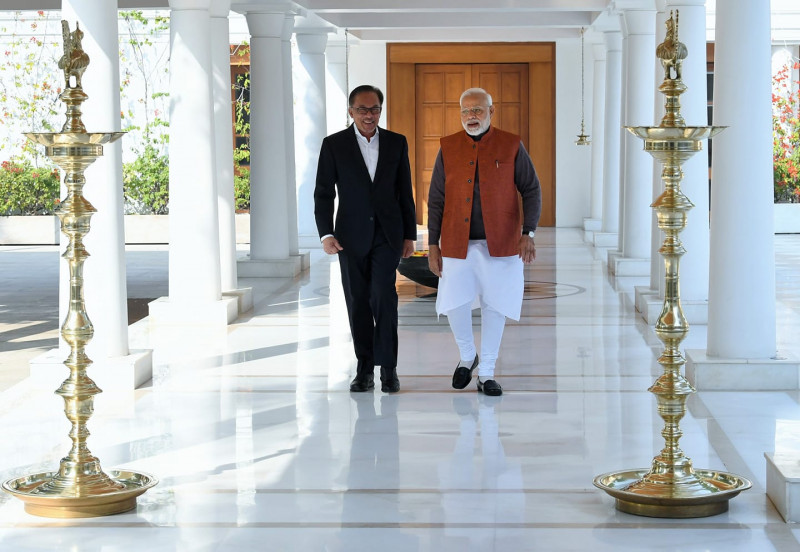

KUALA LUMPUR – India has conveyed its gratitude to Prime Minister Datuk Seri Anwar Ibrahim for his felicitations on the country’s successful lunar landing, and hinted at greater engagement by India in international collaboration on space initiatives.
Indian Prime Minister Narendra Modi thanked Anwar for his wishes, stressing that Malaysia’s warmth and pride in India’s achievements is deeply cherished, the high commission in Kuala Lumpur said.
In a statement, it said that several eminent Malaysian personalities, including leaders of community and cultural associations, diaspora associations and business chambers have shared messages of congratulations.
“The High Commission of India deeply appreciates the warm congratulatory messages on India’s successful Chandrayaan-3 moon mission,” it said.
A day after the landing, Anwar had hailed the event as a milestone event that signifies the “Asian century”.
He especially lauded the achievement of landing at a location in the moon’s southern pole, which had never been explored by humans before.
He added that he viewed the achievement not only as India’s success but also a success for Asia and all its citizens.
In response, the high commission stressed that over 20 Malaysian space experts have attended training programmes in India in the space sector, including, among other things, on remote sensing, small satellite missions and geospatial applications.
In July 2023, two research officers from the Malaysian Space Agency (Mysa) attended short-course training in “Geospatial Application in Disaster Risk Reduction for Environmental Disaster” at the Centre for Space Science and Technology Education in Asia and the Pacific (CSSTEAP) in Dehradun.
The event was held under the Asean-India Space Cooperation Programme.
Since 1997, 14 Malaysian nationals have undergone short-term training and five Malaysian nationals pursued postgraduate courses at CSSTEAP.
Prior to that, a research officer from the Mysa took an international training course on “Small Satellite Mission” at CSSTEAP in 2022, it noted.
In 2019, a Malaysian official in the Malaysian Meteorological Department went for six-month training at the Space Applications Centre, Ahmedabad, sponsored by the Asean-India Science and Technology Development Fund under India’s Science and Technology Department.
As of July 30, India has launched over 400 satellites from 34 countries as part of its extensive international collaboration in space.
“India, while pursuing its national space programme, has attached importance to international cooperation in peaceful use of outer space including launching a large number of foreign satellites and offering capacity building and training programmes,” the high commission said.
The high commission also noted the Indian cabinet’s pride in seeing a large number of women scientists contributing to the success of Chandrayaan-3 and India’s space programme in general.
“This will motivate several aspiring women scientists in the years to come,” it said.
Chandrayaan-3’s lander called Vikram, which contained a rover (Pragyan), landed on the moon’s south pole on August 23, making India the first country to do so.
The spacecraft had launched from the Satish Dhawan Space Centre by the Indian Space Research Organisation on July 14 this year. – The Vibes, August 31, 2023