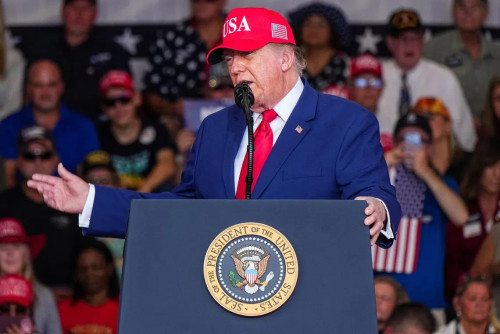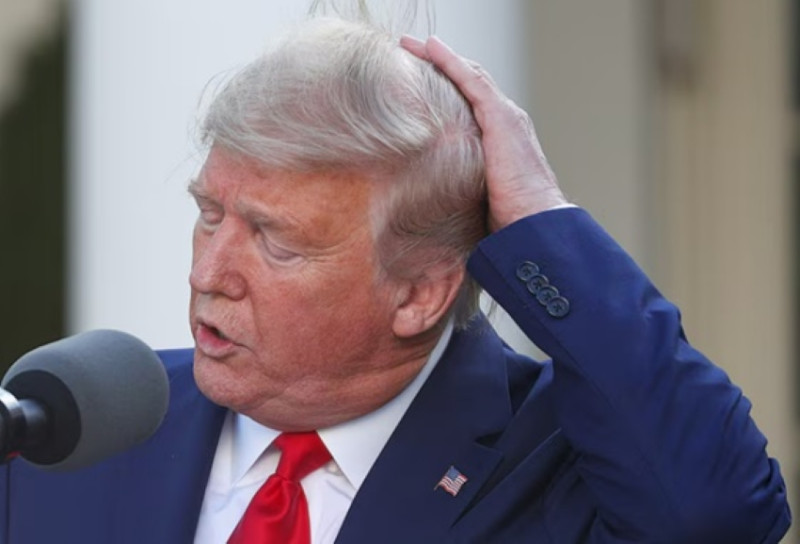

THE disruptive style of politics that has defined Donald J. Trump’s presidency is set to remain a lasting feature of American political life, with global consequences that will continue to shape the world’s largest economy long after he leaves office, say political scientist Dr Wong Chin Huat and economist Professor Wing Thye Woo.
Writing in a joint editorial, the two Malaysian scholars argue that Trumpism is no passing phenomenon but a deep-rooted political shift in the United States.
They warn that developing nations such as Malaysia, along with middle-power countries in the West, must reform and adapt to a world in which the United States no longer plays a stabilising leadership role.
“Rather than wait around hoping for the US to re-embrace reason, democratic values, and global leadership, the rest of the West must step up to preserve the foundations of global stability and prosperity,” they wrote.
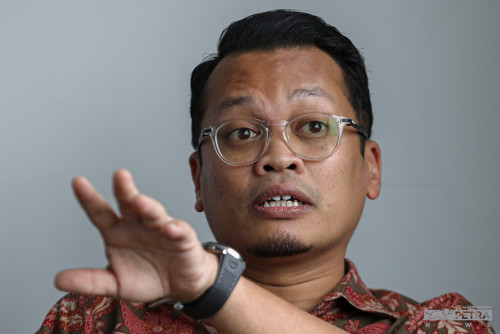
Dr Wong lectures in political science at the Jeffrey Sachs Center on Sustainable Development at Sunway University, while Prof Woo holds posts at the University of California, Davis, Liaoning University in China, and the University of Malaya.
Following Trump’s return to the White House, they note, the idea of a rules-based international order led by the US is now virtually unthinkable — a reality reinforced by the tone of this year’s United Nations General Assembly.
“America’s Western partners will need to adapt to the new reality by reducing their dependence on the US and improving coordination among themselves,” they said, adding: “There is little doubt that Trump’s America cannot and should not be trusted.”
They point to Trump’s admiration for authoritarian figures such as Vladimir Putin, his hostility toward climate action, and his disdain for global institutions and public health cooperation. His administration’s stance on vaccines, they say, threatens to worsen global disease outbreaks.
Trump, they argue, is not an anomaly but a symptom of deeper economic and political failings in the United States. “Between 1980 and 2022, America’s real GDP per capita doubled, yet its real median household income increased by less than a quarter,” they wrote. This stagnation, coupled with automation and offshoring, has fuelled populist resentment and political polarisation.
Even if Trump abides by constitutional limits and exits office in 2029, the problems that enabled his rise will persist, they warned. “The populist forces that propelled Trump’s rise will continue to shape US politics.”
They expect the US to remain focused on what they describe as “ill-conceived” policies aimed at containing China — a misallocation of resources, they argue, that undermines American resilience and long-term competitiveness.
In this climate of uncertainty, they say, middle powers — including the EU-27, UK, Japan, South Korea, Australia, New Zealand and Canada — must take the initiative. With a combined population twice that of the US and a GDP on par with it, they possess sufficient influence to assert global leadership.
“By working together on trade and defence, these countries would strengthen their negotiating positions vis-à-vis the US. After all, if there is one thing Trump responds to, it is raw power,” they said.
But their agenda should go beyond transactional dealings with Trump. Wong and Woo call on these nations to offset the damage caused by “Trump’s capricious unilateralism and toxic Sinophobia”, by bolstering multilateral cooperation in trade, public health, and climate policy.
They also stress the need to recalibrate Western engagement with China, arguing that conflict is not inevitable. “The West’s middle powers are not caught in some Thucydides Trap with China,” they wrote. They urge pragmatic cooperation, particularly on climate action and pandemic preparedness, without overlooking China’s geopolitical risks.
On the humanitarian front, the authors take aim at US policy on Gaza, contrasting Trump’s uncritical support for Israeli actions with the need for principled Western engagement. “The rest of the West should push back,” they argued, noting that countries such as France, Spain, Canada, the UK and Australia have begun recognising the State of Palestine.
Ultimately, they call for a more cooperative and strategic approach by Western middle powers — not through a formal bloc, but via a shared purpose.
“The objective should not be to impose their will on others, as the US has too often sought to do,” they concluded. “Rather, they should leverage cooperation, including with groupings like ASEAN, to prevent the world from spiralling into conflict, economic fragmentation, and environmental disaster.” - September 28, 2025