Murray Hunter
IN the contested waters of the South China Sea, where overlapping claims and great-power rivalry intersect, a familiar pattern is playing out once again.
Recent clashes between Chinese Coast Guard vessels and Philippine forces at Second Thomas Shoal and Scarborough Shoal have underscored Beijing’s preference for calibrated, low-intensity coercion over outright naval confrontation.
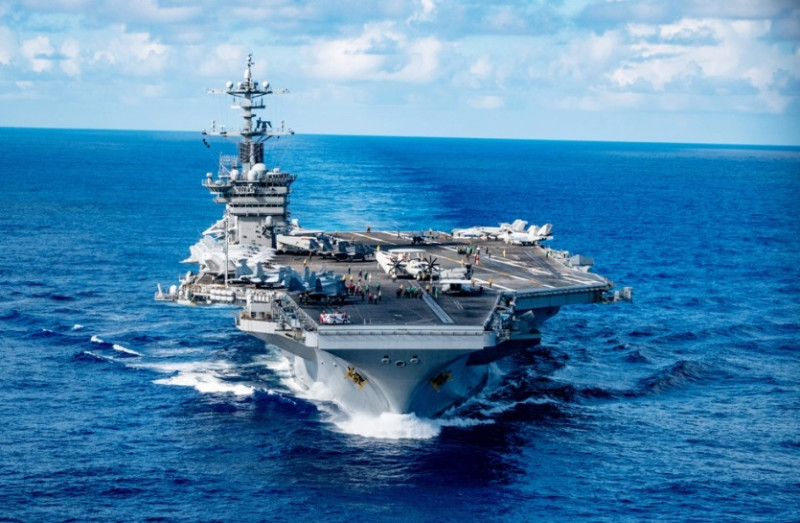
These incidents involving baton strikes, water cannon barrages, and dangerous manoeuvres are coinciding with the USS George Washington Carrier Strike Group’s operations in the area following its transit through the Luzon Strait.
While US officials frame the carrier’s presence as routine freedom of navigation and support for allies, the timing amplifies perceptions of strategic strain on Washington.
The George Washington carrier strike group (CSG), with its F-35 capabilities and escorts, projects power, yet it operates amid a backdrop where China’s “grey zone” tactics using coast guard, maritime militia, and civilian assets are proving remarkably effective at contesting control without crossing thresholds that might trigger full military escalation.
This flare-up arrives as the Trump administration, with Secretary of State Marco Rubio, has issued strong statements reaffirming commitments to the Philippines and challenging excessive maritime claims. Rubio has described Chinese actions as “disturbing” and emphasised that the US will not abandon its treaty ally.
Yet commentators note a broader context where the simultaneous pressures from the ongoing Iran conflict, as US forces remain engaged, appear to stretch decision-making bandwidth at the Pentagon.
Some observers interpret Trump’s approach, including backdowns or de-escalatory signals on Iran, alongside SCS developments, as revealing the limits of US military overstretch and prioritisation.
China’s playbook here is not new but has been refined from experience.
Rather than deploying PLAN capital ships directly against US carriers, Beijing leverages asymmetric advantages, such as swarming an area with smaller vessels, legal warfare (lawfare) narratives framing Philippine resupply as “illegal,” and incremental normalisation of presence.
These tactics erode the status quo slowly, forcing the US and allies into reactive postures.
A direct US response risks escalation optics or alienating regional neutrals, but conscious restraint invites accusations of weakness or abandonment.
This dilemma is precisely the value of grey-zone operations that China is exploiting with the hesitation of US military rules-based responses.
Whether these events are deliberate synchronisation between SCS assertiveness and Middle East tensions or opportunistic convergence, maximize the strain on US military planners.
With resources divided across theatres, the Indo-Pacific “pivot” faces practical tests.
George Washington’s deployment signals resolve, yet without a clear counter to the coast guard militia tactics, it risks underscoring asymmetry.
Philippine resilience, backed by US training and presence (including recent multilateral exercises with Japan), adds layers, but the burden of response often falls on Manila’s smaller forces.
This is an issue the leadership within ASEAN has not considered at this stage.
These actions are tipping the region beyond any strategic balance between the major players.
For the US, the challenge lies in calibrating deterrence.
Carrier strike groups uphold presence and reassure allies, but they do not easily neutralise non-kinetic coercion.
However, China’s unconventional approach demonstrates how patience and asymmetry can challenge even the world’s premier naval power.
As tensions simmer, the sea’s grey waters reflect a contest where victory may belong less to the side with the largest ships and more to the one mastering ambiguity.
This, however, is taking the region away from being an ASEAN-designated ‘zone of peace, freedom, and neutrality (ZOPFAN)’ towards another conflict region. – August 4, 2026




.jpeg)