


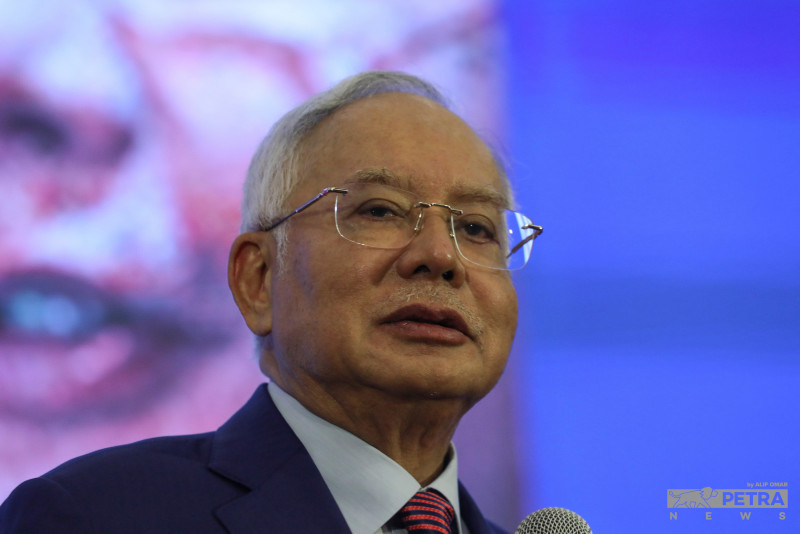
DATUK Seri Najib Razak has recently been granted a conditional royal pardon.
Upon settling the RM50 million fine and complying with stipulated terms, he may serve the remainder of his SRC‑related sentence under house arrest.
In discussing this case, legal facts, political context and political inferences must first be kept separate.
First, it must be clearly stated: Najib has not been exonerated.
His conviction in the SRC case remains intact.
He was originally sentenced to 12 years’ imprisonment and a RM210 million fine. Following the 2024 mercy process, the sentence was reduced to six years, with the fine lowered to RM50 million.
The latest conditional pardon allows the remainder of his SRC sentence to be served under house arrest until 23 August 2028.
This does not overturn the court verdict, nor does it declare Najib innocent.
Only the mode of sentence execution has changed; his conviction stands.
The Yang‑di‑Pertuan Agong’s power of pardon is a constitutional mechanism enshrined under Article 42 of the Federal Constitution.
This must be respected and ought not to be distorted for political expediency.
Second, what merits genuine debate is the signal sent by the system.
The question is not merely whether the decision is lawful.
We must also ask how the public will perceive our institutions.
A former Prime Minister, conclusively convicted by the apex court for serious financial offences, sees his sentence cut from 12 years to six years, before prison time is commuted to house arrest.
Even if every step rests on legal and constitutional grounds, successive sentence reductions risk feeding a dangerous public perception:
Do powerful convicted figures ultimately enjoy greater leeway in how their penalties are enforced?
This is the critical challenge for Malaysia’s anti‑corruption framework.
Anti‑corruption work cannot stop at procedural legality.
It must also convince the people that legal consequences do not shift according to political standing.
Third, the RM50 million fine is not a new penalty.
It is important to clarify that the RM50 million fine was not freshly imposed in this latest ruling.
The quantum was already adjusted under the 2024 pardon review, and full settlement is now a precondition for conditional home detention.
Supporters of the decision may reasonably point out that Najib has not been unconditionally released.
He is still required to pay a substantial fine and abide by restrictions. Breach of conditions can revoke the pardon and send him back to prison.
Nevertheless, from an institutional standpoint, shifting from custodial imprisonment to house arrest objectively lessens the severity of punishment.
For a former head of government convicted of abuse of power, breach of trust and money‑laundering, such a shift inevitably shapes public assessment of anti‑corruption deterrence.
Both observations can co‑exist.
Fourth, do not frame UMNO political pressure as proven royal interference.
It is public knowledge that UMNO has long campaigned for a more favourable pardon outcome for Najib.
Najib retains significant influence within UMNO, which in turn forms a key component of the present Unity Government.
There is therefore an evident political backdrop to this development.
Political pressure, however, does not constitute proof that such pressure dictated the Yang‑di‑Pertuan Agong’s decision.
To date, no conclusive public evidence establishes a causal chain: UMNO lobbying → government intervention → royal ruling
If we demand evidence‑based standards from the government, law‑enforcement agencies and the media, we must hold ourselves to the same rule: evidence first.
Fifth, greater transparency is needed regarding events between 11 September and 18 September.
Notably, the 63rd Federal Territories Pardons Board meeting deferred deliberation on Najib’s pardon application on 11 September.
Just one week later, the 64th meeting approved the conditional pardon on 18 September.
This timeline understandably raises public questions.
Questions, though, are not evidence. Proximity in time does not prove political interference.
Rather than speculating over royal motives, the more pertinent inquiry is this:
What new legal advice, documentation, representations or material factors emerged between the 63rd and 64th meetings?
Appropriate procedural disclosure by the institutions concerned would curb unnecessary political conjecture.
Transparency protects institutions; it does not undermine them.
Sixth, the real priority is safeguarding Malaysia’s hard‑won institutional credibility.
Najib’s incarceration carried profound symbolic weight for the rule of law in Malaysia.
It communicated a straightforward principle: even a former Prime Minister is not above the law.
What needs protecting today is not the political fortunes of any party or individual politician.
It is that very principle.
The Yang‑di‑Pertuan Agong constitutionally holds the power of mercy.
The judiciary exercises independent adjudication.
The Government is tasked with upholding the rule of law.
Anti‑corruption bodies must conduct independent investigations.
Prosecutorial authorities make charging decisions according to law.
These institutions can and must co‑exist with mutual respect.
Seventh, this pardon does not mark the end of Najib’s legal challenges.
The conditional pardon applies only to the remaining term of the SRC sentence.
Najib still faces other legal liabilities, including a 15‑year prison term and RM11.4 billion fine stemming from a separate 1MDB‑related conviction, currently under appeal.
This decision must not be misrepresented as a full resolution of all his legal cases.
Each matter must proceed separately.
My position:
I respect the Yang‑di‑Pertuan Agong’s constitutional power of pardon.
I accept that mercy forms an integral part of our constitutional order.
Yet a mature rule‑of‑law state cannot confine its inquiry merely to whether an action falls within legal authority.
We must also ask:
Are processes transparent? Are standards applied consistently? Do citizens believe in equality before the law?
We must not allege royal interference without evidence.
Equally, we cannot hide behind constitutional procedural compliance to avoid debating the long‑term ramifications for judicial credibility, anti‑corruption deterrence and public trust.
The true test is not about Najib as an individual.
The real test is this:
When the next minister, the next Prime Minister, the next powerful figure, or an ordinary citizen without political connections stands before the law, will the same yardstick be applied?
If the answer is yes, our institutions will endure.
If not, the challenge will extend far beyond one single court case.
Mercy may be legitimate; privilege must not become systemic.
That is the baseline Malaysia must uphold for its rule of law, anti‑corruption agenda and institutional reform. – September 19, 2026
Ronnie Liu Thian Khiew is a former Selangor executive councillor and Parti Bangsa Malaysia (PBM) information chief
The observations reflect the writer's personal insights and do not necessarily represent the official stance of The Vibes.com




.jpg)




_director_Datuk_M._Kumar.jpg)
