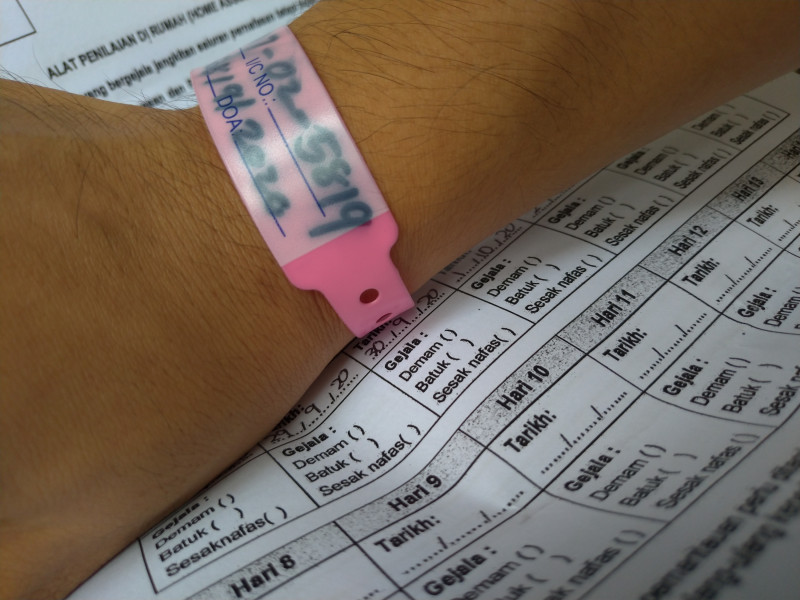

AT EASE is what I should have felt now that the rubbery pink Covid-19 quarantine wrist band is removed – but I am not.
Such was so in spite of the favourable verdict I received from the swab test – along with many Sabah returnees – after taking it at the Kuala Lumpur International Airport (KLIA) on September 28.
My worry bubbled up following a small talk with the frontliner who was handling my quarantine dismissal. The casual exchange began when she was about to cut off my band.
I asked her: “So, am I free to go about my daily routine?”
“Yes. As long as you adhere to the new norms,” she answered as she slipped the cold lower blade of the scissors under the band.
Follow-up question: “I read that this virus has a 14-day incubation period. This is only day 7 of my quarantine; what if I started to develop symptoms on day 13?”
She snipped the band in half, effortlessly. “If that happens, you need to go to the nearest Covid-19 centre and get tested again.”
My last question: “If my symptoms appear on day 13 or later on, does this mean that I may have unknowingly infected others during the previous days in which I should have stayed isolated, but didn’t because I was freed early due to my result on day 7?”
She paused for a moment. Her eyes darted up, like how most do when figuring out answers. Then she cleared her throat and gently nodded her head.
“Yes,” she said as she handed me my green-coloured quarantine dismissal notice.
“It is possible that you may have infected others by then.”
A chancy SOP
Ever since its general incubation period was known, almost every country in the world had religiously adhered to the 14-day quarantine. In fact, a fortnight isolation is the minimum period for some countries such as New Zealand, which had done well in keeping Covid-19 cases low.
Initially, Malaysia too, had obeyed such a guideline.
It was, however, only in September – against the backdrop of the then-looming Sabah election – that the government came up with a revised SOP that allowed the early ending of home quarantine of returnees from said state – that became a Covid-19 hot zone.
Not only that, there was an unannounced workaround for Sabah returnees who wished to be exempted from the mandatory screening and testing at KLIA – which was to pre-emptively get a “Covid-19 not detected” result at least three days before their flight.
Convenient. But what if one gets infected on the way to the airport or in-flight?
And since this lifehack permits the skipping of airport screening and testing, will those who opt for it be given quarantine wristbands? A team of footballers who arrived at KLIA on the same day as I was and skipped the screening there were seen without said band.
Last night, that team – which went up against Sabah in a Super League match on September 27 in the Likas stadium – is scheduled to go against a team from the north.
So, at the end of the day, Sabah returnees may be able to end their quarantine early but in actuality, they are not out of the woods yet and woe be tide if they do venture out as this seemingly glitchy SOP poses real risks of infection.
To merely advise and expect those who have had their quarantine bands cut to obey the 14-day quarantine rule is wishful thinking; because there have been multiple cases of those wearing the band were seen flouting their home isolation – remember how the Sivagangga cluster came to be?
Some believed that Malaysia has done well in flattening the curve but Sunday hinted otherwise, the country has recorded its highest daily increase for the second day in a row – 317 cases.
In a 10-day median comparison; Malaysia averaged three new cases per day from July 7 until 16.
Such figures however, ballooned exponentially to 293 from September 25 to October 4 – the highest 10-day mean since Covid-19 hit our shores.
Have we let our guard down too soon? – The Vibes, October 5, 2020