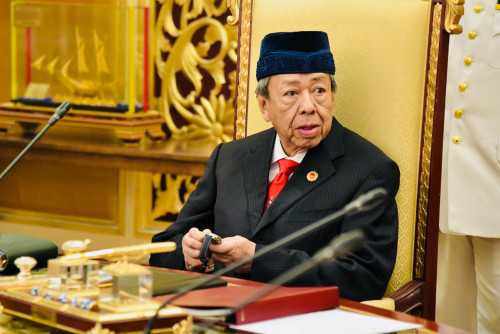

YANG di-Pertuan Agong Al-Sultan Abdullah Ri’ayatuddin Al-Mustafa Billah Shah will be granting an audience to opposition leader Datuk Seri Anwar Ibrahim, giving the PKR president a chance to back up his claim of majority support in the Dewan Rakyat.
Speculation is rife over the result of the 3pm meeting.
Lawyer Aidil Khalid said there are four possible scenarios that could play out after tomorrow’s meeting:
i) Prime Minister Tan Sri Muhyiddin Yassin resigns and the Agong appoints Anwar as the ninth prime minister,
ii) Muhyiddin requests for the dissolution of Parliament and the Agong agrees, leading to a snap general election,
iii) Muhyiddin’s request for dissolution is denied by the Agong and Anwar as prime minister, or
iv) Agong declares a state of emergency in the interest of public safety due to the pandemic and political tussle.
Another scenario is the possibility that Muhyiddin may decide not to resign or call for a dissolution, leaving Anwar with no choice but to table a motion of no-confidence in Dewan Rakyat during November’s sitting.
However, this political tussle does not bode well for a country battling a pandemic.
Based on past experience, Dewan Rakyat will usually prioritise any bills tabled by the government before entertaining those tabled by the opposition.
So, any motion of no-confidence filed by Anwar will most likely be tabled – if ever – after the budget has been debated.
Just ask former prime minister Tun Dr Mahathir Mohamad. His no-confidence motion against Muhyiddin in March is still gathering dust under stacks of government bills.
If Anwar commands the majority in Dewan Rakyat, MPs who are on his side may vote against Budget 2021.
This will take place after a few weeks of debating, leaving the nation in a very precarious economic position.
Agong can call for a parliamentary sitting
It is clear that the Agong must be convinced that Anwar has a “strong, formidable, convincing” majority among federal lawmakers as he claimed – and the best way to cement that is via a motion of no-confidence.
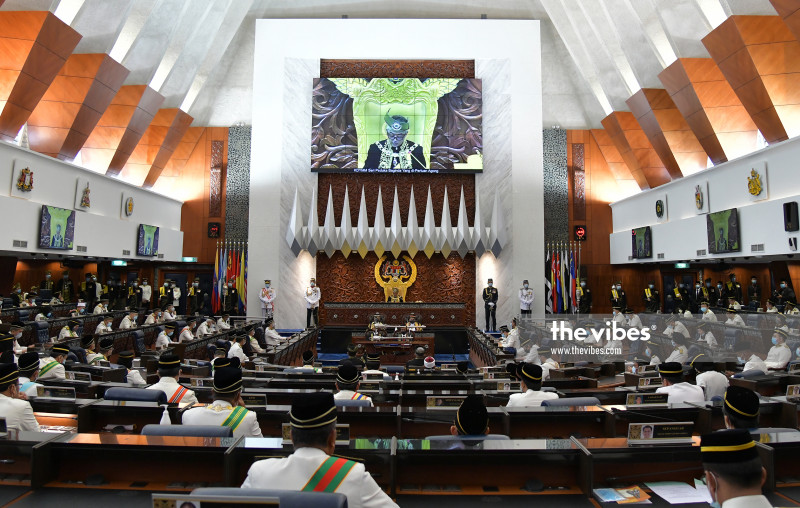
The solution to this conundrum may lie with Article 55 of the Federal Constitution that allows the Agong to summon Dewan Rakyat for a special sitting.
As Bar Council member Muhammad Rafique Rashid Ali suggested in an opinion piece in The Vibes: “The only clear way to resolve the impasse is to have all 221 parliamentarians (minus Batu Sapi) ensconced in the Dewan Rakyat and vote on the no-confidence motion filed by Langkawi (Dr Mahathir) that has been buried beneath mundane government bills and matters purely for Muhyiddin’s survival.”
He wrote once the motion has been carried out and it is clear that the prime minister has lost majority support, the same 221 MPs will then immediately vote on who among them wields the majority confidence.
The result will then be presented to the Agong and that individual – be it Muhyiddin or Anwar – will have received an open endorsement made public instead of through written undertakings and oaths.
However, constitutional law expert Professor Emeritus Datuk Shad Saleem Faruqi argued that while the Agong can invoke Article 55 on the advice of the prime minister.
At the same time, the ruler has a lot of leverage and can insist on a vote of confidence.
“If there is a doubt about who commands the majority, the Agong can insist that the prime minister must within (such and such time) obtain a vote of confidence on the floor of the House, otherwise the Agong may use his discretion to appoint someone else who he thinks commands a majority.
“Note the precedent in Perak in 2009 when a menteri besar (Datuk Seri Nizar Jamaluddin) was dismissed,” Shad Saleem told The Vibes, recalling the Perak political crisis that saw the then Pakatan Rakyat (PR) state government toppled by Barisan Nasional (BN) due to party-hopping.
Devastating effects of a snap GE
The Agong, who has been lauded as one of the most approachable rulers, has a heavy burden to carry.
On one hand, he must ensure the health and safety of all Malaysians as Sabah and Klang Valley are now subjected to the conditional movement control order (CMCO).
On the other, he must ensure there is political stability and Malaysia is governed by the rule of law and the nation weathers the health and economic crisis under stable leadership.
It is this writer’s humble opinion that at this juncture, a parliamentary sitting to end the political tussle far outweighs the benefit of returning the mandate to the people.
The Sabah polls have proven that when poorly managed, election campaigns become Covid-19 hotspots, especially when a prime minister fails to control his politicians and ministers, who think they are above the law.
The public backlash is swift after reports that politicians received special treatment after the polls, leading to more infections.
#KlusterMenteri has been trending on social media in light of how many politicians have tested positive for Covid-19 after returning from Sabah.
Among them is Minister in the Prime Minister's Department (Religious Affairs) Datuk Seri Zulkifli Mohamad Al-Bakri who attended meetings and events until he tested positive.
This led to many high-profile officials, including Health Director-General Tan Sri Dr Noor Hisham Abdullah, being forced to undergo self-quarantine.
Another minister who received public criticism is Plantation Industries and Commodities Minister Datuk Mohd Khairuddin Aman Razali who did not undergo quarantine after returning from Turkey. He was fined RM1,000 compared to errant Malaysians who were detained.
This has led to questions whether Muhyiddin has the political strength to control his ministers and allies or if he is a lame duck prime minister – preferring political expediency to rule of law, considering his party Bersatu is one of the smallest in Perikatan Nasional (PN).
If Muhyiddin comes out on top in a vote of confidence against Anwar, this will grant him the political strength to lead the country.
Muhyiddin can better discipline his cabinet and MPs as there will be no question regarding his support in Dewan Rakyat.
If Muhyiddin is bested, the Agong will be appointing Anwar as prime minister – the man whose coalition was elected on May 9, 2018 to govern the country. – The Vibes, October 12, 2020
Azril Annuar is chief reporter at The Vibes