FOLLOWING recent developments, we may again find the Sabah assembly in the same peculiar predicament it was after the state election in 2020. As we all know, it was then the height of the Covid-19 pandemic and the collapse of the elected federal government under Pakatan Harapan after the Sheraton move.
The move also saw spilling effects into the Sabah government as members of the current government started to leapfrog into other parties, enticed with positions under the new big umbrella of Perikatan Nasional, helmed by Tan Sri Muhyiddin Yassin. The state government under Datuk Seri Shafie Apdal had no recourse but to dissolve the state assembly and call for a new state election.
The Sabah election had 73 state seats up for grabs. After the dust settled Warisan garnered 29 seats, and the remaining seats were won by Perikatan National with 17, Barisan Nasional (14), Parti Bersatu Sabah (seven), independent (three), Parti Keadilan Rakyat (two), and United Progressive Kinabalu Organisation (one).
Now under the Sabah constitution; State Cabinet Article 6(3) reads:
“The Yang di-Pertua Negeri shall appoint as chief minister a member of the legislative assembly who in his judgement is likely to command the confidence of a majority of the members of the assembly and shall appoint the other members mentioned in clause (2) in accordance with the advice of the chief minister from among the members of the assembly.”
Sabah Yang di-Pertua Negeri (TYT) Tun Juhar Mahiruddin back in 2020 had to answer four questions, hence satisfying the requirements under Art 6(3).
1. The most popular belief in local dailies at the time was that a majority meant above 50%. So it is a simple mathematical majority that is supposed to be at 37 seats or more won over 73 seats. But in the linguistic canons of construction the meaning of “majority” must be interpreted plainly.
2. The TYT must be convinced that the chief ministerial candidate is likely to have a “majority” support as stated in Article 6(3).
3. The candidate himself must be a member of the legislative assembly.
4. The TYT has unrestricted confidence under Article 10(2) – the Yang di-Pertua Negeri may act in his discretion in the performance of the following functions – (a) the appointment of a chief minister; (b) the withholding of consent to a request for the dissolution of the legislative assembly.
But there is a conundrum that finalises Articles 6 (state cabinet) that was amended on May 25, 1990, by the then Parti Bersatu Sabah government, thus limiting the four criteria mentioned above, which is called a “deeming provision” under the law.
Article 6(7) says: “For the purpose of Clause (3) of this article, where a political party has won a majority of the elected seats of the legislative assembly in a general election, the leader of such political party, who is a member of the legislative assembly, shall be the member of the legislative assembly who is likely to command the confidence of the majority of the members of the assembly.”
The wordings are specific to finalise Article 6 with important keywords; a political party and the leader of such a political party. Note the use of singular pronouns in this wording. Article 6(7) basically cuts down any misinterpretation and specifically the generalisation in Article 6.
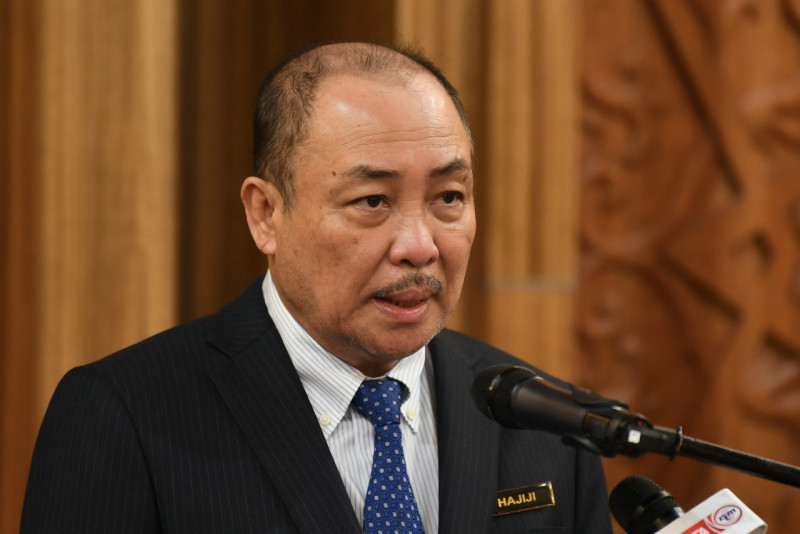
So what actually happened in the year 2020? Warisan won 29 out of 73 Sabah state election seats and by right, Warisan did not lose the state election within the provision in Article 6, as it satisfied the requirement completely. History tells us that the TYT called upon likely candidates for the chief minister namely Datuk Seri Hajiji Mohd Noor and Datuk Seri Shafie Apdal (separately).
We can only guess what was discussed behind closed doors and it was announced later that Hajiji was the new Sabah chief minister.
Interestingly, Gabungan Rakyat Sabah (GRS) helmed by Hajiji himself was registered as a political party on February 26, 2020. So in a nutshell, it satisfies the requirement stipulated under Article 6 and Article 10(2) of the Sabah constitution.
A few days ago, we were again put into the limelight by an important announcement by Barisan Nasional leader Datuk Seri Bung Moktar Radin, that the party withdrew their support for Hajiji (GRS government). Our TYT Tun Juhar will again have to be put to the task as he revisits Article 6 and its entirety.
So what option does Hajiji have with the Sabah GRS government? He has two options in hand.
He could resign as the Sabah chief minister, and hand down his post to a leader of a political party that commands the confidence of a majority; Datuk Seri Shafie Apdal or he could advise the TYT to dissolve the Sabah assembly and we gear up for another state election.
In conclusion, we may have a high possibility for a change of the Sabah government in a few days or weeks to come. Either way, Hajiji is in a very precarious position. Checkmate! – The Vibes, January 7, 2023
Remy Majangkim is an MA63 historian, researcher, activist and tutor