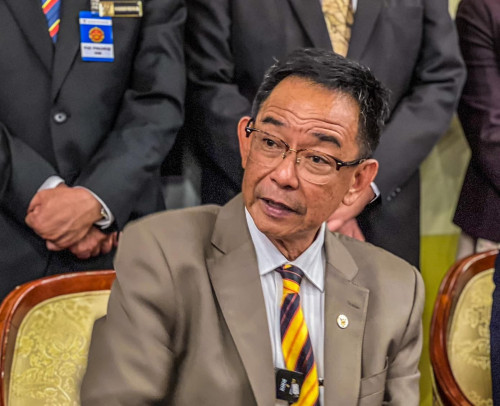
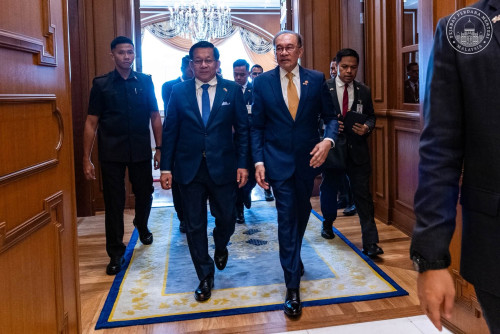
_and_his_Venezuelean_counterpart_Nicolás_Maduro_agreed_at_their_meeting_in_St_Vincent_to_refrain_from_escalating_border_tensions._Facebook_pic..png)
CURRENTLY, we are witnessing wars and conflicts taking place in many parts of the world like Ukraine, Gaza and Sudan. Despite this dismaying news, it is heartening to note some refreshing progresses emanating from two South American countries to avert a conflict.
Venezuela and Guyana have agreed not to resort to force to settle a territorial dispute over the oil-rich Essequibo region. They have engaged in negotiations.
The dispute between the two neighbouring countries is regarding the region known as Essequibo by Venezuela or Guyana Esequiba by Guyana, a 160,00 square km area west of the Essequibo River.
The boundary dispute was inherited from the colonial powers (Spain in the case of Venezuela, and the Netherlands and the United Kingdom in the case of Guyana). This row has continued since the independence of both countries.
Situated at the northern end of South America, Venezuela, with a population of around 28 million, is a predominantly Roman Catholic country (64 percent). The country covers a roughly triangular area larger than the France and Germany.
Venezuela is known to have the largest oil reserves in the world although the wealth has not filtered down towards the ordinary citizens. Nevertheless, the country is famed for being home to the Angel Falls (Kerepakupai Vená), the world's highest waterfall and one of its major tourist attractions.
Neighbouring Guyana is located on South America’s North Atlantic coast. Distinct by its compact tropical rain forest, the country has a population of slightly more than 800,000. Guyana is an indigenous word which means "Land of Many Waters".
About 64 percent of the population are Christians, 25 percent Hindus, and 7 percent Muslims. Despite Muslims being a minority, Mohamed Irfaan Ali was elected president of Guyana in 2020. He is the first Muslim head of state of Guyana.
Border drawn by international arbitrators
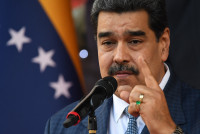
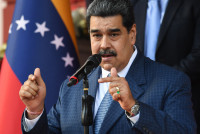
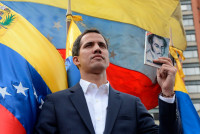
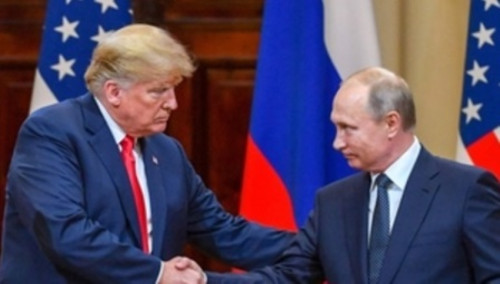
Irfaan Ali and Venezuelan President Nicolás Maduro met recently as a measure to forestall a war.
Following the meeting, both leaders decided not to threaten or use force against one another under any circumstances, which is a good sign of their magnanimity.
Both countries agreed to refrain in any way to escalate the current tense situation from turning into a conflict.
This agreement was contained in an 11-point declaration that was read out at a press conference after the meeting.
The Guyanese and Venezuelan presidents agreed to endeavour to resolve their disputes. A joint commission composed of the foreign ministers and other officials of both countries would address the issue and report within three months.
Essequibo amounts to more than two-thirds of the territory of Guyana and is home to 125,000 of its 800,000 citizens.
Tensions has been escalating in recent weeks following a recent referendum to create a Venezuelan state in the disputed region of Essequibo – a move Guyana considered would be under the guise of a land grab.
History is the reason cited by Venezuela for Essequibo to be under its control. The country stated that it was within its borders during the Spanish colonial period.
Nevertheless, based on the 1899 Paris Arbitral Award, the territory is under Guyana, which claims it as the border was drawn by international arbitrators.
Guyana not the aggressor, says president
The hours-long meeting between both presidents was held at the main international airport in the eastern Caribbean Island of St Vincent. The meeting was initiated by the regional groupings of the Community of Latin American and Caribbean States (CELAC) and the Caribbean Community (CARICOM).
Guyana argues the controversy should be resolved by the International Court of Justice in the Netherlands, while Venezuela if of the view that the court does not have any jurisdiction on the matter.
Guyana’s government was initially adamant that Essequibo was not up for discussion, negotiation, or deliberation.
Irfan Ali made these remarks at a media conference during a break in his talks with Maduro.
“All of this belongs to Guyana,” Irfan Ali said, pointing to a thick leather bracelet on his right wrist featuring the outline of Guyana. “No narrative propaganda decree can change this. This is Guyana.”
Irfan Ali noted that while both parties were committed to keeping peace in the region, Guyana “is not the aggressor”.
“Guyana is not seeking war, but it reserves the right to work with all of our partners to ensure the defence of our country,” he remarked.
Effort to make both sides winners
Rarely do we do we see such rays of hope from leaders from countries willing to settle disputes. If leaders of other countries follow a path of peace and reconciliation, then many issues can be resolved.
Nobody wins in a war or conflict – both sides lose -- as they result in massive loss of lives and destruction of property costing billions.
They drain away money which can be spent on productive purposes like the upliftment of the lives of the people in numerous ways.
Negotiators must always endeavour for a win-win situation where both sides feel they won. Both sides must approach the negotiations with an open heart wanting to satisfy their own needs and the other's needs.
If issues are resolved then both sides are the winners, not one side. Compromises are sometimes necessary in the quest for tangible solutions.
Venezuela and Guyana have set a good example by refraining from starting a war. Hopefully, their negotiations will result in a successful outcome for both countries.
Negotiations are the only way forward in resolving disputes and the victors are the peoples of both countries.
The last thing we would like to see is another war starting in any part of the world, causing misery and hardship to many innocent people, besides resulting is the destruction of property and which could result in the steady outflow of refugees elsewhere.
At present, the world has more pressing issues to deal with – climate change and food security.
So, let the world’s financial and human resources be diverted to these noble causes, instead of conflicts and wars. – The Vibes, December 22, 2023
Benedict Lopez served as director of the Malaysian Investment Development Authority (MIDA) in Stockholm and as economics councillor at the Malaysian embassy in Sweden from 2010 to 2014. He has travelled widely to all parts of the world during the course of his official duties with MIDA.