BY ANYONE’S standard, the elections held in Pakistan on February 8 were neither free nor fair.
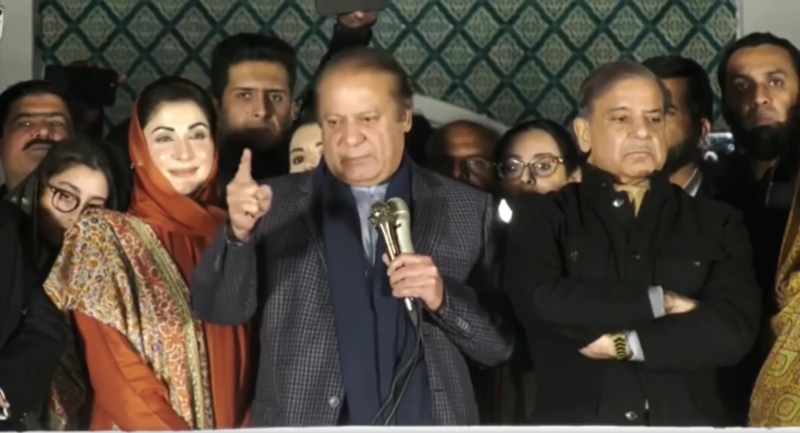
Under the leadership of General Asim Munir, the military ‘massaged’ three-time leader Nawaz Sharif's return to power. Sharif, a convicted corrupt politician, has had an ambivalent relationship with the army for the last 40 years.
Prior to polling day, the military and the judiciary had ensured that the highly popular former prime minister Imran Khan and his Pakistan Tehreek-e-Insaf (PTI) party would not be able to participate in the poll. Imran was pursued by the courts, barred from politics and sent to jail.
However, despite the PTI being disbanded, its electoral symbol (the cricket bat) outlawed and its members banned from running as PTI members — along with blatantly fraudulent ballot stuffing on polling day — Nawaz’s party, the PML(N), was unable to win the most seats.
Instead, the former PTI members — now independents — won the largest number of seats and they are contesting the result of over a dozen of others which they claim have been stolen from them.
Nevertheless, Nawaz declared victory, and is trying to form a coalition government with the Pakistan People’s Party (PPP) led by Bilawal Bhutto Zardari, son of the late Benazir Bhutto. The only bond between the PML(N) and the PPP is that their hatred of each other is slightly less than their hatred of the PTI.
Relations with India
Assuming that Nawaz returns to power — the most likely scenario — what would this mean for some of Pakistan’s most critical relationships?
Since a terrorist attack in Kashmir in February 2019, India-Pakistan relations have deteriorated seriously, including no ambassadorial representation in each other’s capitals since.
However, it hasn’t always been like that, and certainly during Nawaz's third stint (2013-2018), the personal dynamics between Nawaz and Indian Prime Minister Narendra Modi were good. For example, Nawaz attended Modi’s 2014 inauguration and Modi visited Nawaz in Lahore in December 2015 — the first by an Indian leader in more than a decade.
Pakistani Prime Minister Shehbaz Sharif (Nawaz’s brother, who was prime minister after the ouster of Imran in 2022) expressed interest in “serious and sincere talks” with India. There have been suggestions that the two sides could perhaps freeze the Kashmir issue for 20 years and build upon non-contentious bilateral issues, such as trade and the movement of people.
And while Nawaz is on the record of recognising that such poor relations, including virtually no bilateral trade, is bad for the two countries’ economies, he also knows that Kashmir is a “red line” for the military. It was his keen interest in improving relations with Delhi which critically contributed to his downfall in 2017. He’s unlikely to make the same mistake.
Relations with China under Nawaz will continue on a positive note as they have for years and possibly even improve slightly. Beijing would be pleased to see Nawaz’s return to power. It was after all under his previous watch that the USD$60 billion China-Pakistan Economic Corridor (CPEC) — the jewel in China’s Belt and Road Initiative, started.
However, Nawaz will have to manage, as much as possible, the political fallout of the frequent terrorist attacks against Chinese workers and officials working on CPEC projects.
Even though Pakistan already has some 10,000 security personnel dedicated solely to the protection of Chinese interests in Pakistan, Beijing regularly puts pressure on Islamabad to do more to prevent these terrorist attacks, most of which are conducted by the Afghanistan-based Pakistan Taliban, known as the TTP.
Military general effectively rules Pakistan
Afghanistan’s continued public support for the TTP, contrary to Islamabad’s repeated requests that the Taliban cease to do so, is the major stumbling block in any improvement in bilateral relations. The Taliban isn’t about to turn on the TTP, an organisation with which it has deep ideological, operational, historical and tribal links.
However, Kabul also knows that the Pakistani military doesn’t want to escalate this issue by pursuing the TTP into Afghan territory. Accordingly, Pakistan-Afghan relations will probably continue to be frozen.
One mustn’t forget that following the breakdown of negotiations with the TTP under Nawaz’s previous government, the TTP executed the worst massacre of civilians, overwhelmingly school children of military officers, in 2014. Under this fourth Nawaz administration, the security forces will likely continue the status quo, hoping to contain the terrorist menace.
The persistent scourge of terrorism in Pakistan and Afghanistan continuing to harbour terrorists since US troops left Kabul in August 2021 confirm in Washington the importance of maintaining good relations with Pakistan — a unique window on developments in Kabul.
And despite Washington’s public criticism of Pakistan’s seriously flawed election process, the Biden administration is committed to “strengthening its security cooperation” with Islamabad regardless as to who eventually becomes prime minister.
So while Washington may not be pleased with the electoral process, it will absolutely not miss Imran Khan, who repeatedly accused the US of having orchestrated, with the help of the military, his downfall in April 2022.
Importantly, Secretary of State Antony Blinken met with Munir — the man who effectively runs Pakistan, in Washington only a few weeks before the elections.
So, all in all, we shouldn’t expect much change in Pakistan’s foreign relations under a Nawaz premiership, if any, possibly a light improvement in relations with India and the US, two critical relationships for Islamabad. – 360info, February 18, 2024
Dr Claude Rakisits is a visiting research fellow at the Brussels-based Centre for Security, Defence and Strategy (CSDS). He has been following Pakistan politics for 40 years.
Published under Creative Commons and in partnership with 360info.org



.jpeg)