NOTWITHSTANDING pop culture skirmishes and discord over Taylor Swift’s anticipated Eras tour in Singapore, the regional cooperation fostered since Asean’s formation in 1967 has been viewed as a success.
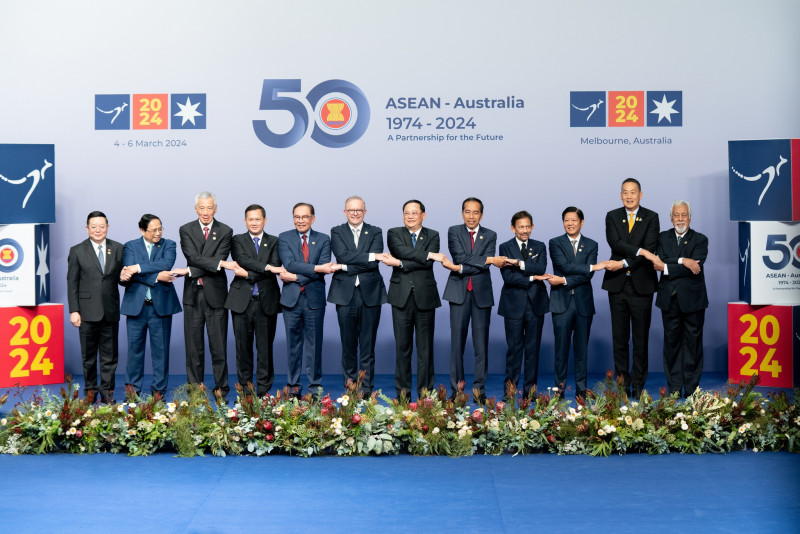
As Australia marks the 50th anniversary of its relationship with the 10-nation Southeast Asian trade bloc, however, it is worthwhile tuning out the noise to focus on the potential harmonies arising from this strategic partnership.
While Swift delivers a short-term economic boost to the cities where she performs, Asean promises to deliver much more in both economic and geopolitical terms.
This two-way trade between Australia and Asean – which in 2022 was worth around AUD$178 billion — has been growing steadily over the years, facilitated by various trade agreements such as the Asean-Australia-New Zealand Free Trade Agreement (AANZFTA) and the Regional Comprehensive Economic Partnership Agreement (RCEP).
Projections based on the 2022 baseline volume of trade suggest another AUD$287 billion could be added by 2040.
These agreements aim to reduce trade barriers and promote economic cooperation between the parties.
The growing consumer market in Asean has fuelled the growth of Australian investment opportunities as well. Two-way investment with Asean in 2022 was AUD$289.7 billion.
Why Asean matters to Australia
Southeast Asia is relatively young with a growing middle class that can provide demand for goods and services such as education, health, infrastructure and financial services, as well as a large base of productive working-age population as the requisite labour force for business expansion.
Similarly, Asean countries have also been investing in Australia, particularly in sectors such as real estate, manufacturing and natural resources.
Asean (Association of Southeast Asian Nations) is a regional intergovernmental organisation comprising 10 Southeast Asian countries: Indonesia, Malaysia, the Philippines, Singapore, Thailand, Brunei, Vietnam, Laos, Myanmar and Cambodia.
Reflected in its motto of “One vision, one identity, one community”, its primary objectives include promoting regional peace and stability, and economic growth, social progress, and cultural development among its members.
The bloc has evolved from a political and security-focused organisation to one with a strong economic agenda.
The Asean Economic Community (AEC), established in 2015, aims to create a single market and production base, facilitating the free flow of goods, services, investment, and skilled labour within the region and aiming towards equitable development and competitiveness.
The size of the Asean bloc has grown over time estimated in 2023 at USD$10.9 trillion in GDP purchasing power parity.
Only three other economies rank above Asean based on this metric, with China, US and India having GDP purchasing power parity of USD$33 trillion, USD$26.8 trillion and USD$13.1 trillion respectively. Foreign Direct Investment (FDI) inflows to Asean constituted 17.1 percent of global inflows in 2022.
The geopolitical landscape has evolved considerably since 1974, when Australia became Asean’s first Dialogue Partner. As such Australia’s ties with Asean have been growing in significance over the last 50 years.
Strategic alliances and soft power
Australia views Asean as a strategic partner in navigating the complex geopolitical landscape of the Indo-Pacific region.
Asean's leadership in regional forums such as the East Asia Summit and the Asean Regional Forum provides Australia with platforms for engagement and cooperation with key stakeholders in the region, including China.
It also serves as a forum for Australia to engage with Southeast Asian nations collectively, offering opportunities to counterbalance China's growing influence in the region.
By strengthening ties with Asean member states and supporting Asean-led initiatives, Australia aims to promote a rules-based order, uphold international norms, and safeguard its interests in the face of China's expanding influence.
Australia recognises the importance of soft power and diplomacy in shaping regional dynamics.
Active engagement with Asean allows Australia to demonstrate its commitment to multilateralism, regional cooperation, and shared values such as democracy, human rights, and the rule of law.
This engagement enhances Australia's reputation and influence in the region, complementing its strategic objectives.
Challenges and opportunities
While Asean-Australia economic relations present numerous opportunities, there are also challenges.
These include differences in regulatory frameworks, infrastructure gaps, and geopolitical tensions.
Perspectives and interests of Asean members regarding China differ from those of Australia, creating a strategic divergence that could constrain the potential for coordinated action to counterbalance China’s growing geopolitical influence in the region.
Strengthening the Australia-Asean connection has become increasingly difficult due to competition from other countries for economic opportunities in Asean.
China, South Korea and Japan remain more important to Asean as trading partners and investors.
However, efforts to deepen economic integration through initiatives like the Regional Comprehensive Economic Partnership (RCEP) present opportunities for further collaboration and economic growth.
As both regions continue to deepen their economic integration and strengthen their partnerships, they are poised to benefit from increased cooperation and collaboration in the years to come. – 360info, March 6, 2024
Dr Radhika Lahiri is an associate professor at the School of Economics and Finance at Queensland University of Technology. Her research interests include macroeconomics and monetary economics, business cycles and economic growth, public economics and development economics.
Published under Creative Commons and in partnership with 360info.org.