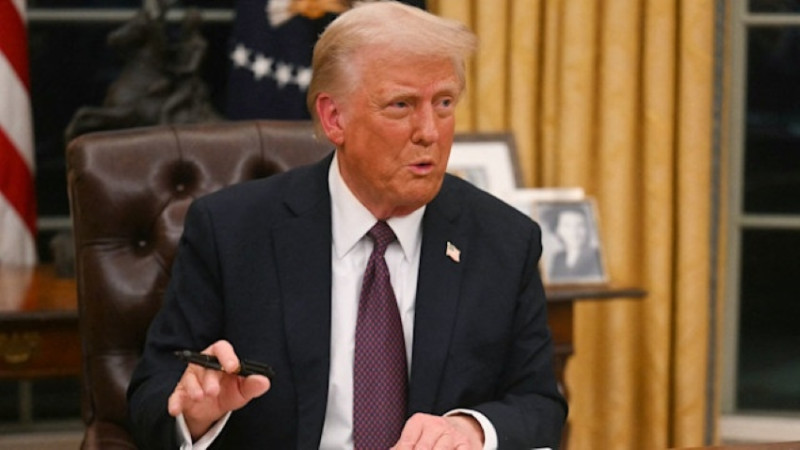
U.S. President Donald Trump on Monday signed an executive order declaring “illicit fentanyl and its core precursor chemicals” to be weapons of mass destruction, casting the deadly synthetic opioid crisis as a direct threat to US national security.
Announcing the order in the Oval Office, Trump said the move was aimed at confronting what he described as an unprecedented scourge of drug-related deaths.
“Today I’m taking one more step to protect Americans from the scourge of deadly fentanyl flooding into our country with this historic executive order,” CNN quoted him saying, adding, “No bomb does what this is doing.”
The announcement came during a White House ceremony honouring US service members with medals “for their central role in the protection of our border.”
Fentanyl, a potent synthetic opioid, is commonly prescribed in medical settings to manage severe pain following major surgery or in advanced cancer treatment. However, the drug is increasingly produced and distributed illegally, posing a serious public health threat.
Its extreme potency makes it highly dangerous. Fentanyl is estimated to be around 50 times stronger than heroin and approximately 100 times more powerful than morphine, meaning that even a minuscule amount can prove fatal.
Under existing US law, it is already a serious criminal offence to use, threaten or attempt to use weapons of mass destruction, a charge that can carry the death penalty in certain circumstances. Federal statutes also define weapons of mass destruction to include “any weapon involving a biological agent, toxin, or vector.”
However, legal experts note that an executive order cannot alter statutory law. A former federal prosecutor specialising in national security questioned whether the designation would have any meaningful legal impact.
The executive order states that “illicit fentanyl is closer to a chemical weapon than a narcotic” and directs Attorney General Pam Bondi to “immediately pursue investigations and prosecutions into fentanyl trafficking.” It also instructs Secretary of State Marco Rubio and Treasury Secretary Scott Bessent to “pursue appropriate actions against relevant assets and financial institutions in accordance with applicable law for those involved in or supporting the manufacture, distribution, and sale of illicit fentanyl and its core precursor chemicals.”
The order frames fentanyl production and trafficking as a direct national security threat, alleging links to organised violence and terrorism.
“The production and sale of fentanyl by Foreign Terrorist Organizations and cartels fund these entities’ operations — which include assassinations, terrorist acts, and insurgencies around the world — and allow these entities to erode our domestic security and the well-being of our Nation,” the order states.
Dennis Fitzpatrick, a former national security attorney with the Eastern District of Virginia, dismissed the move as largely symbolic and potentially counterproductive.
“We already have statutes on the books that are tested, that prosecutors and agents are accustomed to working with, and they’re very clear, and they accomplish the same goals,” Fitzpatrick told CNN. “There’s no practical reason to label fentanyl as a weapon of mass destruction. It’s a political exercise.”
He added that such a designation should fall within the authority of Congress rather than the White House.
“It’s naked lawmaking, and this is an area where Congress has the authority, has the responsibility,” he said.
The executive order comes despite recent federal data showing a sharp decline in overdose deaths. A government estimate released in May indicated that drug overdose deaths fell last year to their lowest level in five years, although synthetic opioids, primarily fentanyl, continued to be involved in the majority of fatalities.
During the same White House event, Defence Secretary Pete Hegseth said the administration had revived the “Mexican Border Service” medals, noting their historical roots.
“Our men and women will be wearing that very same medal as Americans 100 years before who were asked to defend the sovereignty of our country,” Hegseth said. - December 16, 2025