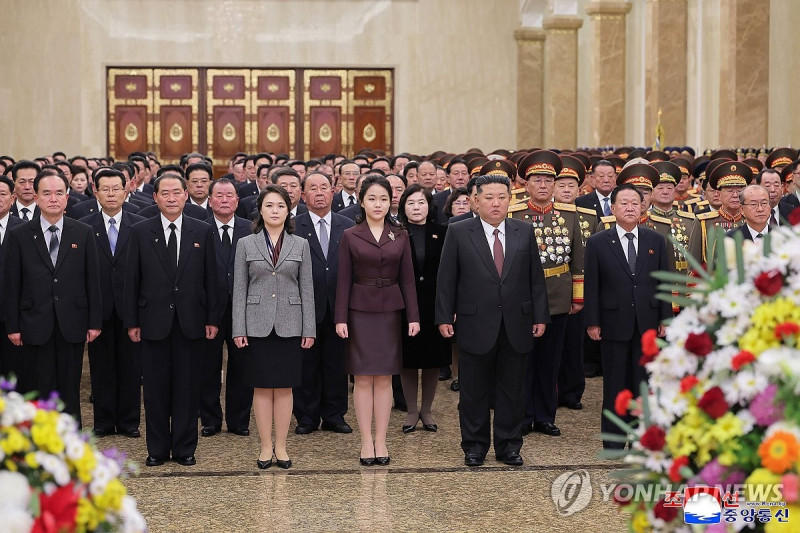
NORTH Korean leader Kim Jong Un’s daughter, Ju Ae, has made her first public appearance at the Kumsusan Palace of the Sun, accompanying her parents to pay respects to the country’s former leaders, state media photographs showed on Friday.
Believed to have been born in the early 2010s, Ju Ae has steadily gained prominence in North Korean media over the past three years, fuelling speculation among analysts and South Korean intelligence officials that she could eventually be prepared to assume a dynastic leadership role.
Reuters on Friday, cited Cheong Seong-chang, vice president at the Sejong Institute think tank, describing Ju Ae’s public presence at the mausoleum as “a calculated move” by her father ahead of the upcoming ruling party Congress, where her eventual succession might be formalised.
State media images published by the Korean Central News Agency (KCNA) showed Ju Ae positioned between her parents, Kim Jong Un and his wife, Ri Sol Ju, in the main hall of the mausoleum during the visit on January 1.
Hong Min, a North Korea expert at the state-run Korea Institute for National Unification, suggested the inclusion of Ju Ae and Ri Sol Ju alongside Kim on major events is intended to project an image of a “stable family” underpinning the country’s dynastic leadership.
Ju Ae has previously made notable appearances in state media, attending New Year celebrations last Thursday and travelling to Beijing in September with her father on her first public overseas trip.
Visits to the Kumsusan Palace of the Sun, where the remains of Kim Il Sung and Kim Jong Il lie, are typically reserved for key dates and anniversaries, reaffirming the country’s dynastic heritage.
Despite widespread speculation, North Korea has never officially confirmed Ju Ae’s age, while South Korea’s Unification Ministry declined to comment on her appearance.
An official noted that it is “too early to say she is a successor” given her young age and lack of an official position within the Workers’ Party.
Hong Min cautioned against drawing premature conclusions, pointing out that the potential roles of Kim’s other children have also left space for ambiguity regarding succession.
“It is practically impossible to publicly designate Kim Ju Ae, who is believed to have just turned 13, as the successor when she is not even old enough to join the Workers’ Party,” Hong said.
Ju Ae’s increasing visibility continues to attract attention in the international community as observers monitor North Korea’s tightly controlled succession strategy, which combines state media imagery with symbolic gestures to affirm continuity of the Kim family dynasty. - January 2, 2026