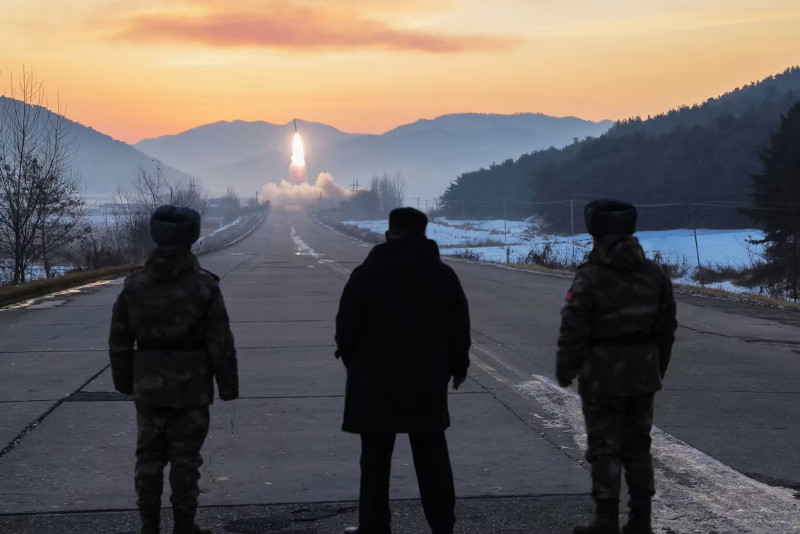
NORTH Korea’s leader Kim Jong Un oversaw the test-firing of what state media described as “cutting-edge” hypersonic missiles on January 4, declaring that worsening global tensions have accelerated the need to prepare the country’s nuclear forces for war.
The test, reported by the Korean Central News Agency on January 5, came against the backdrop of heightened international instability, with Kim making an apparent reference to the United States’ weekend military operation that resulted in the capture of Venezuelan President Nicolas Maduro.
On January 5, KCNA quoted Kim as saying the launch demonstrated “the readiness of the DPRK’s nuclear forces”, referring to North Korea by its official name, the Democratic People’s Republic of Korea.
“Important achievements have been recently made in putting our nuclear forces on a practical basis and preparing them for an actual war,” AFP quoted Kim saying.
Kim said the missile programme was “aimed at gradually putting the nuclear war deterrent on a high-developed basis”.
Seoul and Tokyo said on January 4 that they had detected the launch of two ballistic missiles from near Pyongyang, marking North Korea’s first weapons test of the year.
The launch took place just hours before South Korean President Lee Jae Myung departed for Beijing for a summit with Chinese leaders.
Lee has said he hopes to use the visit to leverage China’s influence over North Korea in an effort to improve relations between Seoul and Pyongyang.
State media images released after the test showed Kim smoking a cigarette as he observed the launch alongside senior officials, with a missile streaking into the early morning sky.
KCNA quoted Kim as saying, “Why it is necessary is exemplified by the recent geopolitical crisis and complicated international events,” a statement widely interpreted as referring to Washington’s capture of President Maduro.
North Korea has condemned the operation as a “serious encroachment of sovereignty” that “clearly confirms once again the rogue and brutal nature of the US”.
The raid has amplified long-standing fears within Pyongyang of a so-called “decapitation strike”, a scenario in which foreign forces attempt to remove the country’s leadership. North Korea has repeatedly accused Washington of pursuing regime change.
For decades, Pyongyang has justified its nuclear and missile programmes as a deterrent against such threats.
The January 4 launch “can be interpreted as a message signalling that Pyongyang possesses a war deterrent and nuclear capabilities, unlike Venezuela”, said Hong Min, an analyst at the Seoul-based Korea Institute for National Unification.
He pointed to state media reports that Kim had visited a facility involved in the production of tactical guided weapons, saying this “demonstrated a capability to launch more precise strikes than existing multiple rocket launchers from various platforms, including air and ground”.
North Korea first tested its new hypersonic missile system in October last year. Hypersonic missiles travel at more than five times the speed of sound and are capable of manoeuvring mid-flight, making them significantly harder to track and intercept.
Such weapons have been used with devastating effect in 2025 by Russia in Ukraine, and by Iran against Israel. North Korea has deepened ties with both countries in recent years.
South Korea’s military said the missiles launched on January 4 landed in the Sea of Japan, adding that it had detected “several projectiles, presumed to be ballistic missiles” fired at around 7.50am local time.
KCNA did not specify the exact number of missiles launched but said they “hit the targets 1,000km away” in the Sea of Japan. - January 5, 2025