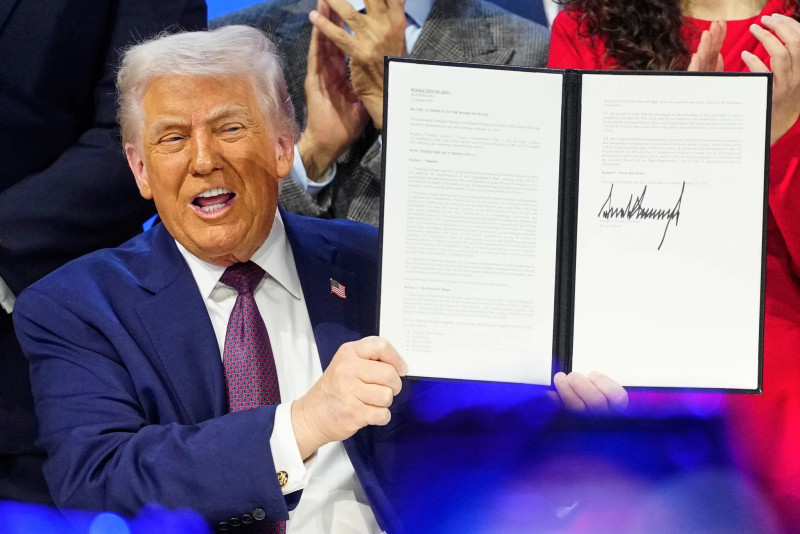
U.S. President Donald Trump’s latest initiative to sidestep the United Nations by establishing a Board of Peace appears to have faltered, as major world powers rejected his plans to expand the board’s role beyond overseeing the Gaza ceasefire.
Reuters cited on Friday that the episode has reaffirmed the U.N.’s enduring centrality in global peacekeeping and raised questions over unilateral attempts to bypass the post-World War II international order.
Originally conceived as a small panel of world leaders to supervise the next phases of Gaza’s ceasefire, Trump’s board has evolved into a much broader vision, with the former president signalling ambitions for it to mediate conflicts worldwide—effectively challenging the U.N. Security Council’s legally mandated authority.
The board’s charter further caused concern by stipulating that Trump would chair it until his resignation, with veto power over decisions and membership.
Trump’s secretary of state, Marco Rubio, sought to reassure critics, stating, “This is not a replacement for the U.N., but the U.N. has served very little purpose in the case of Gaza other than the food assistance.”
Nevertheless, the board’s expanded mandate and suggestions that it could supplant the U.N. drew criticism from both allies and adversaries.
“In my opinion, the basic responsibility for international peace and security lies with U.N., lies with the Security Council,” U.N. Secretary-General António Guterres emphasised.
“Only the Security Council can adopt decisions binding on all, and no other body or other coalition can legally be required to have all member states comply with decisions on peace and security.”
International observers echoed Guterres’ sentiment. Richard Gowan of the International Crisis Group remarked, “The U.S. rollout of the much broader Board of Peace charter turned the whole exercise into a liability.
Countries that wanted to sign on to help Gaza saw the board turning into a Trump fan club. That was not appealing.” He added, “If Trump had kept the focus of the board solely on Gaza, more states, including some more Europeans, would have signed up.”
Key Security Council members—including China, France, Russia, and the United Kingdom—have either declined or remained noncommittal on joining the board. Economic powers such as Japan and Germany also refrained from participation.
Letters inviting world leaders to become “founding members” coincided with Trump’s controversial Arctic ambitions regarding Greenland, which sparked rebukes from Canada, Denmark, and others.
British Prime Minister Keir Starmer, who met with Guterres in London amid the unfolding diplomatic tensions, reaffirmed the U.K.’s commitment to the U.N. and the international rules-based system.
Starmer stressed the U.N.’s “pivotal role in tackling global problems which shape lives in the UK and all over the world.”
France, Spain, and Slovenia cited conflicts with U.N. procedures in declining the invitation, with French President Emmanuel Macron stating that the board “raises serious questions, in particular with respect to the principles and structure of the United Nations, which cannot be called into question.”
U.N. members critical of Trump’s initiative, including China, emphasised the irreplaceable role of the Security Council. China’s ambassador Fu Cong warned against bypassing the U.N., stating, “No single country should dictate terms based on its power, and a winner-takes-all approach is unacceptable.
“We shall not cherry-pick our commitments to the organization, nor shall we bypass the U.N. and create alternative mechanisms.”
Of roughly 60 countries invited, around 26 have joined the board, while nine European nations declined. Some Muslim-majority countries—including Turkey, Saudi Arabia, Egypt, Jordan, Indonesia, Pakistan, Qatar, and the United Arab Emirates—have supported its Gaza-focused mission, with no endorsement of Trump’s global ambitions.
Louis Charbonneau of Human Rights Watch criticised the initiative, saying, “It’s hardly surprising that very few governments want to join Trump’s wannabe-U.N., which so far looks more like a pay-to-play club of human rights abusers and war crimes suspects than a serious international organization.
Instead of handing Trump $1 billion checks to join his Board of Peace, governments should work on strengthening the U.N.”
While Trump’s Board of Peace continues to attract limited support, analysts note that its influence remains constrained, with the U.N.’s established mandate for binding decisions and global conflict resolution remaining intact. Gowan of the Crisis Group concluded, “I remain unconvinced that this is a real long-term threat to the U.N.” - January 30, 2026