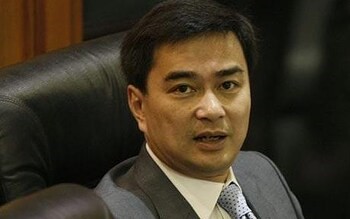
AS Bangkok’s bustling markets filled with lunchtime crowds, former Prime Minister Abhisit Vejjajiva attracted a mix of curiosity and admiration, with passersby stopping him for selfies and warm greetings.
Reuters reported on Wednesdas, the Oxford-educated economist, who led Thailand from 2008 to 2011, is making a high-profile return to politics, aiming to restore the fortunes of the Democrat Party ahead of general elections on February 8.
“Good to see you again, still handsome just like before,” said a noodle vendor, reflecting the lingering goodwill for Abhisit among segments of the electorate.
Speaking to Reuters, Abhisit, 61, explained that his return is motivated by a desire to offer voters genuine choice and revitalise his party.
“Every time I meet people, they are frustrated with the lack of choice,” he said. “I just want to offer a choice and revive the party.”
Abhisit’s comeback comes after years of decline for Thailand’s oldest political party, which had long dominated southern provinces and Bangkok but slid into obscurity following the 2014 military coup. Many voters have expressed renewed confidence in his leadership.
“When Abhisit left, the party lost its power because people no longer trusted the leadership,” said Yuttapum Rattanamanee, a government employee from the northeast. “Abhisit is capable, competent and honest.”
While surveys indicate that Abhisit is unlikely to secure enough support to return as prime minister, his reemergence has helped consolidate conservative and older voters.
Political scientist Olarn Thinbangtieo of Burapha University observed that “his return has lifted support” after the party’s leadership had drifted from its principles during previous years.
Abhisit’s tenure as prime minister was marked by political turmoil, including the 2010 military crackdown on anti-government protests in central Bangkok, which resulted in 90 deaths.
Rights groups criticised the operation as an excessive use of lethal force, although Thai courts later dismissed criminal charges against Abhisit and senior officials.
The current campaign is set against a backdrop of national challenges, including devastating floods in southern Thailand last November, which claimed 145 lives across nine provinces.
In flood-hit Songkhla, a January survey showed Abhisit leading voter preference over incumbent Prime Minister Anutin Charnvirakul, reflecting the party’s enduring appeal in its southern stronghold.
“It suggests that southern people are coming back, warming to us,” Abhisit said.
Despite this support, reclaiming Bangkok, the country’s largest electoral block with 33 seats and 4.5 million voters, remains a significant challenge.
“Ideally, we would have liked more preparation,” Abhisit admitted, acknowledging the difficulty of winning over an electorate that had largely swung to a predecessor of the People’s Party in 2023.
The snap election follows Prime Minister Anutin’s decision to dissolve parliament in December amid a tense border conflict with Cambodia, a move analysts interpreted as an attempt to leverage rising nationalism.
Abhisit insists, however, that his campaign is focused not on nostalgia but on transforming and revitalising the Democrat Party. “We’re bringing back the principles people once supported us for,” he said.
Thailand’s election will see a three-way contest for the premiership among major parties, with Abhisit’s Democrat Party, Anutin’s Bhumjaithai Party, and Natthaphong Ruengpanyawut’s People’s Party vying to form a government in a likely coalition scenario.
Abhisit’s personal appeal, combined with his efforts to restore conservative and southern voter confidence, could make the Democrats a pivotal player in post-election negotiations. - February 4, 2026