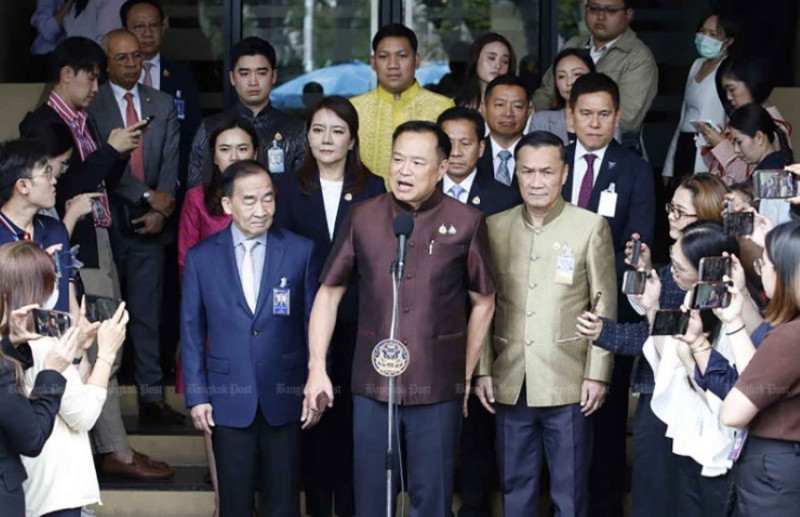
THAILAND"S Prime Minister Anutin Charnvirakul appears poised to consolidate power after calling a snap general election less than 100 days into his tenure, capitalising on a surge of nationalism triggered by renewed fighting along Thailand’s border with Cambodia.
Reuters cited, standing before supporters at a rally in Bangkok last month, Anutin framed the election as a test of patriotism, urging voters to back his Bhumjaithai Party as the defender of national sovereignty.
“I promise to you all that I will safeguard Thailand with my life,” the 59-year-old said. “Just choose Bhumjaithai to guard the country, to help safeguard all of our land.”
That message appears to have resonated. Preliminary results released late on Sunday by Thailand’s Election Commission showed Bhumjaithai taking a commanding lead over the progressive People’s Party and the populist Pheu Thai party.
“Nationalism is in the heart of everybody in the Bhumjaithai party,” Anutin told reporters as results began to emerge. “Our people have given us more than what we expected.”
If Anutin succeeds in forming a government, he would become the first Thai prime minister in two decades to be voted back into office, underscoring both his political dexterity and the chronic instability that has defined Southeast Asia’s second-largest economy.
Anutin, once best known internationally for championing the legalisation of cannabis in 2022, ascended to the premiership last August at the head of a minority government after his predecessor was removed by a court order.
His term began just weeks after Thailand and Cambodia agreed to a ceasefire following violent border clashes.
The calm was short-lived. Fighting resumed in early December with greater intensity, stretching across much of the land border and reviving nationalist sentiment at home.
The conflict provided Anutin, a conservative politician known for his loyalty to Thailand’s powerful monarchy, with an opportunity to reinforce his credentials and seek a stronger mandate.
Late on December 11, less than three months after taking office, Anutin announced the dissolution of parliament in a brief social media post: “I am returning power to the people.”
The move followed a breakdown in relations with the opposition People’s Party, which had initially backed his premiership, and set the stage for Sunday’s vote.
Anutin’s rise reflects a blend of personal pedigree and political calculation.
Born into a family of Chinese ancestry with deep ties to business and power, he is the son of Chavarat Charnvirakul, founder of the Sino-Thai Engineering and Construction Company and a former acting prime minister.
After earning an engineering degree in the United States, Anutin first led the family firm before entering politics under the government of billionaire Thaksin Shinawatra in 2004.
That early career was interrupted when Thaksin’s Thai Rak Thai party was dissolved by a court ruling in 2007, resulting in a five-year ban from politics for Anutin.
He returned in 2012 as leader of Bhumjaithai, then a regional party rooted in Thailand’s rural northeast, and steadily transformed it into a national force capable of leading a coalition.
His success lies in balancing provincial powerbrokers who deliver rural votes with urban appeal, bolstered by technocrats appointed to key ministries, said Napon Jatusripitak of the Thailand Future think tank.
Thailand’s conservative-royalist establishment, long locked in struggle with Thaksin-aligned populists and, more recently, a youthful progressive movement led by the People’s Party, has also coalesced behind Anutin, Napon said.
“I think many can see that, strategically speaking, Bhumjaithai is the best chance to fend off the progressives and the Thaksin-ites,” he said. “It’s definitely a marriage of convenience.”
Even with a strong showing at the polls, Anutin faces daunting challenges.
Thailand’s economy is stagnating under the weight of trade tensions and high household debt, while regional instability persists, with relations with Cambodia strained and civil war continuing in neighbouring Myanmar.
History also looms large. No democratically elected Thai prime minister has completed a full term since Thaksin in 2005, a reminder that even a nationalist wave and electoral success may offer only limited respite from Thailand’s enduring political turbulence. - February 9, 2026