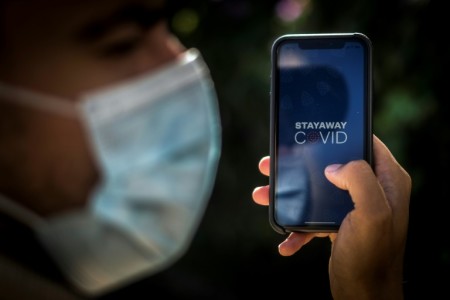
MOBILE apps that help shoppers identify and avoid American-made or US-owned products have experienced a sudden rise in popularity in Denmark following renewed diplomatic tensions sparked by US President Donald Trump’s remarks about acquiring Greenland.
AP reported today that developers behind the apps say interest surged in late January after Trump revived calls for US control of the mineral-rich Arctic island, a semiautonomous territory of Denmark, prompting a backlash among some Danish consumers seeking ways to express opposition through everyday purchasing choices.
Ian Rosenfeldt, the creator of the “Made O’Meter” app, said downloads spiked dramatically during the height of the transatlantic dispute.
Around 30,000 people downloaded the free app in just three days, contributing to more than 100,000 total downloads since its launch last March.
Rosenfeldt, a Copenhagen-based digital marketer, said the idea for the app emerged from frustration shared in a Facebook group formed by Danes interested in boycotting US goods.
“Many people were frustrated and thinking, ‘How do we actually do this in practical terms,’” said the 53-year-old. “If you use a bar code scanner, it’s difficult to see if a product is actually American or not, if it’s Danish or not. And if you don’t know that, you can’t really make a conscious choice.”
The latest version of “Made O’Meter” uses artificial intelligence to analyse multiple products at once and suggest similar alternatives produced in Europe. Users can set filters such as “No USA-owned brands” or “Only EU-based brands,” and the app claims an accuracy rate of more than 95%.
“By using artificial intelligence, you can take an image of a product … and it can make a deep dive to go out and find the correct information about the product in many levels,” Rosenfeldt said during a demonstration at a Copenhagen supermarket.
“This way, you have information that you can use to take decisions on what you think is right.”
After an initial burst of interest when the app first launched, usage declined before surging again last month as Trump escalated rhetoric about Greenland.
App activity peaked on Jan. 23, when users carried out nearly 40,000 product scans in a single day, compared with about 500 daily scans last summer.
Although usage has since fallen, Rosenfeldt said there were still roughly 5,000 scans a day this week. More than 20,000 users are based in Denmark, with others in Germany, Spain, Italy and even Venezuela.
“It’s become much more personal,” Rosenfeldt said, describing the episode as a sense of “losing an ally and a friend.”
Trump announced in January that he would impose new tariffs on Denmark and seven other European countries that opposed his Greenland ambitions, before abruptly withdrawing the threat.
He later said a “framework” agreement had been reached with the help of NATO Secretary-General Mark Rutte, though few details have been made public.
Technical talks between the US, Denmark and Greenland on Arctic security began in late January, with Copenhagen and Nuuk maintaining that sovereignty is non-negotiable.
Rosenfeldt acknowledged that individual boycotts would not meaningfully harm the US economy, but said the effort was about signalling consumer sentiment and encouraging retailers to look more closely at European suppliers.
“Maybe we can send a signal and people will listen and we can make a change,” he said.
A similar Danish app, “NonUSA,” has also seen a surge in interest. It surpassed 100,000 downloads in early February, according to co-creator Jonas Pipper, 21. On Jan. 21 alone, the app recorded more than 25,000 downloads, with users scanning products at a rate of 526 per minute at one point.
About 46,000 users are based in Denmark, with around 10,000 in Germany, Pipper said.
“We noticed some users saying they felt like a little bit of the pressure was lifted off them,” he said. “They feel like they kind of gained the power back in this situation.”
Economists, however, question whether such consumer-driven protests can produce tangible results. Christina Gravert, an associate professor of economics at the University of Copenhagen, said genuinely American products account for only a small share of Danish supermarket stock, estimated at between 1% and 3%, including items such as nuts, wine and confectionery.
At the same time, Denmark remains heavily reliant on US technology, from Apple iPhones to Microsoft software.
“If you really want to have an impact, that’s where you should start,” Gravert said.
Both boycott apps are themselves distributed through Apple’s App Store and Google’s Play Store.
Gravert, who specialises in behavioural economics, said consumer boycotts are often short-lived and rarely result in lasting change unless backed by coordinated action.
“It can be interesting for big supermarket brands to say, OK, we’re not going to carry these products anymore because consumers don’t want to buy them,” she said. “If you think about large companies, this might have some type of impact on the import they do.”
Among shoppers in Copenhagen, reactions were mixed.
“We do boycott, but we don’t know all the American goods. So, it’s mostly the well-known trademarks,” said Morten Nielsen, 68, a retired navy officer. “It’s a personal feeling … we feel we do something, I know we are not doing very much.”
Others were unconvinced.
“I love America, I love traveling in America,” said 63-year-old retiree Charlotte Fuglsang. “I don’t think we should protest that way.” - February 9, 2026