THE United States military is preparing for the possibility of sustained, weeks-long operations against Iran should President Donald Trump give the order, according to two U.S. officials, signalling a potential escalation far beyond previous confrontations between the two countries.
The contingency planning, described to Reuters on condition of anonymity due to its sensitivity, underscores the growing stakes surrounding fragile diplomatic efforts aimed at curbing Tehran’s nuclear ambitions.
Reuters, on Saturday, cited, U.S. and Iranian diplomats met in Oman last week in an attempt to revive negotiations over Iran’s nuclear programme, even as Washington reinforced its military presence in the region, fuelling concerns that renewed hostilities could erupt.
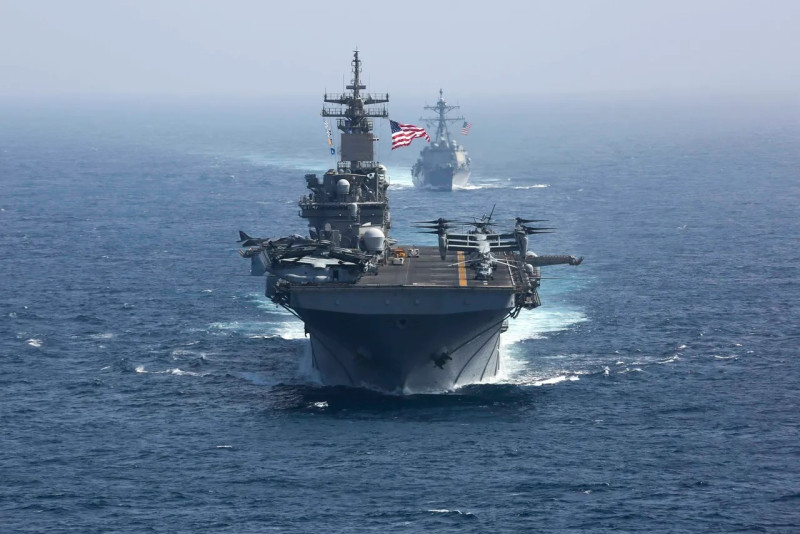
On Friday, U.S. officials said the Pentagon would deploy an additional aircraft carrier to the Middle East, alongside thousands of extra troops, fighter aircraft and guided-missile destroyers — a build-up designed to bolster both offensive and defensive capabilities.
Speaking to American service personnel at a base in North Carolina, Trump acknowledged the challenges of negotiations with Tehran.
“It has been difficult to make a deal” with Iran, he said.
“Sometimes you have to have fear. That's the only thing that really will get the situation taken care of,” Trump added.
Asked about preparations for a potentially prolonged military operation, White House spokesperson Anna Kelly said: “President Trump has all options on the table with regard to Iran.”
“He listens to a variety of perspectives on any given issue, but makes the final decision based on what is best for our country and national security,” she said.
The Pentagon declined to comment on the operational planning.
Last year, the United States deployed two aircraft carriers to the region during a period of heightened tensions and carried out strikes on Iranian nuclear facilities. June’s “Midnight Hammer” operation, however, was effectively a single, discrete strike involving stealth bombers flying from the United States to hit nuclear targets.
Iran’s response was limited to a restrained retaliatory strike on a U.S. base in Qatar.
The current planning is understood to be considerably more complex. In the event of a sustained campaign, U.S. forces could target not only nuclear infrastructure but also Iranian state and security facilities, according to one of the officials, who declined to provide further specifics.
Military analysts warn that the risks to U.S. forces would be significantly greater in a prolonged conflict. Iran possesses an extensive missile arsenal, and retaliatory strikes could trigger a cycle of escalation with unpredictable regional consequences.
One of the officials said Washington fully expects Tehran to respond militarily if attacked, raising the prospect of sustained exchanges over time.
The White House and Pentagon did not answer detailed questions regarding the potential risks of Iranian retaliation or a broader regional war.
Trump has repeatedly threatened to bomb Iran over its nuclear and ballistic missile programmes and its suppression of domestic dissent. On Thursday, he warned that the alternative to a diplomatic breakthrough would “be very traumatic, very traumatic.”
Iran’s Revolutionary Guards have cautioned that any strike on Iranian territory would prompt retaliation against U.S. military bases across the region. The United States maintains installations in Jordan, Kuwait, Saudi Arabia, Qatar, Bahrain, the United Arab Emirates and Turkey.
Israeli Prime Minister Benjamin Netanyahu met Trump in Washington on Wednesday and said that any agreement with Iran “must include the elements that are vital to Israel.”
Tehran has indicated it is willing to discuss restrictions on its nuclear programme in exchange for sanctions relief, but has firmly rejected linking negotiations to its ballistic missile capabilities. - February 14, 2026