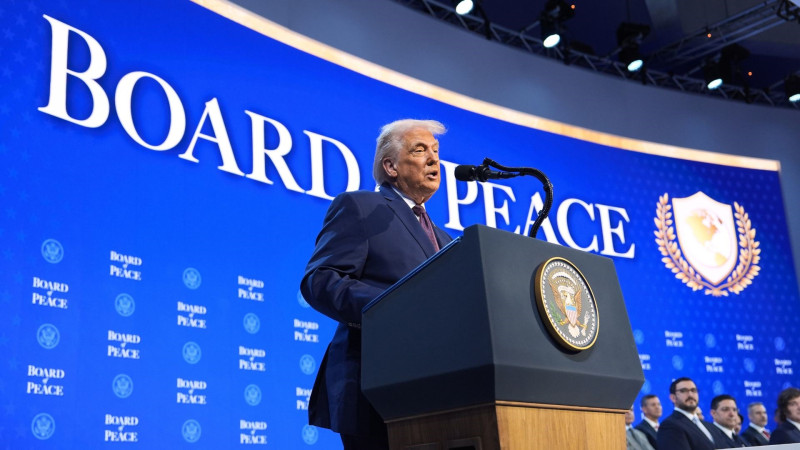
UNITED States President Donald Trump will on Thursday chair the inaugural meeting of his newly formed Board of Peace, launching a controversial diplomatic initiative on Gaza that notably excludes Palestinian representatives while securing an initial US$5 billion for reconstruction.
Reuters reported that the gathering, to be held at the United States Institute of Peace building in Washington — recently renamed by the president — is expected to draw delegations from 47 countries and the European Union.
Among those attending are Israel and states ranging from Albania to Vietnam, though several permanent members of the United Nations Security Council, including France, Britain, Russia and China, will not be represented.
Senior U.S. officials said Mr Trump will announce that participating nations have raised US$5 billion as a first instalment towards rebuilding the war-ravaged Gaza Strip.
The fund will require many billions more in the months ahead. Of the initial pledges, US$1.2 billion is expected from the United Arab Emirates and a further US$1.2 billion from Kuwait, according to a U.S. official.
The disarmament of Hamas militants, the scale and governance of the reconstruction fund, and the delivery of humanitarian assistance to Gaza’s civilian population are likely to test the board’s credibility in the weeks and months ahead.
Trump is also expected to confirm that several nations are preparing to contribute thousands of troops to an International Stabilisation Force intended to help secure Gaza once conditions permit.
However, the deployment is not anticipated for several weeks or months, as demilitarisation remains a central obstacle.
Hamas, wary of potential Israeli reprisals, has shown reluctance to surrender its weapons under Trump’s 20-point Gaza plan, which led to a fragile ceasefire in October after two years of conflict.
“We are under no illusions on the challenges regarding demilitarization, but we have been encouraged by what the mediators have reported back,” a senior administration official said.
The board itself has provoked unease in diplomatic circles.
Its exclusion of Palestinian representation has drawn criticism, while Trump’s suggestion that the body could eventually expand its remit beyond Gaza has prompted concern that it may encroach upon the role of the United Nations as the principal forum for international diplomacy and conflict resolution.
Speakers at the event are expected to include Secretary of State Marco Rubio, U.S. envoys Steve Witkoff and Jared Kushner, former British prime minister Tony Blair, who is anticipated to assume a senior role within the board, U.S. ambassador to the United Nations Mike Waltz, and High Representative for Gaza Nickolay Mladenov.
One board member, speaking on condition of anonymity, said the initiative faces formidable hurdles. Establishing security within the enclave is a prerequisite for progress in reconstruction and governance, yet the local police force is neither adequately prepared nor fully trained.
The same official described the flow of humanitarian assistance as “disastrous” and in urgent need of expansion.
Even if aid were to increase substantially, it remains unclear who would be responsible for distributing it on the ground.
A further unresolved issue concerns engagement with Hamas. While the board could liaise with countries that exert influence over the group — notably Qatar and Turkey — Israel remains deeply sceptical of both governments’ roles.
With fundamental questions over security, governance and legitimacy still unanswered, the effectiveness of Trump’s Board of Peace will depend not only on the sums pledged in Washington but on whether it can translate financial commitments into durable stability in Gaza. - February 19, 2026