THE United States Supreme Court has ruled that tariffs imposed by President Donald Trump under a 1977 economic emergency statute were unlawful, casting uncertainty over an estimated US$175 billion in duties collected over the past year and setting the stage for a protracted legal battle over refunds.
The court did not provide guidance on how the government should return the funds, prompting immediate questions over whether importers will be reimbursed and how such a process would unfold.
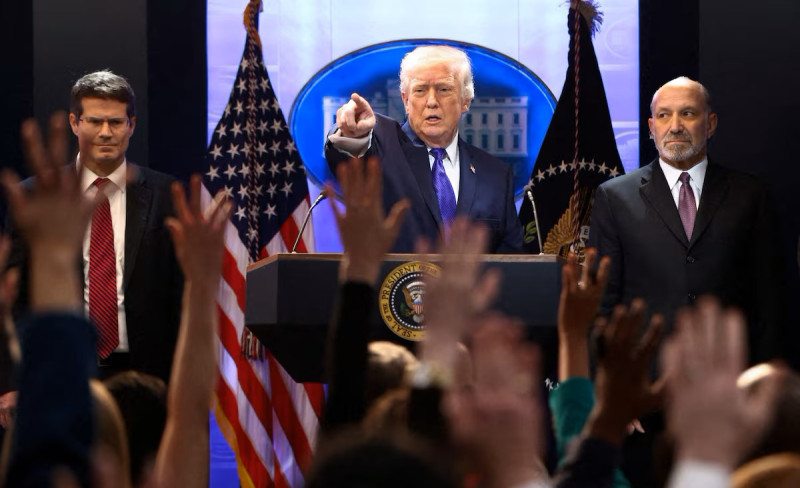
Speaking at a press conference, Trump indicated that the issue would not be resolved quickly. “We'll end up being in court for the next five years,” Reuters reported him saying today.
The case now returns to the US Court of International Trade, which will be tasked with determining how refunds should be handled.
Justice Brett Kavanaugh, in a dissenting opinion, warned that the ruling would likely produce significant practical consequences, including the challenge of issuing repayments.
He noted that it had been acknowledged during oral arguments that distributing refunds was likely to be “a mess.”
Under existing procedures, importers pay estimated tariffs to US Customs and Border Protection when goods enter the country, posting a bond in advance.
The government later finalises the amount owed in a process known as liquidation, typically around 314 days after entry. Excess payments are refunded or shortfalls collected.
With more than 1,000 lawsuits already filed in the trade court seeking refunds, legal experts anticipate a surge in further claims.
Importers have two years under US trade law to bring cases seeking repayment. However, legal practitioners have cautioned that smaller businesses could be disproportionately affected, as some may forgo claims rather than incur substantial legal costs.
Complications may also arise where the company seeking repayment was not the official importer of record, potentially triggering additional contractual disputes over who is entitled to any refunded sums. Trade groups have warned that the process could take years.
There is precedent for large-scale trade refunds. In 1998, after the Supreme Court declared part of the harbour maintenance tax unconstitutional, the Court of International Trade supervised a complex repayment process involving more than 100,000 claimants.
Within hours of the ruling, Trump moved to reinstate tariffs using alternative statutory authority. He signed executive orders imposing a temporary 10 per cent global import duty for 150 days under Section 122 of the Trade Act of 1974, a rarely used provision allowing duties of up to 15 per cent to address serious balance-of-payments deficits.
The order replaces tariffs of between 10 and 50 per cent previously levied under the International Emergency Economic Powers Act, which the Supreme Court found unlawful, and ends the collection of those now-banned duties.
The new measures maintain exemptions for aerospace products, passenger vehicles and certain light trucks, goods from Mexico and Canada compliant with the US-Mexico-Canada Agreement, pharmaceuticals, and selected critical minerals and agricultural products. After 150 days, any extension would require congressional approval.
Treasury Secretary Scott Bessent said the revised framework would likely preserve overall tariff revenue. “We will get back to the same tariff level for the countries. It will just be in a less direct and slightly more convoluted manner,” he told Fox News, adding that the Supreme Court’s decision had reduced the administration’s negotiating leverage.
Trump signalled that further investigations under Section 301 of the Trade Act of 1974 and Section 232 national security provisions were imminent, potentially paving the way for additional country-specific duties.
“We have alternatives, great alternatives,” he said. “Could be more money. We'll take in more money and we'll be a lot stronger for it.” Asked whether future tariff rates might rise, he replied: “Potentially higher. It depends. Whatever we want them to be.”
US Trade Representative Jamieson Greer said details of new Section 301 investigations would be released in the coming days, describing them as “incredibly legally durable.”
Such probes, while more procedurally complex, are generally considered more resilient to judicial challenge than emergency measures.
Legal analysts suggest that although the administration’s pivot to established trade statutes may prolong uncertainty, it could also introduce greater transparency and procedural clarity.
Janet Whittaker, senior counsel at Clifford Chance in Washington, said the administration would now have to adhere to defined investigative processes, giving businesses more visibility.
Meanwhile, the question of refunds remains unresolved.
Asked whether the administration would reimburse importers, Trump suggested the matter would be contested in court for years.
Bessent similarly indicated that repayments were “in dispute” and could be drawn out over “weeks, months, years.”
With litigation mounting and fresh tariff measures taking effect within days, the ruling has injected renewed volatility into US trade policy, even as the administration seeks to maintain revenue levels and negotiating leverage through alternative legal avenues. - February 21, 2026