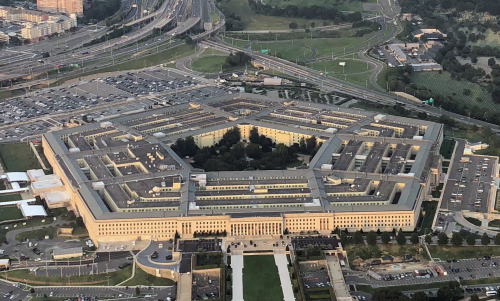
THE Trump administration is to convene senior executives from America’s largest defence contractors at the White House on Friday, as Washington moves urgently to replenish weapons stockpiles depleted by recent strikes on Iran and other military engagements.
According to individuals familiar with the plans, companies including Lockheed Martin and RTX, the parent company of Raytheon, have been invited to attend.
The discussions are expected to centre on accelerating weapons production to restore inventories that have been drawn down sharply since Russia’s invasion of Ukraine in 2022 and Israel’s military operations in Gaza.
Reuters reported on Wednesday that the latest conflict with Iran has further strained supplies, consuming longer-range missiles beyond those previously provided to Kyiv.
One person briefed on the meeting said the focus would be on pressing manufacturers to move faster to increase output.
In a social media post earlier this week, U.S. President Donald Trump insisted there was a “virtually unlimited supply” of U.S. munitions and that “wars can be fought ‘forever,’ and very successfully, using just these supplies.”
Behind the scenes, however, the Pentagon is working on a supplemental budget request of roughly US$50 billion to fund replenishment of weapons used in recent operations, including those in the Middle East.
Deputy Defence Secretary Steve Feinberg is leading the effort, and the proposal could be released as early as Friday. The figure remains preliminary.
The urgency has intensified following US strikes on Iran over the weekend, which involved the deployment of Tomahawk cruise missiles, F-35 stealth fighters and one-way attack drones.
Raytheon recently reached a new agreement with the Pentagon to ramp up Tomahawk production to 1,000 missiles annually.
The Defence Department currently plans to purchase 57 of the missiles in 2026 at an average cost of US$1.3 million each.
The administration has also increased pressure on contractors to prioritise fulfilment of defence contracts over shareholder returns.
In January, Trump signed an executive order aimed at identifying companies deemed to be underperforming on contracts while distributing profits to investors.
The Pentagon is expected to publish a list of such contractors, who would then have 15 days to submit board-approved corrective plans or face potential enforcement action, including contract termination.
The military escalation has reverberated across the region.
US Secretary of State Marco Rubio said all personnel were accounted for after a drone struck the grounds of the US consulate in Dubai.
A source indicated the attack was suspected to be Iranian.
The United States has since closed embassies in Saudi Arabia, Kuwait and Lebanon and advised Americans to leave certain countries in the region.
Trump said most of Iran’s military installations had been “knocked out” and that further strikes had targeted elements of the Iranian leadership.
An Israeli source said Israel had also struck a compound linked to the body responsible for selecting Iran’s next supreme leader.
Iranian media outlets have reported heavy casualties.
The US-based Human Rights Activists News Agency reported that more than 1,000 people, including children, had died since the war began on Saturday, with over 5,400 civilians injured.
The group said its figures were preliminary and that hundreds more reported deaths were being verified.
Oil markets have been roiled as vessels largely halted transit through the critical Strait of Hormuz, sending US petrol prices to their largest one-day increase since 2005.
Crude prices continued to rise while US equity indices, including the Dow, S&P 500 and Nasdaq, fell by around one per cent or less.
The top US military commander in the region, Admiral Brad Cooper, head of US Central Command, said American forces had struck nearly 2,000 targets in Iran since the operation began.
In a video statement, Cooper said US forces had “severely degraded Iran’s air defenses” and destroyed hundreds of ballistic missiles, launchers and drones.
Footage released alongside his remarks showed missiles and aircraft launching from US ships and targets exploding on the ground.
He noted that Iran had retaliated by launching more than 500 ballistic missiles and over 2,000 drones.
Cooper said US forces were “hunting” Iran’s remaining mobile ballistic missile launchers to eliminate their “lingering launch capability.”
The operation has involved more than 50,000 troops, 200 fighter jets, two aircraft carriers and bombers, with additional assets en route.
“We’ve just begun,” Cooper added. - March 4, 2026