U.S. President Donald Trump issued a forceful warning to Iran, threatening severe military retaliation if Tehran obstructs oil shipments through the Strait of Hormuz, even as he predicted the war could end sooner than initially anticipated.
Trump, speaking at a news conference at Trump National Doral in Florida, also reiterated his belief that pre-emptive action was necessary.
“If I didn’t hit them first, they were going to hit our allies first. I believe upon information and belief,” Reuters cited him saying, adding, “They were going to take over the Middle East.”
The phrase “upon information and belief” is typically used in legal contexts to indicate statements based on second-hand information, but believed to be true by the speaker.
The US president’s remarks included an inaccurate claim that Iran possesses U.S.-made Tomahawk cruise missiles, despite no evidence supporting such access.
“Whether it’s Iran or somebody else … a Tomahawk is very generic,” Trump said. When pressed about why he alone in the administration made this claim, he admitted, “Because I just don’t know enough about it. Whatever the report shows, I’m willing to live with that report.”
Trump warned that any obstruction of oil tanker traffic would provoke attacks
“TWENTY TIMES HARDER” than previous strikes, threatening to destroy targets that could make it “virtually impossible for Iran to ever be built back, as a Nation, again — Death, Fire, and Fury will reign upon them — But I hope, and pray, that it does not happen!”
He also framed the threat as a strategic signal to China and other oil-dependent nations.
In response, Iran’s Revolutionary Guard emphasised that the end of the conflict would be determined solely by Tehran.
Spokesperson Ali Mohammad Naini stated, “We are the ones who will determine the end of the war,” while asserting that attacks from the U.S. and Israel could prompt Iran to block oil exports entirely.
The military campaign has already caused widespread devastation. U.S. and Israeli airstrikes targeting Iranian nuclear and energy facilities have killed at least 1,332 civilians in Iran and wounded thousands.
In Lebanon, more than 400 fatalities have been reported, with nearly 700,000 people displaced. Israel has confirmed casualties on its side, including an 11th death near Tel Aviv from Iranian strikes.
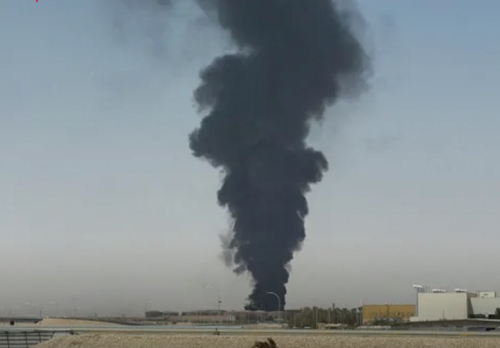
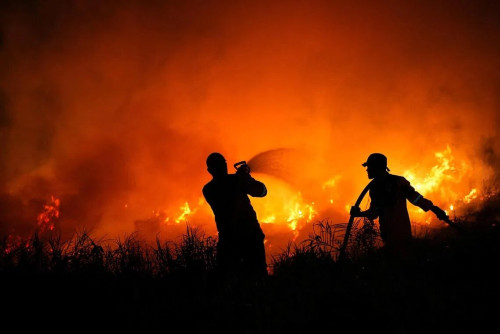
Tehran is reeling from fires at oil refineries, raising concerns over contamination of food, water, and air.
Markets have been highly volatile, with Brent crude oil prices surging as high as 29 per cent in intraday trading before settling near 7 per cent above recent levels.
The Strait of Hormuz remains effectively closed, choking global oil and liquefied natural gas transport.
In the United States, concerns over rising gasoline costs weigh heavily ahead of the November midterm elections, with a Reuters/Ipsos poll showing 67 per cent of Americans expect fuel prices to rise further.
In Tehran, the appointment of 56-year-old Mojtaba Khamenei as Iran’s new supreme leader has reinforced hardline control over the security apparatus and government, a move Trump has publicly opposed.
Iran state media broadcast scenes of crowds rallying behind the new leader, holding portraits of both Mojtaba and his late father, Ali Khamenei, who was killed by an Israeli strike at the start of the war.
Many citizens expressed support, while others voiced concern that hopes for reform have been dashed. University student Zahra Mirbagheri, 21, said, “It was a slap in the face to our enemies that thought the system will collapse with the killing of his father. Our late leader's path will continue.”
The war has escalated tensions across the region, with Turkey reporting the interception of a ballistic missile fired from Iran. U.S.-Israeli strikes have extended to central Iran and Lebanon’s capital, Beirut, where Hezbollah militias have been engaged.
Iran maintains that its operations are defensive, claiming the U.S. and Israel have created instability that threatens the entire region.
As the conflict continues, the trajectory of global oil supply, Middle East security, and international markets remains precarious, with both military and diplomatic outcomes uncertain. - March 10, 2026