TENSIONS between the United States and Iran have sharply escalated amid an ongoing regional conflict involving Israel, with lawmakers in Washington criticising President Donald Trump’s handling of the situation while Tehran issues threats of retaliation and global energy markets react to the standoff.
US Senator Chris Murphy, a senior member of the Senate Foreign Relations Committee, described Trump as having “lost control” and acting in a state of panic amid the crisis.
Murphy is among a growing number of lawmakers criticising the joint US–Israel military operations against Iran, which are now in their fourth week.
He has previously characterised the campaign as “Trump’s crazy war”, warning that the conflict is beginning to affect the broader US economy, particularly through rising fuel prices.
Trump has intensified pressure on Tehran by threatening to destroy Iranian power facilities if the country does not reopen the Strait of Hormuz, a critical global shipping route.
"If Iran doesn't FULLY OPEN, WITHOUT THREAT, the Strait of Hormuz, within 48 HOURS from this exact point in time, the United States of America will hit and obliterate their various POWER PLANTS, STARTING WITH THE BIGGEST ONE FIRST!", Trump posted on his Truth Social platform.
Iran has responded with its own warnings, stating that any strike on its infrastructure would trigger retaliatory attacks on American assets in the region.
AFP reported on Sunday that Iran's military operational command said that if its facilities are targeted, "all energy, information technology and desalination infrastructure belonging to the US" in the region would be considered legitimate targets.
The exchange follows a series of military actions and counteractions involving Iran and Israel. Iranian forces reportedly launched missiles that struck areas in southern Israel, including Dimona and Arad, injuring more than 100 people after bypassing air defences. Israel, in turn, carried out renewed strikes on Tehran.
Israel’s Health Ministry reported a surge in casualties linked to the ongoing conflict. In the past 24 hours alone, 303 people were admitted to hospitals, with eight in serious condition and 29 in moderate condition.
A further 20 individuals were treated for acute anxiety. Since the beginning of the conflict, a total of 4,564 people have required hospital treatment.
The conflict has also heightened concerns over global energy markets.
The Strait of Hormuz, through which roughly one-fifth of the world’s crude oil trade passes, has become a focal point of geopolitical tension. Brent crude prices have risen above US$105 per barrel amid the uncertainty.
A coalition of 22 countries, including the United Kingdom, France, Germany, Italy, South Korea, Australia, the United Arab Emirates and Bahrain, has condemned what it described as the “de facto closure of the Strait of Hormuz by Iranian forces”.
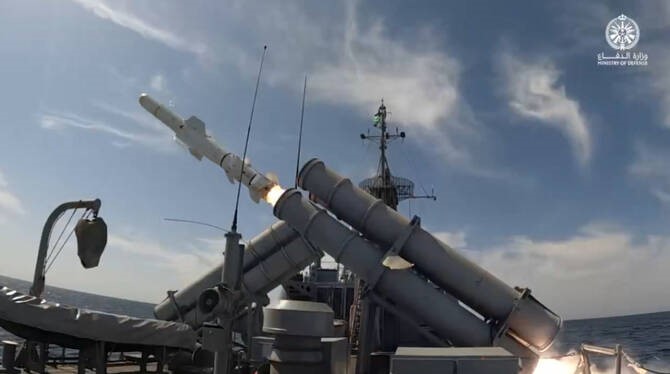
Military activity in the region has expanded alongside the diplomatic standoff. US Central Command reported that bunker-busting munitions were used against an underground Iranian coastal facility, aimed at degrading Iran’s ability to threaten maritime navigation.
Additional US Marine deployments to the region have also been reported.
Iran has continued to demonstrate its military reach by launching retaliatory actions against regional states it accuses of enabling US operations.
Saudi Arabia reported intercepting ballistic missiles and drones near Riyadh, while the United Arab Emirates said it responded to incoming aerial threats.
There have also been claims of an attempted Iranian missile strike on a US–UK base at Diego Garcia, located roughly 4,000 kilometres away, although Iran has not acknowledged responsibility.
Analysts suggest that despite reported losses among its leadership and infrastructure, Iran continues to demonstrate operational resilience. Neil Quilliam of Chatham House noted that the country has shown “a lot of resilience that we didn’t perhaps expect”.
The human impact of the conflict continues to be felt across the region. In Israel, residents described scenes of destruction following missile impacts, including significant damage to residential areas.
In Arad, a resident recounted the moment of impact, saying: “There was a ‘boom, boom!’, my mother was screaming. This was terrifying... this town had never seen anything like this.”
In Dimona, which is widely believed to host the region’s only nuclear facility, missiles reportedly landed within close proximity, injuring dozens.
The International Atomic Energy Agency has urged restraint, with its director Rafael Grossi calling for “military restraint to avoid any risk of a nuclear accident.”
Meanwhile, broader regional anxiety persists as the conflict overlaps with major cultural observances in Iran, including Nowruz. Public life has continued in parts of Tehran, although uncertainty and concern remain widespread as the war enters its fourth week.
Observers warn that the convergence of military escalation, energy insecurity and political rhetoric could further destabilise the region, with implications extending well beyond the immediate conflict zone. - March 22, 2026