OIL prices advanced on Tuesday amid growing supply concerns, as Iran denied holding talks with the United States to end the conflict in the Gulf, contradicting remarks by U.S. President Donald Trump that a deal could be reached soon.
Reuters cited on Tuesday that Brent crude futures rose US$2.89, or 2.9 per cent, to US$102.83 a barrel at 0710 GMT, while West Texas Intermediate (WTI) climbed US$2.49, or 2.8 per cent, to US$90.62.
The market reaction followed a volatile session in which crude had fallen more than 10 per cent on Monday after Trump ordered a five-day delay to planned strikes on Iran’s power plants, citing what he described as constructive discussions with unnamed Iranian officials that produced “major points of agreement”.
“By shelving the plan to strike Iranian power plants for five days, the U.S. effectively sucked much of the ‘war premium’ from the oil price,” said Tim Waterer, chief market analyst at KCM Trade.
“Today's moderate bounce is just the market finding its footing in the mud. Traders are aware that while the missiles are on hold, the Strait of Hormuz is still far from a clear waterway.”
The Strait of Hormuz, a critical chokepoint for global energy flows, remains a key concern for markets, with the conflict having disrupted shipments of roughly one-fifth of the world’s oil and liquefied natural gas. Despite the tensions, two tankers bound for India reportedly passed through the strait on Monday.
Tehran rejected Trump’s claim of ongoing contact with Washington, dismissing it as an attempt to influence financial markets. Iran’s Revolutionary Guards also said they had carried out attacks on U.S. targets, describing Trump’s statements as “worn-out psychological operations”.
Analysts cautioned that even with a potential easing of tensions, structural risks remain elevated.
“Even with a possible decrease in tensions after (Monday’s) announcement from President Trump, we expect a price floor of US$85–US$90 and a natural drift back to the US$110 range until the Strait of Hormuz is restored,” Macquarie said in a client note.
The investment bank added that if the strait remains effectively closed through April, Brent could climb as high as US$150 a barrel.
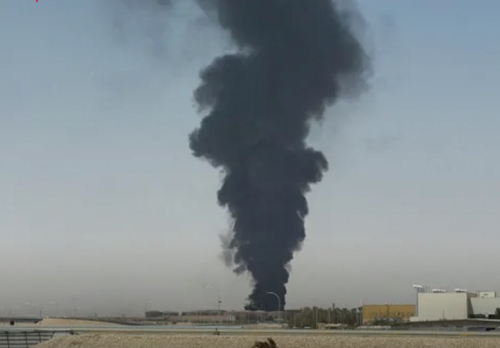
Meanwhile, reports of continued attacks on energy infrastructure added to market unease.
A gas company office and a pressure-reduction station in Isfahan were reportedly hit, while a projectile struck a gas pipeline supplying a power station in Khorramshahr, according to Iran’s Fars news agency.
In response to tightening supply conditions, the United States temporarily waived sanctions on certain Russian and Iranian oil already in transit. Industry sources indicated that traders have since been offering Iranian crude to Indian refiners at a premium to ICE Brent.
U.S. Energy Secretary Chris Wright said on Monday that global oil prices have not risen sufficiently to trigger demand destruction, while International Energy Agency Executive Director Fatih Birol said the agency is consulting with Asian and European governments on possible additional releases of strategic reserves if needed.
Despite some signs of diplomatic activity, markets remain braced for continued disruption at least through April, with analysts noting that geopolitical risk is likely to support prices and sustain inflationary pressures.
“Markets are bracing for disruption at least until April, which continues to act as a tailwind beneath Brent while maintaining momentum for inflation,” said Priyanka Sachdeva, senior market analyst at Phillip Nova.
Energy executives and policymakers at a conference in Houston also highlighted the broader economic implications of the conflict, while U.S. Energy Secretary Chris Wright downplayed the severity of the crisis. - March 24, 2026