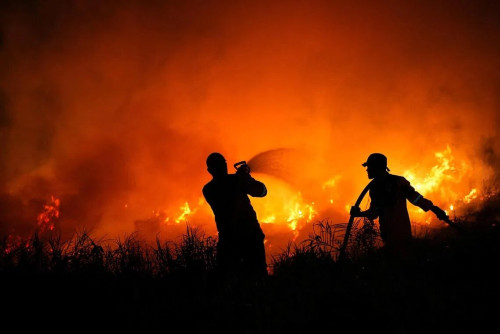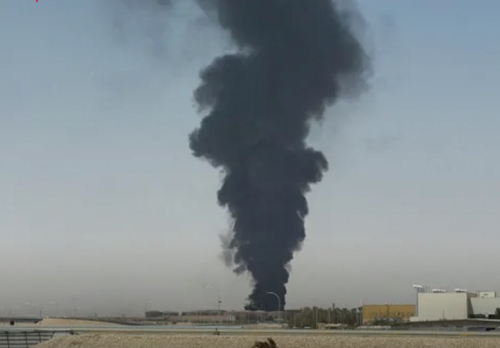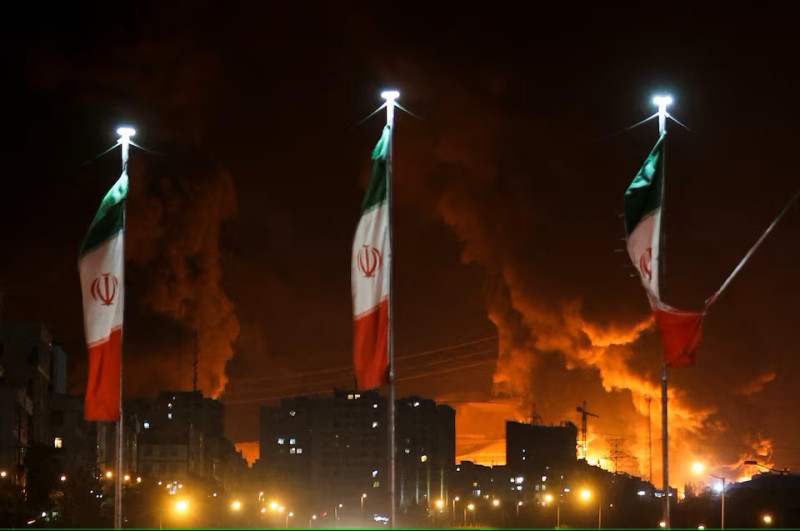
IRAN on Wednesday firmly rejected a U.S. proposal to pause the ongoing war in the Middle East, escalating attacks on Israel and Gulf Arab nations, including strikes that ignited a fuel tank at Kuwait International Airport.
The defiance coincides with Israeli airstrikes on Tehran and a significant U.S. military build-up in the region, including the deployment of paratroopers and additional Marines.
AP reported Iranian Foreign Minister Abbas Araghchi telling its state television that his government has not engaged in negotiations to end the conflict and has no plans to do so.
This followed reporting by Iranian state TV’s English-language channel quoting an anonymous official stating Iran had rejected the U.S. ceasefire proposal and presented its own conditions for halting hostilities.
Pakistani officials, who transmitted the U.S. plan to Tehran, described the 15-point proposal broadly. It reportedly covers sanctions relief, a rollback of Iran’s nuclear program, limitations on its missile program, and reopening the strategically vital Strait of Hormuz.
An Egyptian official involved in mediation confirmed that the plan also seeks to restrict Iran’s support for armed groups.
Despite Iran’s public rejection, President Donald Trump maintained that the country remains interested in a deal.
“They are negotiating, by the way, and they want to make a deal so badly, but they’re afraid to say it because they figure they’ll be killed by their own people,” he said. “They’re also afraid they’ll be killed by us.”
Iran has consistently refused to discuss its ballistic missile program or its backing of regional militias, which it considers vital to national security.
Control over the Strait of Hormuz, through which a fifth of global oil shipments pass, remains a strategic advantage for Tehran, and its continued restriction has contributed to volatility in global energy markets.
The United States has responded by sending additional military forces to the region.
At least 1,000 troops from the 82nd Airborne Division are scheduled for deployment in the coming days, while around 5,000 Marines trained in amphibious assaults, along with thousands of sailors, are also being sent.
The paratroopers are specifically trained to secure contested areas and key airfields.
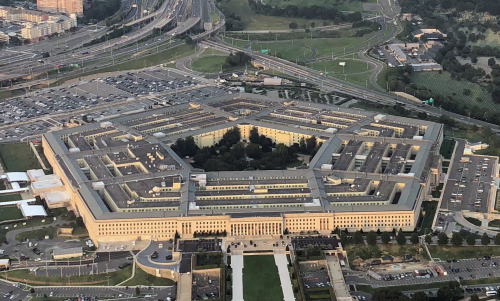
Diplomatic efforts continue amid major challenges. Mediators are exploring possible in-person talks between the U.S. and Iran, potentially in Pakistan as soon as Friday.
Trump confirmed that U.S. negotiators include special envoy Steve Witkoff, his son-in-law Jared Kushner, Secretary of State Marco Rubio, and Vice President JD Vance, though no Iranian participants have been publicly identified.
Press TV, the English-language arm of Iranian state media, outlined a five-point proposal from Tehran, including halts to killings of Iranian officials, safeguards against future attacks, reparations, cessation of hostilities, and Iran’s full control over the Strait of Hormuz.
Many of these demands, particularly reparations and continued restriction of the strait, are expected to be unacceptable to Washington.
The conflict has already resulted in substantial casualties. Iran reports over 1,500 deaths, while Israel has lost 20 civilians and two soldiers in Lebanon.
At least 13 U.S. military personnel have been killed, alongside dozens of civilians in the West Bank and Gulf Arab states. Lebanon and Iraq have also suffered significant losses due to the involvement of Iranian-backed militias.
Energy markets have remained highly sensitive. Brent crude, the global benchmark, traded around US$100 a barrel on Wednesday, down from near US$120 last week, but still 35 per cent higher than at the start of hostilities.
Rising energy costs continue to raise concerns over inflation, affecting prices for basic goods, mortgages, and loans.
Iran has allowed limited passage through the Strait of Hormuz but has barred ships from the U.S., Israel, and allied nations from transit, maintaining a chokehold that continues to pressure global markets and complicate diplomatic solutions. - March 26, 2026