ISRAELI forces have begun establishing extensive buffer zones in southern Lebanon, Gaza and Syria in a bid to secure territory and pre‑empt future threats.
After the attacks of October 7 2023, senior Israeli military and defence officials told Reuters that the creation of buffer zones reflects a profound change in strategic doctrine.
Rather than relying on borders alone for security, Israel is pushing beyond them to clear, occupy or control swathes of territory it views as potential threat zones.
This approach has placed the country in what officials describe as a semi‑permanent state of war.
The shake‑up in Israel’s security thinking has come amid a ceasefire pause agreed between the United States and Iran, which has led both sides to halt certain attacks while negotiating a broader end to the conflict that erupted on February 28.
Israel has agreed to suspend strikes on Iranian territory but says it will continue its campaign against Iranian‑backed Hezbollah.
Hezbollah entered the wider regional conflict on March 2 by launching rockets into Israel.
In response, Israeli forces launched a ground advance into southern Lebanon with the declared objective of clearing a buffer zone extending as far as the Litani River, encompassing roughly 8 per cent of Lebanese territory.
Israel has ordered hundreds of thousands of residents to evacuate, and troops are demolishing homes in Shi’ite villages that military officials say were used by Hezbollah to store weapons or stage attacks.
A senior Israeli military official, speaking on condition of anonymity, said the aim is to “clear” an area stretching five to ten kilometres beyond the internationally recognised border to put Israeli towns out of range of Hezbollah projectiles.
In some villages close to the frontier, Israeli troops reportedly found what the official described as evidence that nearly 90 per cent of homes contained weapons or equipment linked to Hezbollah, a claim that underpins their classification of those structures as military positions.
Retired Israeli brigadier general Assaf Orion, former head of military strategy, described the new doctrine as a departure from defensive postures.
“Israel no longer waits for the attack to come,” he said. “It sees an emerging threat and it attacks it pre‑emptively.”
Once secured, these buffer zones will leave Israel in control of territory in Lebanon, Syria, the West Bank and Gaza.
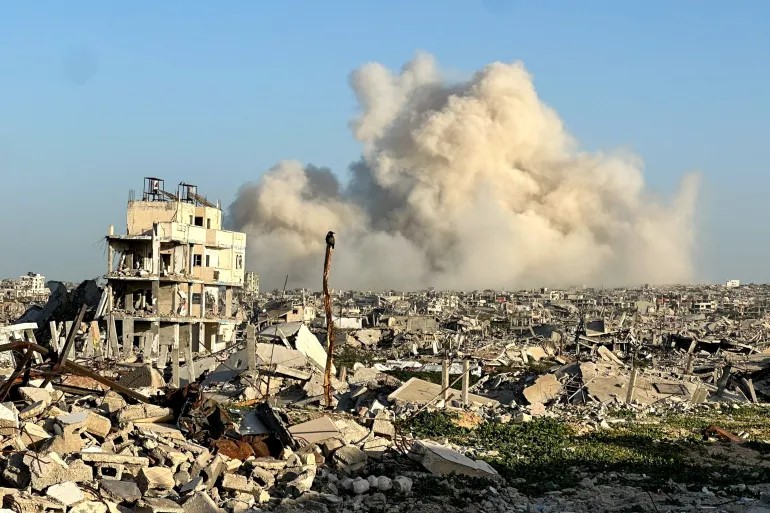
In Gaza, Israel retains control of over half the territory following an October ceasefire with Hamas that envisages the withdrawal of Israeli forces and disarmament of Hamas — terms that appear unlikely to be realised in the near future.
“We have established security belts deep beyond our borders,” Israeli Prime Minister Benjamin Netanyahu said in a video message released on March 31.
“In Gaza — more than half of the Strip’s territory. In Syria, from the Mount Hermon summit until the Yarmuch River. In Lebanon — a vast buffer zone that thwarts the threat of invasion and keeps anti‑tank fire a distance away from our communities.”
The detailed Lebanese buffer zone plan has not yet been presented to Netanyahu’s cabinet, officials said. The Israeli military referred inquiries on the matter to the prime minister’s office, which did not immediately respond to requests for comment.
Israel has long held territory beyond its borders, including the occupied West Bank and Gaza, and the Golan Heights in southern Syria — the latter annexed in 1981.
Hundreds of thousands of Israeli settlers now live in the West Bank alongside about three million Palestinians, who regard the territory as central to aspirations for a future state.
To many displaced Lebanese and Palestinian people, the destruction of villages and seizure of land is seen as territorial expansion.
This perception has been fuelled by comments from far‑right figures in Netanyahu’s government.
Finance Minister Bezalel Smotrich said in March that Israel should extend its border to the Litani River and has made similar remarks about annexing and settling Gaza.
However, another senior military official said the Litani would not become a new official border. Instead, the buffer zone would be monitored by ground troops conducting raids as needed without permanently holding positions along the river.
Israeli Defence Minister Israel Katz likened the devastation in southern Lebanon to the “scorched‑earth” operations used against Hamas in Gaza that saw entire cities depopulated.
“The village homes adjacent to the border, which serve as Hezbollah outposts for all intents and purposes, will be destroyed according to the Rafah and Khan Younis model in Gaza, to remove the threat from Israeli towns,” he said on March 31.
International law experts have criticised the sweeping destruction of civilian property. Eran Shamir‑Borer of the Israel Democracy Institute said that such devastation is largely unlawful unless based on individual analysis of military necessity.
“Sweeping destruction of houses in southern Lebanon that is not based on individual analysis would be unlawful,” he said.
Public scepticism in Israel about long‑term peace deals with neighbours has grown after decades of failed negotiations with the Palestinians, Lebanon and Syria.
Polls indicate a low level of belief among Israelis that peaceful coexistence with a future Palestinian state is achievable, and that any current ceasefire will bring lasting calm.
Ofer Shelah, research programme director at the Tel Aviv‑based Institute for National Security Studies, said that without a negotiated settlement with Lebanon, having a buffer zone in the north could prevent attacks or ground incursions by Hezbollah, but warned that the manpower required to patrol multiple fronts could strain the Israeli military over time.
“We would be better off eventually going back to the international border and maintaining a mobile active defence beyond the border, without having outposts there,” he said. - April 9, 2026