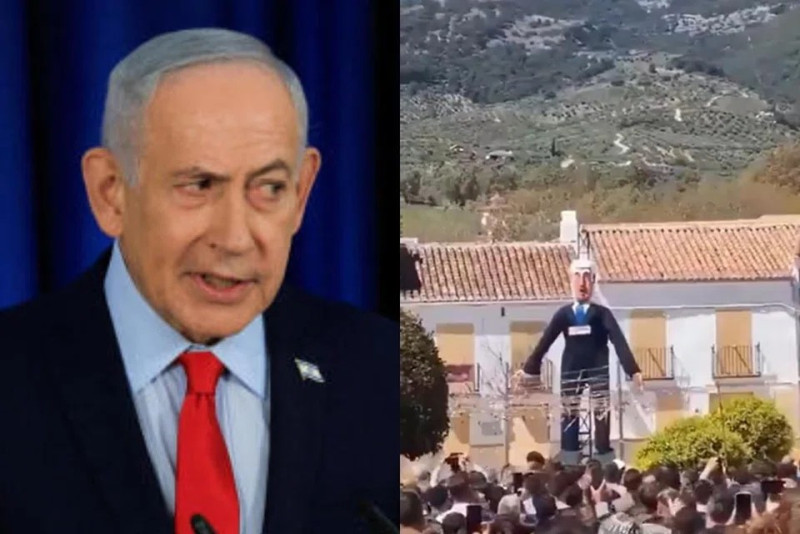
RELATIONS between Spain and Israel have come under renewed strain after Israeli authorities condemned the burning of an effigy resembling Benjamin Netanyahu during a traditional festival, an incident that has fed into broader tensions linked to the war in Gaza.
Reuters cited today Israel’s Foreign Ministry denouncing the act as indicative of “worrying antisemitic hatred” and drew a direct line between the episode and political rhetoric from the Spanish government led by Pedro Sánchez.
The diplomatic response included summoning Spain’s representative in Israel for a formal reprimand, with officials describing the display as unacceptable.
Madrid rejected the accusation, insisting it remains firmly committed to opposing all forms of hatred and discrimination, including antisemitism, and distancing itself from the local event.
The incident took place in El Burgo, where municipal authorities defended the burning as part of the long-established “Burning of Judas” tradition.
The town’s mayor, María Dolores Narváez, said the seven-metre effigy was packed with explosives before being set alight during festivities on 5 April, in keeping with customary practice.
She added that previous editions had featured figures such as Donald Trump, emphasising that the effigies are symbolic and not directed at any one group.
The dispute unfolds against a backdrop of increasingly fraught ties between the two countries, as developments across the Middle East, including Israel’s posture towards Iran and Lebanon, continue to reverberate through European diplomacy.
In a separate but related expression of dissent, events in Vienna have drawn attention to growing divisions within European societies over the Gaza conflict.
Mia Sol Stoelen, an activist of Israeli and Norwegian heritage based in Norway, burned her Israeli passport in protest, later saying her views had evolved significantly following time spent in the region.
Having lived for seven years in Tel Aviv, she said she initially believed coexistence was largely harmonious, but that perception shifted after visiting the West Bank.
“I realised I had profoundly misunderstood the reality. Visiting the West Bank opened my eyes to what is happening,” she said.
She cited entrenched tensions, including the 1995 killings carried out by Baruch Goldstein at the Ibrahimi Mosque in Hebron, as emblematic of a longer history of violence.
Stoelen also described restrictions in Hebron, alleging that certain areas remain off-limits to Palestinians, including main roads reserved for Israelis and foreign visitors.
Reflecting on Israel’s internal dynamics before the 7 October attacks, she said weekly mass demonstrations against the government had already exposed deep societal divisions.
She further linked those divisions to the assassination of former prime minister Yitzhak Rabin, arguing that it marked a turning point in the country’s social and political trajectory.
“Many intellectuals left the country, and this has changed the composition of society,” she said. “Those arriving now tend to lean towards more extreme ideologies, creating an increasingly divided society.”
Stoelen went on to characterise Israel as a “proxy” of the United States, alleging that reliance on American military and financial support contributes to instability across the Middle East.
She said she had received threats, including death threats from unidentified individuals, after sharing footage of the passport burning online, and criticised Norwegian authorities for what she described as an insufficient response.
She also accused Norway of holding economic interests linked to companies associated with the conflict.
Turning to international coverage, she argued that Palestinians are often portrayed unfairly and urged Western governments to reconsider their approach.
“The Western world must reflect on how this situation has been allowed to happen and continue,” she said. - April 12, 2026