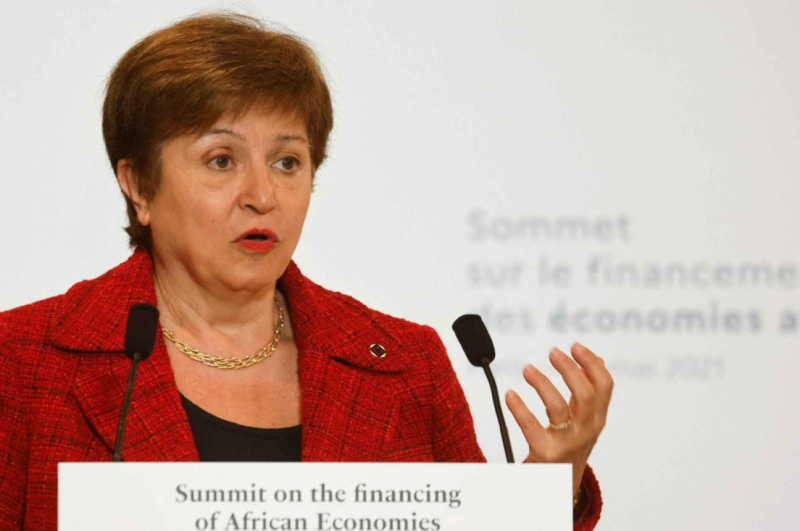
THE world must abandon any expectation of a return to long-term stability and instead build economies capable of withstanding increasingly frequent crises, according to International Monetary Fund Managing Director Kristalina Georgieva.
Speaking on Bloomberg’s Leaders with Francine Lacqua podcast, Georgieva said recent years had demonstrated that global shocks are no longer exceptional events but an enduring feature of the international economic landscape.
“I am worried that we are not completely internalising yet that this is how the world is going to be,” Georgieva said. “We are not going to get to a place where shocks are gone.”
Her warning comes after a succession of major disruptions that have tested the resilience of economies worldwide, including the Covid-19 pandemic, the war in Ukraine, global trade tensions arising from tariff disputes and the ongoing conflict in the Middle East.
Since assuming leadership of the Washington-based IMF in 2019, Georgieva has overseen the institution through some of the most turbulent years in modern economic history. The fund, which has a lending capacity of nearly US$1 trillion, serves 191 member countries and plays a central role in safeguarding global financial stability.
Reflecting on the IMF’s role during periods of uncertainty, Georgieva stressed that evidence-based policymaking remains the institution’s most valuable tool.
“The best ammunition we have is objective analysis,” she said.
Beyond immediate geopolitical and economic risks, Georgieva highlighted the rapid expansion of artificial intelligence as one of the most significant structural transformations facing the global economy.
She acknowledged that international institutions, including the IMF, underestimated the social and economic consequences of globalisation for many communities, despite its overall contribution to economic growth.
“We collectively, including the fund, did not appreciate the backlash against globalisation that came from the fact that, yes, the world economy is doing better as a whole, but many communities were hollowed out because their jobs disappeared and there was not enough attention to them,” she said.
Warning against repeating those mistakes, Georgieva said policymakers must ensure that the rise of artificial intelligence does not deepen inequality or leave sections of society behind.
“I’ll tell you what I’m very keen not to see repeated is the same with artificial intelligence.”
Her remarks come as governments, businesses and international organisations grapple with the implications of AI-driven automation on employment, productivity and long-term economic competitiveness.
The IMF is expected to publish an updated assessment of global economic prospects in July, following its decision in April to lower growth forecasts amid heightened uncertainty linked to conflict in the Middle East and broader geopolitical tensions.
Georgieva’s message signals a growing consensus among international policymakers that resilience, adaptability and inclusive growth will be critical to navigating an era increasingly shaped by economic disruption, technological transformation and geopolitical instability. - June 8, 2026