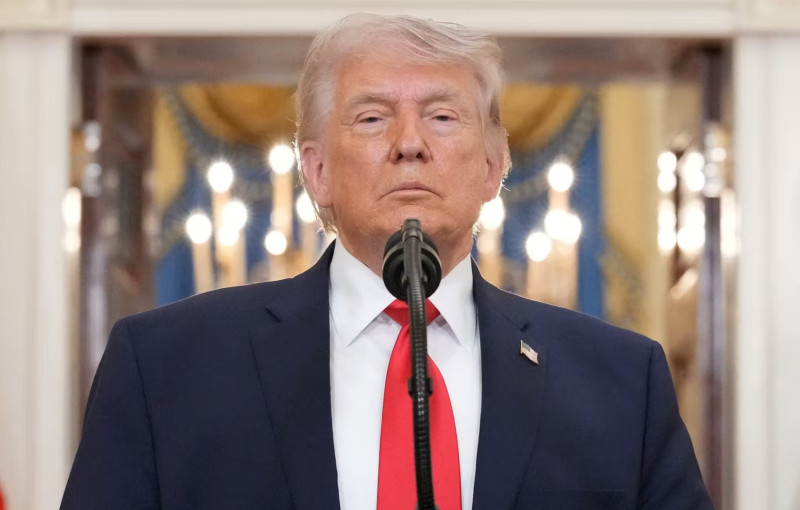
UNITED States President Donald Trump has claimed that a breakthrough agreement with Iran is close after announcing he had called off planned military strikes, presenting the development as a major step towards ending months of conflict that has destabilised the Middle East and rattled global energy markets.
Speaking in the Oval Office on Thursday, Trump told reporters: "We just made a great settlement of the war with Iran."
The BBC reported today that the remarks came despite Iran rejecting suggestions that a final accord had been reached. Iranian Foreign Ministry spokesperson Esmail Baghaei described reports of a completed agreement as "speculative" and stressed that "nothing has been finalised".
Trump nevertheless expressed confidence that negotiations were nearing completion, saying the central objective of preventing Iran from obtaining nuclear weapons had effectively been secured.
"We have a deal that Iran will never have a nuclear weapon, which was the whole purpose of what we had to go through to get this. So, it's a very big thing," he said.
According to Trump, a formal signing ceremony could take place in Europe once the remaining documents are completed.
There will "probably be a signing, maybe in Europe" once the documents are finalised, he said, adding that it should be completed "pretty quickly".
"The documents are in 'pretty final shape - so we'll see'."
Trump further suggested that the strategically vital Strait of Hormuz, effectively closed by Iran following the outbreak of conflict, would reopen rapidly once an agreement is signed.
The US President also revealed that he had consulted regional leaders, including Israeli Prime Minister Benjamin Netanyahu and key Gulf allies, claiming broad support for the proposed arrangement.
"The whole Middle East is very happy," Trump said.
The Israeli Prime Minister's Office confirmed that Netanyahu had spoken with Trump but stressed that Israel was not directly involved in the proposed memorandum of understanding.
In a statement, Israel said Netanyahu welcomed Trump's efforts to secure a final settlement that would include "the removal of enriched material, the dismantling of enrichment infrastructure, limits on missile production, and the cessation of Iran's support for its terrorist proxies in the region".
While acknowledging that much of the memorandum's text had been completed, Baghaei indicated that significant obstacles remained.
He said most of the document had already been "finalised", but accused Washington of introducing "excessive demands" and additional conditions at a late stage.
Baghaei also reiterated that Iran would not "depart from its red lines".
The contrasting statements emerged only hours after Trump had adopted a markedly more confrontational tone, warning that "the United States will be hitting Iran... very hard tonight" and threatening future action against Iranian energy infrastructure, including the strategically critical Kharg Island export terminal.
Located in the northern Gulf, Kharg Island handles approximately 90 per cent of Iran's oil exports and is regarded as the backbone of the country's energy trade.
Trump also declared that the United States would "assume total control" over regional oil and gas markets, adding that this would occur "much like we have with Venezuela".
Iran responded with warnings of severe retaliation should additional attacks occur.
In a statement, Iran's military declared: "Considering recent US threats against Iran's oil infrastructure, either oil and gas exports are for everyone or they will be available for no-one."
Iranian negotiator Mohammad Bagher Ghalibaf also cautioned Washington against escalating the conflict.
"Wrong strategies and impulsive decisions will... create an endless quagmire that you will be stuck in for years," he said.
The latest diplomatic manoeuvring follows a sharp escalation in military activity after a US Apache helicopter crashed in the Gulf earlier this week.
On Wednesday, US Central Command announced a new wave of strikes targeting military, surveillance and radar facilities in southern Iran.
Iran responded through its Islamic Revolutionary Guard Corps, which said it launched attacks against American military installations in Bahrain, Kuwait and Jordan.
Authorities in Bahrain reported that an 11-year-old girl was injured after an Iranian drone strike damaged homes and vehicles. Jordanian officials said approximately 20 Iranian missiles were intercepted, while Kuwait confirmed its forces had engaged multiple "hostile aerial targets".
The wider conflict has also drawn international concern after three Indian sailors were killed when a US strike hit a vessel in the Gulf of Oman. New Delhi summoned a senior American diplomat following confirmation of the deaths.
The incident occurred amid an expanding US maritime blockade designed to restrict access to Iranian ports and curb Tehran's oil-export revenues. According to reports, US forces have engaged nine vessels since the campaign began, including three during the current week.
Despite Trump's optimism, the continued exchange of military strikes and competing demands at the negotiating table underscore the fragility of any potential settlement.
The latest developments prompted renewed international appeals for restraint, with the United Nations warning that the region remains dangerously close to a broader crisis.
A spokesperson for UN Secretary-General António Guterres said he was "deeply concerned by the continuing escalation in the Middle East".
"He urges the parties to return to the full implementation of the ceasefire and avoid any further deterioration."
Calls for de-escalation were also issued by Pakistan, Russia, China, Turkey, India and Saudi Arabia, as diplomatic efforts intensified to prevent the conflict from spiralling into a prolonged regional confrontation. - June 12, 2026