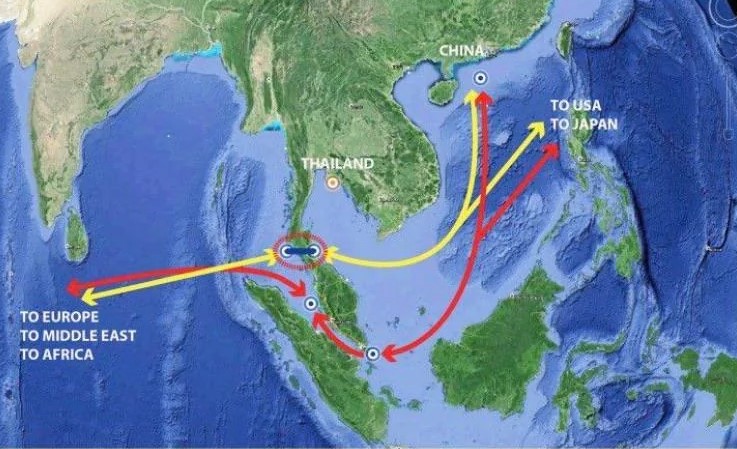
THAILAND’S proposed one trillion-baht logistics corridor is facing escalating domestic resistance and regulatory roadblocks, complicating government efforts to present the project as a viable alternative to the heavily congested Strait of Melaka.
The massive trans-shipment initiative, which seeks to connect new deep-sea ports in Chumphon and Ranong via a ninety-kilometre rail and highway network, was recently resuscitated by Prime Minister Anutin Charnvirakul.
Reuters reported on Thursday that the move followed geopolitical disruptions in the Middle East and the closure of the Hormuz Strait, which underscored global vulnerabilities regarding maritime chokepoints.
However, a comprehensive review of government documents and extensive interviews with residents and planning experts reveal deep structural friction, capped by a recent regulatory order mandating an entirely new Environmental and Health Impact Assessment due to stark discrepancies in marine life density data.
For the artisanal fishing communities along the western Andaman coast, the mega-project represents an existential threat to their traditional way of life.
Chaiyaporn Arunrasamee, a fifty-year-old fisherman, expressed his deep anxieties while tending to his equipment in the small island hamlet of Baan Hat Sai Dam.
“Personally, I don't want it to happen at all, Chaiyaporn said of the project. This thing will be located in the area where we make our living. Where will we go?”
Beyond the coastal fishing sectors, the proposed land bridge directly intersects highly profitable agricultural hubs in the fertile Phato district.
Local entrepreneurs question the necessity of top-down industrialisation when existing green economies are already thriving independently.
“My hometown's durian industry alone generates around 10 billion baht a year without needing to build anything new,” said 30-year-old coffee entrepreneur Chalermchart Seekhiao. People need to understand: this isn't an empty wasteland.”
Independent researchers point out that while the modern iteration of the scheme excludes controversial petrochemical complexes and oil refineries to minimise public backlash, the underlying commercial challenges remain unchanged.
“The concept hasn't really changed. What has changed is the packaging, noted Wipawadee Panyangnoi, an independent researcher who specialised in the proposal.
“In the past they openly talked about industrial estates and petrochemicals, which people opposed. Today the project is framed as transport infrastructure and logistics because that language is easier for the public to accept.”
Logistical experts are equally cautious regarding whether international cargo liners will willing bear the significant financial and temporal costs associated with unloading containers, transporting them overland, and reloading them onto waiting vessels.
Eugene Mark, an analyst at Singapores ISEAS-Yusof Ishak Institute, suggested the project might ultimately serve a more localised purpose.
“The land bridge may ultimately...emerge as a modular national security asset aimed at securing local energy routes and boosting Thailand's own western export capabilities,” Mark said.
He added that proving that this double-handling model can genuinely compete with the seamless transit through the Straits of Melaka remains a major hurdle.
Addressing these concerns, Jiraroth Sukolrat, the Director-General of Thailands Office of Transport and Traffic Policy and Planning, clarified that internal government projections indicate a potential 30 per cent reduction in logistics costs for specific feeder segments, particularly ships with a capacity of twelve thousand shipping units or lower.
“We want to capture some of this 80% market, particularly the feeder segment,” Jiraroth explained, referencing the vast volume of trans-shipment cargo that currently passes through regional hubs like Singapore. We are not targeting giant mainline vessels.
Jiraroth maintained that the state would primarily occupy a regulatory and supporting role, leaving the financial burden to external syndicates.
“It has to be a consortium involving shipping lines, port operators, financiers and land developers,” he said, adding, nevertheless, securing major foreign investment introduces significant geopolitical vulnerabilities.
Analysts warn that attracting capital from major regional powers could trigger intense domestic political pushback in Thailand over foreign control.
“Chinese state enterprises are unlikely to commit significant capital unless they secure strong operational leverage, which would trigger intense domestic political pushback in Thailand over foreign control,” Mark stated.
Thailand must navigate a delicate diplomatic balancing act to prevent the corridor from becoming a geopolitical flashpoint.
With a state-appointed review panel set to submit its findings before the end of July, the combination of regulatory delays and unyielding community opposition presents a daunting hurdle for the administration.
“Local opposition alone rarely cancels a top-down mega-project in Thailand, but it acts as a powerful regulatory drag that compounds investor risk,” Mark added. - June 18, 2026