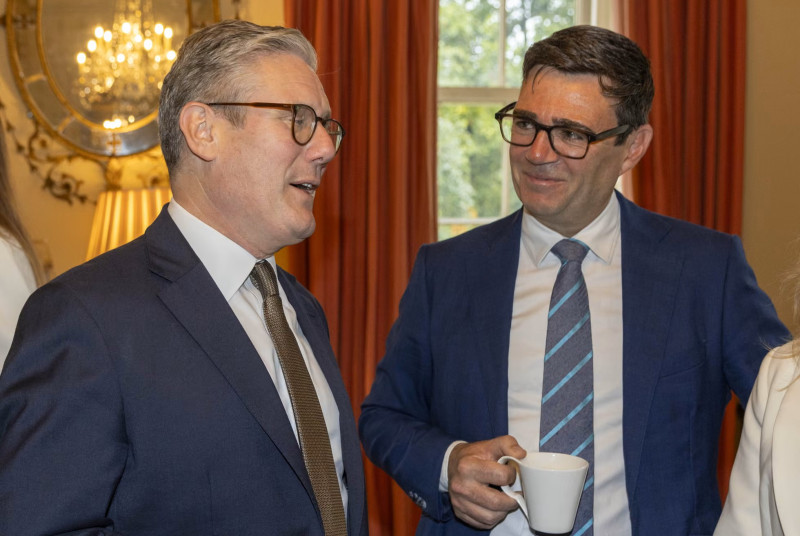
BRITISH Prime Minister Sir Keir Starmer made his final appearance at Prime Minister's Questions (PMQs) on Wednesday, closing his tenure by insisting he was leaving the United Kingdom in a stronger position as he prepares to step down next week following the loss of support within the governing Labour Party.
Starmer, who has led Labour for six years and served as prime minister for the past two, will formally resign on Monday, paving the way for Labour leader-elect Andy Burnham to become Britain's next prime minister without the need for a general election.
Under Britain's parliamentary system, the governing party can replace its leader during a parliamentary term, with the new leader automatically becoming prime minister if the party retains a majority in the House of Commons. The next general election is not due until 2029.
"Every prime minister knows when they take up the torch that the day will come when they have to pass it on," AP reported Starmer telling MPs.
"This is the end of my political journey," he said, adding that he intended to remain in Parliament as a backbench lawmaker.
Starmer's final PMQs struck a more reflective tone than the usually combative weekly exchanges, combining political debate with tributes, humour and bipartisan acknowledgements.
He opened the session by expressing shock over the killing of former lawmaker Ann Widdecombe, describing it as a "chilling" reminder of the dangers facing public representatives after three serving or former MPs were killed during his 11 years in Parliament.
He urged politicians across the political spectrum "to do more to defend our democracy."
Instead of listing official engagements, as is customary at PMQs, Starmer joked that he had "an important appointment with the television" later in the day to watch England face Argentina in the FIFA World Cup semi-final.
Conservative Party leader Kemi Badenoch used the occasion to caution Labour that replacing its leader was "no silver bullet", recalling that Starmer had once predicted she would not survive a year as opposition leader.
"Life comes at you fast," Badenoch said.
Starmer came to power with a landslide victory in the 2024 general election but announced his resignation after Labour suffered heavy losses in May's local elections, amid growing dissatisfaction over the government's economic performance and a series of political controversies.
During his farewell appearance, Starmer defended his government's record, citing stronger protections for workers, measures to reduce child poverty, legislation aimed at preventing official cover-ups following public tragedies, and increased defence spending.
"I am proud to leave this country in better shape than I found it," he said.
He also highlighted his government's foreign policy achievements, particularly rebuilding relations with European allies after Brexit and strengthening international support for Ukraine in its war against Russia.
Opposition leader Badenoch praised Starmer's decision to welcome Ukrainian President Volodymyr Zelenskyy to London after the Ukrainian leader's tense meeting with US President Donald Trump at the White House last year.
Recalling the visit, Starmer said crowds gathered outside Downing Street had warmly welcomed Zelenskyy.
"The moment he got out of the car and hugged me, they cheered from the top of their voices, the British people, to tell President Zelenskyy exactly what they thought of him and the way he had been treated," he said.
Starmer concluded his final appearance by thanking parliamentary colleagues, civil servants, staff and members of the public.
He also addressed his wife, Victoria, and their two teenage children, who watched from the public gallery.
"I love you," he said before ending with a simple, "Goodbye."
Members of Parliament from across the political divide responded with a standing ovation, prompting Speaker Lindsay Hoyle to remind the House that while cheering is permitted, applause remains against Commons rules. - July 16, 2026