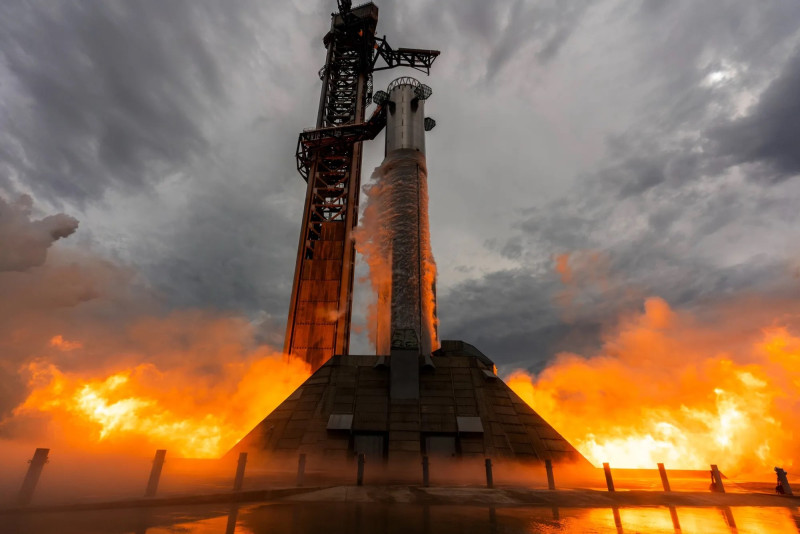
SPACEX’S massive Starship rocket came within seconds of launching on its latest test flight Thursday before an engine ignition failure triggered an automatic abort, sending clouds of smoke and vapour across the launch pad in Texas.
The company’s founder and chief executive officer Elon Musk said two engines would be replaced before the rocket attempts another flight, with the next launch window expected as early as next week.
“We will replace two engines to be confident of a good flight,” Musk said on X.
The upcoming mission would mark the 13th flight of Starship, which stands at 407 feet (124 metres) tall and is powered by 33 main engines, making it the world’s largest and most powerful rocket.
During the launch attempt, SpaceX’s webcast showed engine ignition beginning about three seconds before the scheduled liftoff. However, several engines failed to fire, causing the remaining engines to shut down automatically and keeping the rocket firmly on the launch pad.
On-screen data indicated that four engines did not ignite, although SpaceX did not immediately provide further details on the cause of the failure.
It was the first time a full-scale Starship had experienced a last-second launch abort.
The launch team immediately began draining fuel from the rocket after the abort, while SpaceX’s automated safety systems successfully halted the countdown.
The failed ignition prevented a potentially dangerous launch, as operating with too few engines could have caused the mission to fail. Previous Starship test flights have ended in explosive failures, including mid-air break-ups.
Despite the setback, SpaceX had been preparing for a significant mission. Twenty of the company’s newest Starlink satellites were scheduled to be carried aboard Starship for deployment during the planned hour-long flight.
The mission was also expected to test communications between the new satellites and existing Starlink systems, while capturing images of Starship’s heat shield during re-entry.
Neither the Starship spacecraft nor its Super Heavy booster was intended to be recovered during the flight, with both planned to splash down in the ocean.
Starship remains a crucial component of NASA’s plans to return astronauts to the Moon. The US space agency has selected SpaceX and Jeff Bezos’ Blue Origin to develop lunar landing systems for future Artemis missions.
Both SpaceX’s Starship and Blue Origin’s Blue Moon lander are expected to be ready for upcoming lunar missions, including preparations for Artemis III, which aims to return astronauts to the lunar surface after more than half a century.
The following mission, Artemis IV, planned for no earlier than 2028, is expected to use one of the commercial lunar landers to transport astronauts to the Moon’s south polar region. - July 17, 2026