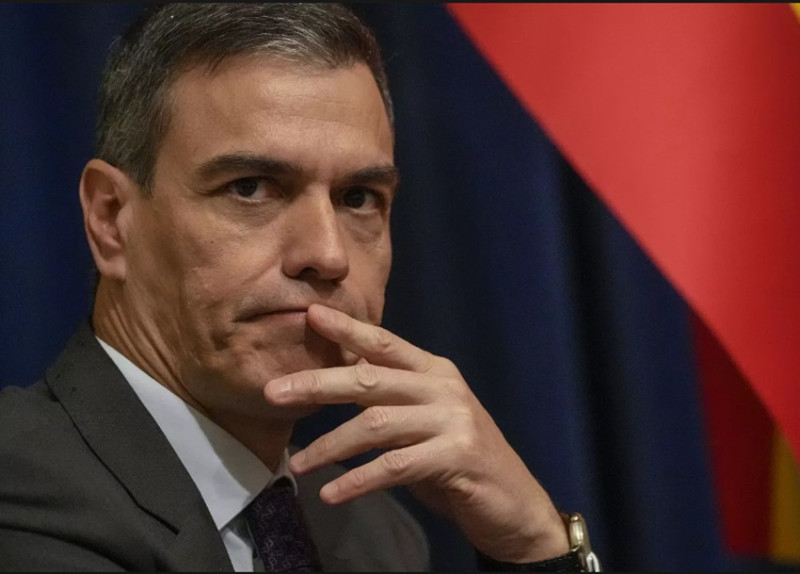
SPAIN has chosen to stand its ground on human rights, warning that attempts to punish those defending international justice risk damaging the very system created to prevent abuses and hold the powerful accountable.
In a strongly worded post on his official Instagram account, Spanish Prime Minister Pedro Sánchez said Spain would not “look the other way” as individuals and institutions committed to upholding international law faced increasing pressure.
“Sanctioning those who defend international justice is putting the entire human rights system at risk,” Sánchez said, adding that the European Union could not remain passive in the face of what he described as persecution.
Madrid is now calling on the European Commission to activate the EU Blocking Statute to protect the independence of the International Criminal Court (ICC) and the United Nations.
The statement comes amid growing scrutiny over the treatment of Francesca Albanese, the United Nations special rapporteur on the situation of human rights in the Palestinian territories, who has faced sustained political attacks and attempts to discredit her work after speaking out on alleged violations of international humanitarian law.
For Albanese, the backlash has become part of a larger struggle over whether international human rights mechanisms can function independently when their findings challenge powerful governments and political interests.
Rather than retreating, Albanese has continued to defend her mandate, arguing that the responsibility of a UN rights official is to document and speak on violations regardless of who may be implicated.
Her treatment has raised uncomfortable questions: if those tasked with defending international law can themselves be targeted for doing their work, what does that mean for the credibility of the global rights system?
Spain’s response reflects a growing concern among some governments and human rights advocates that international institutions are facing a credibility crisis — not because they have failed to act, but because those attempting to enforce accountability are increasingly becoming targets themselves.
The issue also represents a troubling sign of how pressure can be applied against those who challenge powerful interests.
The freezing of accounts and actions that have made life increasingly difficult for individuals such as Albanese raises concerns over whether institutions are being used to intimidate those who continue carrying out their responsibilities without fear or favour.
Reflecting on the broader implications, Datuk Vinod Sekhar, the publisher of The Vibes and Chairman of the Petra Group, warned that when institutions meant to uphold principles begin bending to political pressure or selective application of rules, the consequences extend far beyond individual cases.
It risks weakening public trust and undermining the very foundations of accountability and justice.
At stake is not only one UN official or one international court, but whether the world’s human rights architecture can survive when accountability becomes politically inconvenient.
Spain’s decision to openly defend the independence of the ICC and the United Nations places it among countries arguing that international law cannot operate on a selective basis — applied firmly in some cases while ignored in others.
As conflicts continue to expose divisions within the international community, Sánchez’s warning carries a broader message: defending human rights cannot only be convenient when it aligns with political interests.
For Spain, silence is no longer an option. And for critics of the current global order, the growing pressure on figures like Albanese represents a troubling sign of a system under strain. – July 17, 2026