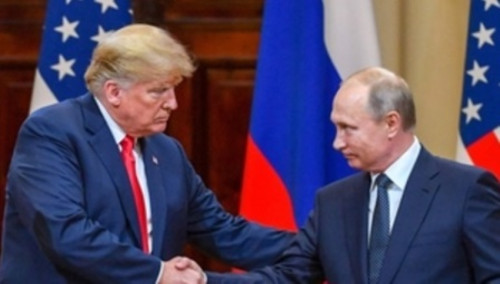
US President Donald Trump has paused the United States' military campaign against Iran, opening a potential diplomatic window after nearly two weeks of sustained airstrikes, as Tehran signalled it would suspend its retaliatory operations provided Washington refrains from further attacks.
The halt follows 13 consecutive nights of U.S. bombardment, with no strikes reported since late Friday. Iran, which had responded to each round of U.S. attacks by targeting neighbouring countries hosting American military bases, has likewise held back its operations for the past two days.
Reuters cited a senior Iranian official, speaking on condition of anonymity, sayingTehran's position remained unchanged and directly linked to U.S. actions.
"Our position remains ‘attack for attack’: if the attacks stop, Iran will also halt its operations. That message has already been conveyed to the United States."
The temporary suspension comes as the Trump administration seeks to create room for diplomacy while weighing military assessments that the campaign has become increasingly difficult to sustain.
U.S. Ambassador to the United Nations Mike Waltz said Trump had deliberately ordered the pause to allow negotiations an opportunity to progress.
"He's giving talks some space, he's giving it a little bit of room," Waltz said, without elaborating.
According to a U.S. official familiar with the matter, military planners advised that the intensive bombing campaign had largely exhausted the list of pre-selected targets intended to counter Iranian threats to shipping through the Strait of Hormuz.
The official, speaking anonymously, said General Dan Caine, Chairman of the Joint Chiefs of Staff, had privately warned Trump that restarting major combat operations would carry additional risks, particularly because of mounting pressure on U.S. munitions inventories.
The concerns include declining stocks of interceptor missiles used by U.S. air defence systems deployed across the Middle East.
Neither Caine's office nor U.S. Central Command commented, in line with the longstanding practice of withholding details of confidential military advice provided to a sitting president.
Speaking on NBC's "Meet the Press", Waltz insisted the U.S. military remained fully capable of carrying out its missions.
"The U.S. military has everything that it needs," he said, adding that Defence Secretary Pete Hegseth had "inherited a depleted situation" when the Trump administration took office.
Despite the lull in hostilities, Tehran remains unconvinced that Washington's move represents a genuine shift in policy.
Another senior Iranian source told Reuters the leadership viewed the pause with caution rather than confidence.
"There is more scepticism than optimism about the halt in attacks. The prevailing view is that the pause is tactical rather than genuine. Iran has accumulated enough bitter experience with what it sees as U.S. deception," the source said.
For the past fortnight, Washington has maintained that its nightly strikes were launched in response to Iranian actions threatening maritime traffic in the Strait of Hormuz, through which around one-fifth of global oil shipments passed before the conflict escalated.
Iran has retaliated by striking water desalination facilities in neighbouring Gulf Arab states while insisting it intends to retain control of the strategically important waterway.
The renewed U.S. military offensive also effectively derailed last month's interim agreement aimed at ending the conflict.
Several U.S. media outlets reported that Trump's decision followed a high-level meeting on Friday during which senior military and political advisers questioned the value of continuing the bombing campaign.
CNN reported that Vice President JD Vance had voiced reservations, while Axios said Admiral Brad Cooper, commander of U.S. forces in the Middle East, recommended halting the operation after concluding it had reached the limits of its military effectiveness.
Meanwhile, uncertainty continues to weigh heavily on ordinary Iranians.
Nader, a 49-year-old import-export businessman in Tehran, said the temporary cessation of attacks had done little to reassure the public.
"Everyone in the country is stuck in limbo," he told Reuters by telephone. "Trump is playing games with Iran. He neither ends the war and leaves the region nor strikes decisively. It's exhausting." - July 27, 2026