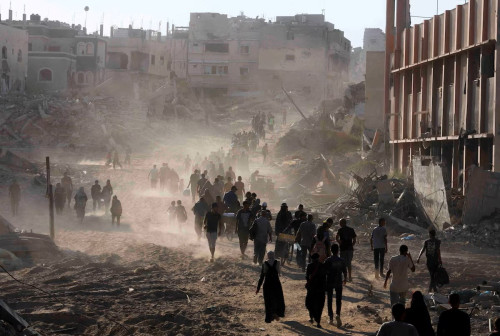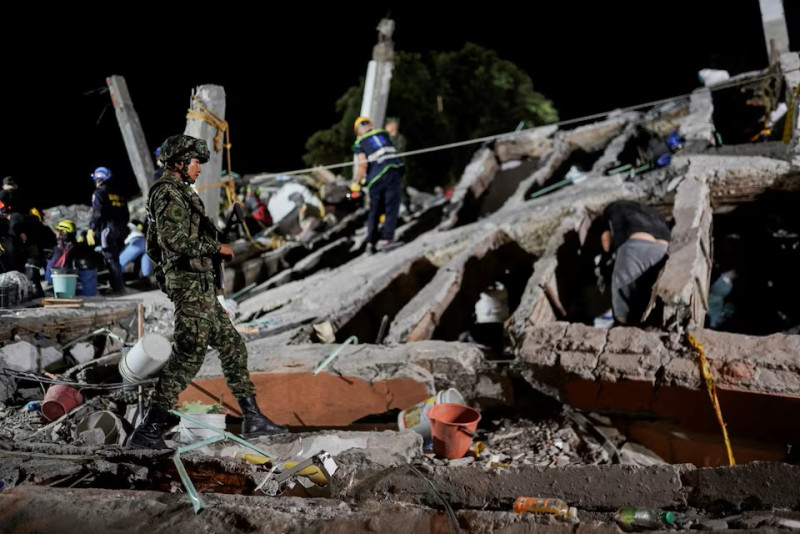
RESCUE crews dug through mountains of rubble in western Colombia on Tuesday, repeatedly calling for silence so they could listen for survivors trapped beneath buildings brought down by the country’s most devastating earthquake this century.
The magnitude 7.4 earthquake struck early Monday in Colombia’s coffee-growing heartland, killing at least 254 people, according to separate reports from affected cities, with 101 deaths recorded in Pereira and 95 in Cali, the country’s third-largest city.
The death toll is expected to rise as rescuers reach areas cut off by damaged roads and communications.
Reuters reported that the violent shaking left apartment blocks, homes, schools and health centres cracked, tilted or completely flattened, while hospitals and animal shelters were also damaged.
In Pereira and Cali, rescue workers operated through the night and into Tuesday using cranes and excavators, while volunteers formed human chains and passed buckets of debris hand-to-hand as they searched for people still trapped.
In one of the most emotional moments of the rescue operation, crowds in Cali cheered as workers pulled a woman alive from the rubble of the destroyed Torres del Limonar apartment complex and carried her away on a stretcher.
But the scale of the destruction was overwhelming.
Thousands of people were left homeless after apartment complexes collapsed and homes developed deep structural cracks, forcing families to spend the night outside while awaiting safety assessments.
Alberto Machado, 34, said the earthquake destroyed his home in Cali shortly after he dropped his son at school. His wife, mother-in-law and two young children spent the night at a neighbour’s house, uncertain about what they would do next.
A sports centre in the city prepared to shelter about 60 people overnight, including 30 elderly residents evacuated from a damaged nursing home.
Dog and cat shelters also appealed for food, medicine and volunteers as they struggled to cope with the aftermath.
In Pereira, Rosa Gonzalez said she narrowly escaped the guest house she ran with her husband and 10-month-old baby.
“The structure started creaking and just as we ran outside the building collapsed,” she said, stroking her cat, which was rescued during the night.
Eight people escaped alive, but an elderly man remained trapped on a terrace, and Gonzalez feared he could be among those killed.
Social media influencer Jose Gallego was at Pereira airport when the earthquake struck and recorded footage of the violent shaking as he sheltered beneath a table while sections of the ceiling fell.
“There were people injured, bleeding, screaming and trying to reach their families,” he said.
More than 100 aftershocks had been recorded by Tuesday afternoon, prompting many survivors to remain outdoors rather than return to damaged homes.
“I crossed the city on foot; it took two hours and the scenes were devastating,” Gallego told Reuters. “It was like a nightmare come to life.”
The destruction extended beyond Colombia’s main cities.
Many Indigenous communities in the forested Pacific-facing department of Choco, close to the earthquake’s epicentre, remained without electricity or basic services, complicating rescue and relief operations.
Andres Caicedo, a community leader in Sipi, a remote woodland community that is an 11-hour road and river journey from the departmental capital, said residents were struggling to obtain basic assistance.
“We're going up trees for scraps of internet connection,” Caicedo told Caracol TV. “We have children and older people who still haven't gotten over the shock ... We don't have a health center or medical supplies, we've done what we can with our own hands.”
By Tuesday afternoon, three airports remained closed, while several areas, particularly Choco, were still without reliable access to gas, water and electricity. Major highways were also blocked.
The National Coffee Federation was working with affected families to assess damage to farms and rural infrastructure, its chief German Bahamon said on social media.
The disaster comes just days after new President Abelardo De La Espriella took office. He travelled to affected areas and pledged economic support for people who had lost their homes.
However, the government’s handling of information about the disaster has drawn criticism. Although De La Espriella gave a national death toll around midday Monday, government agencies were reportedly instructed not to release their own figures, leaving conflicting estimates and confusion over the number of fatalities.
Cali’s public health secretary, German Escobar, said the city’s morgue was full and authorities were recovering bodies from the streets.
Cali Mayor Alejandro Eder, one of several officials to impose overnight curfews backed by security forces to prevent looting, was confronted by residents in a badly affected neighbourhood, according to footage circulating on social media.
With communications still unreliable in some of the hardest-hit areas, officials warned that it could take several days to establish the full scale of the destruction and determine the final death toll.
For rescuers still working among the ruins, the immediate priority remained finding anyone who might still be alive. - August 12, 2026