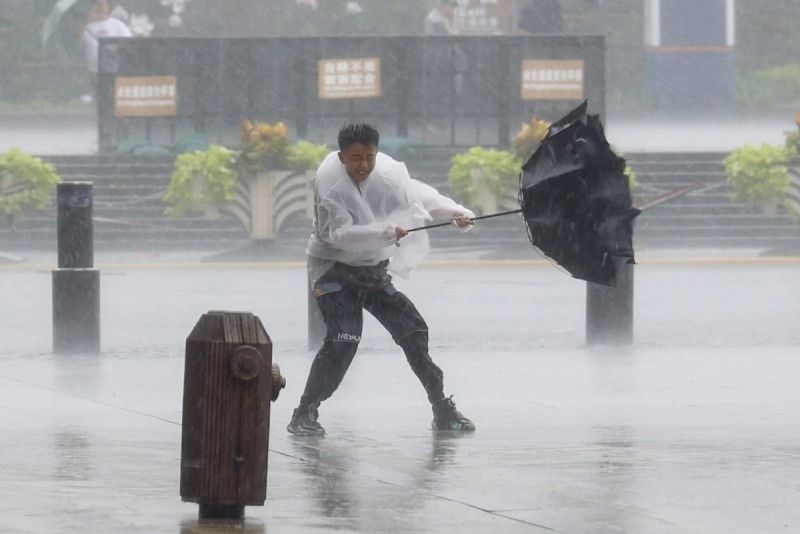
REMNANTS of China’s strongest typhoon this year brought intense rainfall to Beijing and large parts of the country on Wednesday, flooding major roads, stranding vehicles and forcing authorities to suspend hundreds of bus services as the capital braced for further downpours.
Beijing issued its second-highest rainstorm warning, suspending 250 bus routes and closing 150 tourist attractions, while 10 subway lines operated at reduced speeds, state news agency Xinhua reported.
The heavy rain transformed a multi-lane road in the capital into a virtual river, bringing traffic to a standstill as cars and buses became partially submerged, according to video footage circulating on Chinese social media.
Beijing’s northern Changping district recorded the highest hourly rainfall on Wednesday, receiving 90.7 mm (3.6 inches) within an hour after 9am, authorities said.
The storm has weakened after travelling about 6,000 km (3,700 miles) before making landfall on Sunday in the eastern province of Zhejiang. Its remnants, however, continue to draw tropical moisture deep into the mainland, raising the risk of flooding across northern and central regions.
In the coastal city of Yuhuan in Zhejiang, heavy rain submerged nearby streets, while scores of vehicles crowded onto a bridge that remained above the rising floodwaters. Almost 200 mm (8 inches) of rain fell in the area, according to social media footage verified by Reuters.
Rainfall records were also broken in parts of Zhejiang and the central provinces of Henan and Hubei this week.
The city of Wugang recorded 209.5 mm (8.2 inches) of rain in a single day, breaking its August rainfall record, while Xiangyang received 169.1 mm (6.6 inches).
Residents across northern and central China were warned to prepare for several more days of heavy rain as the storm’s vast rain bands continued to move inland.
The extreme weather comes as China faces increasingly destructive storms and rainfall events that scientists have linked to climate change, with an emerging El Niño pattern contributing to higher temperatures and potentially more frequent and intense typhoons.
Extreme rainfall already causes billions of dollars in economic losses in China each year, disrupting manufacturing, damaging infrastructure and destroying crops.
Chinese meteorologists are increasingly turning to artificial intelligence-powered weather models alongside conventional forecasting systems in an effort to improve warnings and strengthen the country’s ability to cope with increasingly severe weather. - August 12, 2026