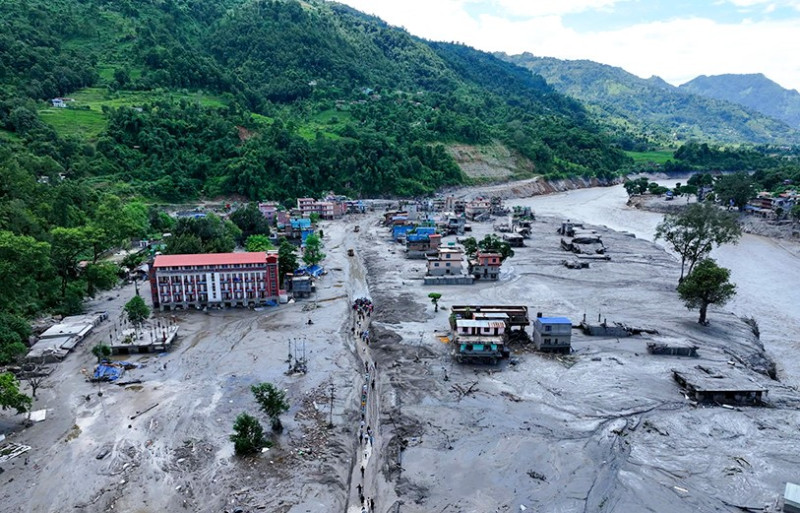
DEVASTATING floods in Nepal have left communities in Rasuwa and Nuwakot struggling to access medical care after roads and bridges linking remote settlements to better-equipped hospitals were swept away.
For eight-year-old Milan Raila, the consequences were life-threatening.
Three days after the Aug 26 Bhotekoshi floods destroyed his home and the entire settlement of Kaindaletar in Uttargaya Rural Municipality, Milan woke at 4am with severe abdominal pain.
His family, which had been sheltering at a relative’s home, rushed him by motorbike to the primary health centre in Jibjibe, about 20km away.
“We rushed him to the primary health care centre at Jibjibe,” The Kathmandu Post cited Bishal Raila, Milan’s relative saying. “But the doctors there could not figure out what was wrong with him.”
Doctors referred Milan to Rasuwa District Hospital in Dhunche, where tests confirmed that he had appendicitis, a potentially life-threatening condition if treatment is delayed.
However, doctors at the hospital were reluctant to operate because most were junior physicians and the facility lacked the equipment needed for major surgery.
“We kept him at the hospital for two days because there was no ambulance available to take him to Kathmandu,” Bishal said. “The access road is narrow, and only a single-lane track has been opened. With the help of a ruling-party leader, we managed to arrange a helicopter rescue.”
Milan was eventually airlifted to Kanti Children’s Hospital in Kathmandu, where doctors found that his appendix had ruptured. He underwent surgery and was discharged on Sunday.
“The risk increases when it takes days for a patient with appendicitis to reach an appropriate facility for treatment,” said Dr Amrit Prajapati, medical superintendent at Dhunche Hospital. “We cannot perform the surgery under general anaesthesia, so we referred him to Kathmandu.”
Before the floods devastated communities along the Trishuli river basin, residents generally travelled to Trishuli Hospital for treatment because it was better equipped, had trained doctors and health workers, and was more accessible.
Kaindaletar was previously only about 10 minutes by road from Trishuli District Hospital. It now requires a helicopter to reach the facility.
Seriously ill patients are being forced to spend hours travelling to Kathmandu, while those with less severe conditions are often left to cope at home.
On Monday, 29-year-old Phurpuyamo Tamang from Gatlang in Rasuwa and her newborn baby were also airlifted to Kathmandu after both developed health problems following childbirth.
The mother had delivered at Gatlang Health Post, but Aamachhodingmo Rural Municipality has been completely cut off from the road network, making an immediate road transfer impossible. Both were flown to Paropakar Maternity and Women’s Hospital for further treatment.
Another resident, Pasang Mhando Tamang of Thulo Haku, has also fallen ill since her 21-year-old son went missing in the floods. She has repeatedly lost consciousness and needs treatment in Kathmandu, but the destruction of the road linking the area to the district headquarters has left her stranded in the village.
Doctors at Rasuwa District Hospital said residents of Kalika and Uttargaya rural municipalities rarely sought treatment there before the floods because Trishuli Hospital in neighbouring Nuwakot was closer and more convenient.
Patients could also reach Kathmandu within two to three hours if they required specialist treatment.
Now, the journey to Nuwakot can take more than five hours, while the road to Trishuli Hospital itself has been damaged by the floods.
“Before the flood, most patients from Rasuwa, Nuwakot and parts of Dhading used to seek treatment at our hospital,” said Dr Rajendra Lama, director of Trishuli Hospital. “But now, even patients from the district headquarters are unable to come to our hospital.”
Doctors have also raised concerns over pregnant women being unable to attend antenatal appointments, while some women in labour may have been forced to deliver at home.
Health experts have warned that increased home deliveries can raise the risk of maternal and neonatal deaths.
The hospital administration said all health services disrupted by the floods have since resumed, but patient numbers have fallen sharply.
Dr Lama warned that the decline should not be interpreted as an improvement in public health.
“If patients do not receive timely treatment, their health problems will become more serious,” he said.
The Bagmati provincial Ministry of Health and Social Development said discussions were under way to increase staffing at Dhunche Hospital and Trishuli Hospital following the disaster.
However, the ministry recently could not send a paediatrician to Dhunche Hospital because there is no sanctioned post for the position.
Dinesh Rupakheti, the ministry’s information officer, said doctors working under scholarships or on contract could be deployed if patient numbers increased, but creating new sanctioned positions was not currently possible.
He said additional doctors alone would not resolve the problem.
“So many things including equipment are also required to provide the services,” Rupakheti said.
The floods have therefore left communities facing a second crisis beyond the destruction of homes and infrastructure: access to timely medical care, particularly for patients requiring surgery, specialist treatment, maternity care and emergency intervention. - September 9, 2026