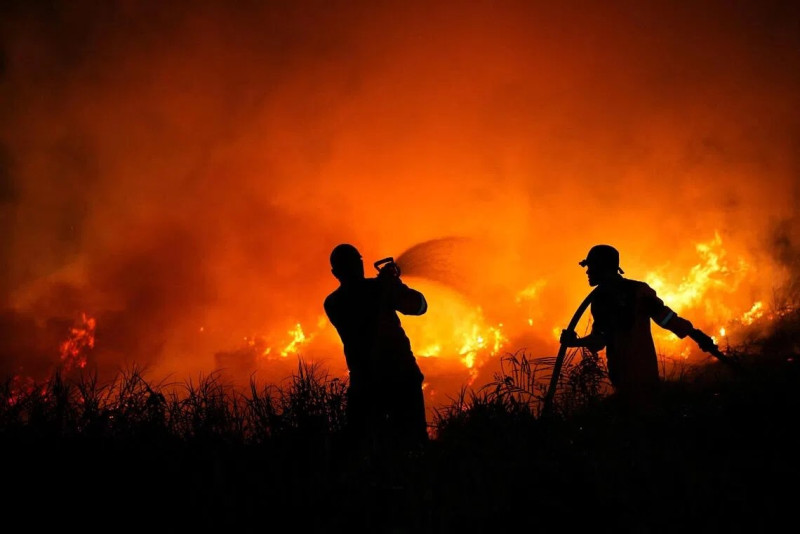
HUMAN activity remains the main driver of Indonesia’s forest and land fires, authorities say, as more than 200,000 hectares were burned between January and July and smoke from fires in Sumatra and Kalimantan continued to pose a cross-border haze threat.
The area burned in the first seven months of 2026 was 69 per cent higher than during the same period last year, according to a Channel NewsAsia (CNA) report.
While hot and dry conditions linked to the El Nino phenomenon have made vegetation more vulnerable to burning, Head of Indonesia’s National Disaster Management Agency (BNPB), Suharyanto, said human activity remained the main cause of fires.
He said land clearing for agriculture, open burning of rubbish and the use of fire to prepare agricultural areas could all trigger fires, particularly during dry and windy conditions.
What begins as a small fire can quickly spread across larger areas, threatening forests, plantations and nearby communities.
The scale of the fires has also heightened concerns over transboundary haze, with smoke affecting air quality in neighbouring countries including Malaysia, Singapore and the Philippines.
More than 22,000 hotspots had been detected across Indonesia as of September 21, with concentrations in several parts of Kalimantan and Sumatra, Suharyanto said.
The authorities are using satellite monitoring to identify hotspots and high-risk areas, while community patrols are being deployed to detect fires and prevent local burning activities from escalating.
Suharyanto said the combination of satellite data and ground-level monitoring was important because technology could identify fire activity from the air while communities had direct knowledge of conditions in affected areas.
Indonesia has also deployed dozens of aircraft for water-bombing operations and weather modification efforts.
“However, aerial operations face challenges such as poor visibility caused by thick smoke and a lack of water sources near fire locations,” Suharyanto said.
“International cooperation is also being carried out to strengthen aerial firefighting capabilities,” he added.
But environmental experts say the focus cannot remain on putting out fires after they have started, as the practices that cause them must also be addressed.
University of Indonesia environmental science expert Mahawan Karuniasa said the effectiveness of Indonesia’s response would depend on consistent enforcement and whether communities had affordable alternatives to burning.
“Cost is one of the factors driving some farmers to choose burning. Clearing land without using fire requires labour, machinery and transport, with costs ranging from 10 million rupiah (RM2,270) to 20 million rupiah (RM4,550) per hectare, depending on the condition of the land. By contrast, burning is seen as a cheaper and faster method,” he said.
“For that reason, technology such as plant-waste shredders, land-clearing machinery and agricultural equipment can form part of the solution,” he added.
A CNA report highlighted farmers using mini excavators, tractors and wood-chipping machines to clear land without burning, showing how relatively simple mechanical equipment can provide an alternative to fire.
Waste management is another part of the problem, particularly in areas without adequate rubbish collection services, where open burning remains common.
Mahawan said waste separation, composting and waste-processing facilities should therefore be strengthened alongside enforcement.
He said bans alone would not be sufficient if communities did not have cheaper and more accessible alternatives.
Enforcement has also intensified, with police identifying 162 suspects linked to 219 fire cases as of September 16, while 26 companies had their permits suspended and another 95 remained under investigation, Mahawan said.
The figures underline how Indonesia’s recurring fires are closely tied to human activity, from agricultural land clearing and waste burning to broader land-management practices.
While dry weather can make fires spread faster, the challenge for authorities is increasingly about preventing people from starting fires in the first place, while providing practical alternatives to burning. - September 29, 2026