World

Putin okays non-working period in May to prevent Covid-19 surge

President backs proposal by Russian health watchdog

Updated 5 years ago · Published on 23 Apr 2021 11:00PM

Putin okays non-working period in May to prevent Covid-19 surge
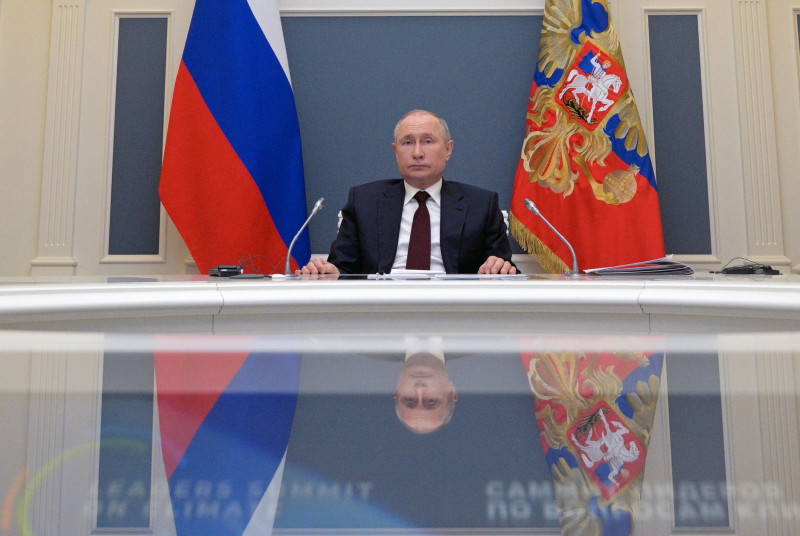
Russian President Vladimir Putin says he will ‘sign the relevant decree’ on a non-working period from May 1 to 11 in a bid to contain the spread of Covid-19. – EPA pic, April 23, 2021

MOSCOW – President Vladimir Putin today backed a proposal by the head of Russia’s health watchdog to introduce a non-working period early next month to prevent a surge in Covid-19 infections.

“If you think that it’s necessary, let’s do it. Today, I’ll sign the relevant decree,” he said in a televised meeting in response to a proposal from the head of Rospotrebnadzor, Anna Popova.

She said the non-working stint from May 1 to 11 is part of an effort to limit the time Russians spend on public transport and their exposure to the coronavirus.

Many Russians go on vacation in early May every year.

May 1, when Russians mark Labour Day, and May 9, when the country celebrates its victory in World War II, are public holidays.

Before the announcement, the period from May 4 to 7 was supposed to be regular work days.

The move, expected to be welcomed by the public in an election year, also signals a reversal in Russia’s recent hands-off approach to containing the virus.

Most restrictions across the country have been lifted, and life in the capital here – the epicentre of the country’s outbreak – all but returned to normal at the beginning of the year.

Instead of a fresh lockdown, Russia has relied on its home-grown Sputnik V vaccine to tackle a fresh wave of infections that battered the country since last autumn.

But, it has been among the hardest hit by Covid-19, with the Rosstat statistics agency recording more than 224,000 virus-related deaths – significantly higher than the 107,501 health officials reported as of today.

The Rosstat toll means Russia has the third-highest number of virus deaths in the world, after the United States and Brazil.

Putin, in his annual state-of-the-nation address this week, hailed three vaccines developed by Russia, saying they are central to the nation’s ambition of developing herd immunity by autumn. – AFP, April 23, 2021

Related News

Education / 1w

Zambry leads Malaysia delegation to Russia for bilateral cooperation talks

Opinion / 2w

Wikipedia has become compromised by intelligence agencies and ideological capture

World / 3w

Why Russia is expanding the Northern Sea Route

Education / 1mth

Malaysia must embrace AI in education to avoid falling behind

Malaysia / 2mth

Covid-19 cases in Malaysia stable, no deaths recorded this year – MOH

LENS: KL / 3mth

Russian Embassy in Kuala Lumpur holds special May Day remembrance

Spotlight

World

Series of explosions, fires hit three southern Thai provinces

Opinion

One more temple falls: The destruction of Malaysia’s soul?

Opinion

Why is Israel pushing toward confrontation with Türkiye?

Malaysia

‘Uncle Anwar’ sends representative to children’s entrepreneurs day in Subang Jaya

Malaysia

‘Look at temple dispute based on facts and laws’ – DAP reps tell Rayer

By Alfian Z.M. Tahir

Malaysia

Malaysia, Brunei set deadline to demarcate boundary, enhance border security

Malaysia

Police probe indecent act allegedly targeting woman in Sungai Petani

Malaysia

Sarawak postpones three major programmes over haze concerns

You may be interested

World

Two police officers among seven killed in wrong-way crash on UK’s A66

World

AirAsia flight undergoes cleaning after passenger ‘incident’ before Shanghai landing

World

Canada to hit US goods with dollar-for-dollar tariffs after trade talks collapse

World

Iran claims stronger hand as Pezeshkian calls for end to West Asia war

World

US threatens tougher Iran sanctions, raising pressure on China

World

Teen killed in sword attack at Swedish school was a 17-year-old girl

World

TikTok agrees to US$400 million settlement over alleged child privacy violations

World

Trump says ‘extraordinary’ US growth can tackle US$40 trillion debt