World

N. Korea claims another test for developing reconnaissance satellite

Through it, the country’s aerospace organisation confirmed the reliability of satellite’s systems

Updated 4 years ago · Published on 06 Mar 2022 11:00AM

N. Korea claims another test for developing reconnaissance satellite
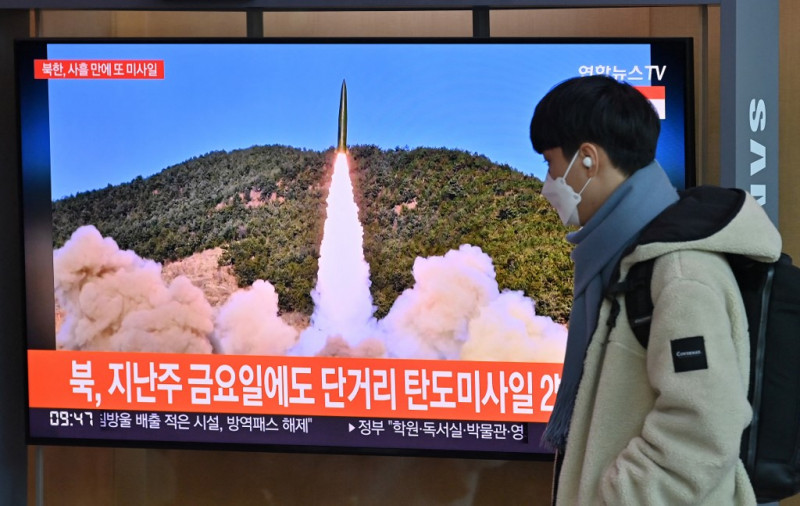
South Korea’s military has already said it believed this last test was actually the firing of another ballistic missile by the North, the latest in a flurry of weapons tests this year. – AFP pic, March 6, 2022

SEOUL – North Korea today said it has conducted another test for the development of a reconnaissance satellite.

The test was carried out yesterday, the state news agency KCNA said in a two-paragraph report that came just days before presidential elections in South Korea.

South Korea’s military has already said it believed this last test was actually the firing of another ballistic missile by the North, the latest in a flurry of weapons tests this year.

“The DPRK National Aerospace Development Administration (NADA) and the Academy of Defence Science conducted another important test on Saturday under the plan of developing a reconnaissance satellite,” KCNA said in its English language report today.

DPRK stands for the country’s official name, the Democratic People’s Republic of Korea.

“Through the test, the NADA confirmed the reliability of the data transmission and reception system of the satellite, its control command system and various ground-based control systems,” KCNA said.

From hypersonic to medium-range ballistic missiles, Pyongyang test-fired a string of weaponry in January and last week launched what it claimed was a component of a “reconnaissance satellite” – although Seoul described it as another ballistic missile.

Despite biting international sanctions over its nuclear weapons, Pyongyang has ignored US offers of talks since high-profile negotiations between leader Kim Jong-un and then-US president Donald Trump collapsed in 2019.

Instead of diplomacy, Pyongyang has doubled down on Kim’s drive to modernise its military, warning in January that it could abandon a self-imposed moratorium on testing long-range missiles and nuclear weapons. – AFP, March 6, 2022
Related News

Opinion / 5mth

Norway harshly cancels NSM missile supply contract to Malaysia

Opinion / 6mth

Sun Tzu: Why Iran has won

Malaysia / 10mth

Perlis Mufti reveals existence of deviant movement from South Korea

Culture & Lifestyle / 1y

Malaysia's unseen, silent underwater warriors

Sports & Fitness / 2y

Revive inter-state league to spot new talents, says former team manager

Business / 3y

Sabah to roll out My Second Home programme to woo more talents

Spotlight

Education

Fadhlina: Numerous factors considered before any decision made to close schools

Malaysia

Traffic congestion in Bandar Sunway persists into the afternoon

Malaysia

Two people allegedly stabbed in Kepong attack, student faces 20 years in jail

Malaysia

KLIA steps up K9 patrols at peak hours after security incidents

Malaysia

Customs seizes RM162m in drugs, including 460kg hidden in cemetery hut

Malaysia

Fourteen men charged over teenager’s death after alleged two-day ordeal

Malaysia

Instant billionaire? Bank customer finds RM1 billion mistakenly credited to account

Malaysia

Irene Sofiya murder: Accused’s family to take legal action over fake social media posts

World

Indonesia records 277,075 respiratory infections as forest fires fuel haze crisis

You may be interested

World

Indonesia hotspots spike as Kalimantan records 326, Sumatra 303

World

Trump says Iran strike was postponed after military plans leaked to media

World

Houthi missile intercepted over Riyadh as attacks intensify pressure on Saudi Arabia

World

Ukraine accuses US of aiding Russia over missile warnings and Starlink restrictions

World

Malaysia seeks China’s satellite technology to improve flood warnings, combat cross-border crime

World

Pope Leo XIV diagnosed with lung cancer after successful surgery

World

Indonesia records 277,075 respiratory infections as forest fires fuel haze crisis