FRANKFURT – As a string of Covid-19 vaccines near approval, Frankfurt Airport staff are gearing up to handle the unprecedented logistical challenge of transporting millions of life-saving doses worldwide.
Frankfurt is Europe's largest hub for transporting pharmaceutical goods and will be key to the success of inoculating millions of people against the deadly coronavirus.
"The stress is increasing now that we're entering the ‘hot’ phase," Karin Krestan, Lufthansa Cargo's director of operations, told AFP during a tour of the temperature-controlled “Cargo Cool Centre” terminal.
Krestan, who uses her skills as a former nurse, is sure her team is ready for the task.
"The processes have been established, we're very confident and we feel well prepared," she said.
In fact, Max Philipp Conrady, head of freight infrastructure at Fraport, told AFP: “We've been ready since August”.
Keeping cool
Frankfurt's cargo terminal has been working around the clock since the pandemic began, delivering medicine, surgical gowns and masks and supporting global supply chains as passenger numbers collapsed and airlines grounded planes.
The vast temperature-controlled hangar, a few kilometres from the main passenger terminal, handled 120,000 tons of vaccines, drugs and other pharmaceutical products in 2019, airport operator Fraport said.
It has 12,000 sq metres of temperature-controlled warehouses, essential for storing medicines.
About 8,000 square metres around the size of a football field, handles Lufthansa cargo alone, Krestan said.
Warehouses hum as ventilation systems pumps conditioned air and staff buzz around on forklifts. Boxes packed with measles vaccines stand ready for departure.
Frankfurt has 2,000 square metres of cold storage, Krestan said, set at two to eight degrees Celsius, which is ideal for vaccines.
Fraport recently boosted investment in high-tech refrigerated “dollies” that transport vaccines from cold-storage hangars to planes, and now have 20 so several freighters can be loaded at the same time.
Some vaccines, such as one produced by AstraZeneca and Oxford University, can be shipped at normal refrigerator temperatures.
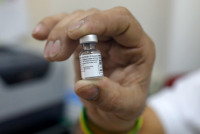
But Pfizer's, developed at the BioNTech lab in Mainz, around 20km from the Frankfurt airport, must remain at around -70°C.
That requires car-sized containers which use dry ice to keep contents at stable, ultra-low temperatures.
They can do so for up to 120 hours without a power supply, long enough to reach far-flung destinations.
Flight capacity
The EU recently agreed to buy 300 million doses of the Pfizer/BioNTech vaccine, presaging a huge logistical operation, much of which will involve Frankfurt in the coming months.
While the airport has the capacity to handle the extra-cold freight, Krestan noted that flight capacity will be a major factor in the pace of distribution.
Providing a single dose to the world's nearly eight billion people would require 8,000 jumbo jets, the air transport association IATA estimated in September, adding that the cargo industry faces "its largest single transport challenge ever".
Cargo planes can normally carry up to a million doses unless sub-zero temperatures must be maintained.
Adding to the challenge, 40% of annual global air cargo is typically carried by passenger aircraft, which have been vastly curtailed due to the pandemic.
A study commissioned by DHL estimates that 15,000 flights would be necessary to transport 10 billion doses.
Fraport is in communication with manufacturers “to see how we can optimise traffic”, Conrady said.
A lot rides on the operation's success, especially at hubs such as Frankfurt. Without swift and global inoculations, the air transport sector will lack the passenger numbers it needs to stay aloft. – AFP, November 28, 2020