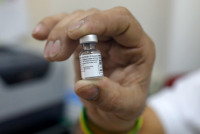
MOSCOW – Pharmaceutical giant AstraZeneca's Russian branch said today it would use part of Russia's homemade Sputnik V vaccine in further clinical trials.
“Today we announce a clinical trial programme to assess safety and immunogenicity of a combination of AZD1222, developed by AstraZeneca and Oxford University, and Sputnik V, developed by Russian Gamaleya Research institute,” AstraZeneca said in a statement published on its website in English and Russian.
The pharmaceutical company said that adults over the age of 18 will be enrolled in the trials.
Both the AZD1222 and Sputnik V jabs use human adenovirus vectors.
Russia's Direct Investment Fund, which funded the development of Sputnik V, said in a statement today that on November 23 it offered AstraZeneca the use of “one of the two vectors of the Sputnik V vaccine in additional clinical trials of its own vaccine”.
Those trials are expected to start before the end of this year.
“Combinations of different Covid-19 vaccines may be an important step in generating wider protection through a stronger immune response and better accessibility,” AstraZeneca said in its statement.
It added that cooperation with the Gamaleya Research Institute – the developer of the Sputnik V jab – is “important to explore the potential of vaccine combinations unlocking synergies in protection and accessibility through a portfolio approach.”
Russia was one of the first countries to announce the development of a coronavirus vaccine, which it named Sputnik V after the Soviet era satellite.
Last week Russia started a large-scale public vaccination drive, offering the vaccine initially to medics and other people in risk groups.
While the vaccine is yet to complete its third and final phase of trials, its developers said that interim trial results showed 95 percent efficacy.
The British-Swedish drugmaker AstraZeneca had earlier said that its vaccine was on average 70 percent effective. – AFP, December 11, 2020