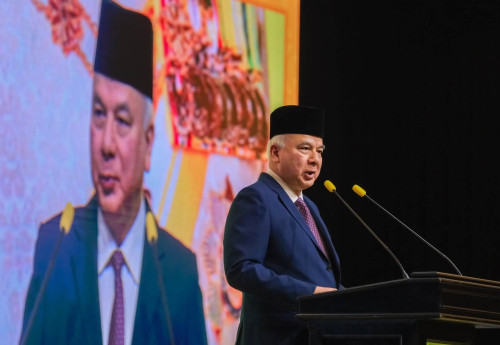
THE Employees Provident Fund (EPF) has secured its position as the 13th largest pension fund globally and the fifth largest in Asia as of September 2024, with a total fund size of US$247 billion, said EPF Chief Executive Officer Ahmad Zulqarnain Onn (pic).
“We are proud to say that EPF is one of the largest pension funds in the world. We aim to continue growing at a similar pace, forecasting an eight to nine per cent compound annual growth rate (CAGR) over the next two decades,” Ahmad Zulqarnain stated during the EPF’s 2024 dividend briefing.
He also highlighted the improvement in the average and median savings rates of its members, which reflects positively on the fund’s long-term growth.
As of December 31, 2024, the EPF’s investment assets stood at RM1.25 trillion, with 63 per cent of it allocated to domestic investments. Domestic investments contributed RM37.02 billion, accounting for 49.7 per cent of the total investment income, thus providing stability to the EPF's overall returns.
For 2024, EPF declared a dividend rate of 6.3 per cent for both its Simpanan Konvensional and Simpanan Shariah accounts, resulting in a total payout of RM73.24 billion. This payout includes RM63.05 billion for Simpanan Konvensional and RM10.19 billion for Simpanan Shariah.
Economists believe the EPF’s higher dividend payout will stimulate economic activity and contribute to national growth.
In a Bernama exclusive today, Malaysian Economic Association President Dr. Yeah Kim Leng said, “The seven-year-high dividend will boost the savings of over 16 million EPF members, improving their future well-being. It will also increase withdrawals for eligible members, which will boost economic activity when spent or invested.”
Dr. Yeah added that the dividend rate for 2024, which is roughly double the average fixed deposit rate, is highly commendable not just for the superior returns, but for the EPF’s consistent performance in generating high returns year after year.
“The strong and stable performance is the envy of many pension and investment funds globally, especially given the rise in global uncertainties and financial market turbulence,” he noted.
Prof. Geoffrey Williams, an economist, also commented on the higher dividend, saying it would lead to increased balances in the accounts of active EPF members, potentially resulting in higher consumption and supporting economic growth.
Williams praised the EPF's strategy in portfolio diversification, which has proven effective in generating strong returns.
“The EPF’s improved performance is attributed to its robust investment strategy, divestment of underperforming assets, and strong returns from overseas investments,” Beranma quoted him saying.
Looking ahead, Dr. Yeah believes that the EPF will be able to navigate global uncertainties with its resilient portfolio allocation strategies.
He warned, however, that the unpredictable policies of U.S. President Donald Trump could disrupt the global economy and financial markets, which might pose challenges for the EPF to sustain last year’s performance.
“However, as long as the EPF continues to generate a dividend payout higher than the inflation rate and outperforms other retirement funds, its members' retirement savings will remain intact,” Dr. Yeah added.
Williams also expressed optimism, stating that while global headwinds persist, they are expected to ease, and good performance will likely continue into 2025. – March 1, 2025