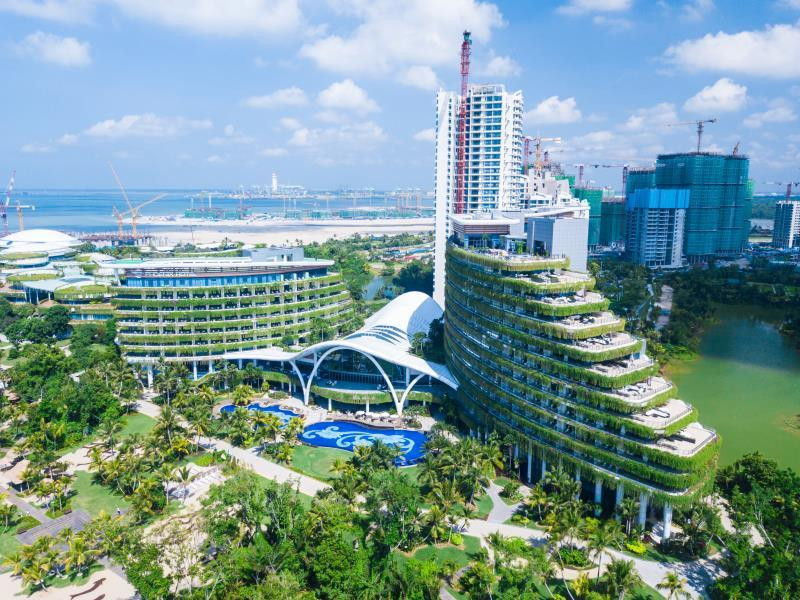
FOREST City is positioning itself as a major player in the development of the Special Financial Zone (SFZ) and the Johor-Singapore Special Economic Zone (JS-SEZ), with plans to enhance its transportation infrastructure to become the southern transportation hub of Malaysia.
The company is set to upgrade the current road transport network and establish a rail system, aiming to improve connectivity within the region.
In collaboration with Causeway Link, Forest City has introduced a bus route linking the area to the Customs, Immigration, and Quarantine Complex (CIQ) at the Sultan Abu Bakar Complex (KSAB), facilitating easier cross-border commuting between Malaysia and Singapore since 2023.
Country Garden Pacificview Sdn Bhd’s deputy president, Syarul Izam Sarifudin, shared that Forest City and Causeway Link are working to further improve public bus services to ensure smoother operations. The planned improvements include optimizing existing routes between Forest City and key locations like EduCity, NSK Nusajaya, AEON Bukit Indah, and increasing bus frequency along the Forest City-Second Link route.
A new bus route connecting Forest City to Kuala Lumpur was trialed starting February 12 and officially launched on February 16, offering additional convenience for weekend commuters. This service will integrate better with Johor Bahru’s public transport system, enhancing accessibility for a wide range of users.
In addition, Syarul Izam indicated that Forest City is prepared to participate in any future mega transportation projects, including the revival of the Kuala Lumpur-Singapore High-Speed Rail (HSR) and the development of the Autonomous Rapid Transit (ART) or Light Rail Transit (LRT), should the government decide to pursue these initiatives.
Meanwhile, Mohamad Fazli Mohamad Salleh, chairman of the State Works, Transport, Infrastructure, and Communications Committee, reaffirmed the state government's commitment to improving road and public transportation connectivity between the SFZ Forest City and JS-SEZ.
He noted that approximately 300,000 to 400,000 people cross the international border between Malaysia and Singapore daily through the Johor Causeway and Second Link. To streamline this, the new single inspection system at both CIQs, which incorporates facial recognition technology and QR codes, has started operations, expediting the immigration clearance process.
Mohamad Fazli further highlighted the state's plans to develop a comprehensive transportation network linking Forest City with JS-SEZ. A key part of this plan is the Rapid Transit System Link (RTS Link), which will connect Bukit Chagar in Johor Bahru to Woodlands North in Singapore, acting as a key catalyst for improved cross-border travel.
The RTS Link project is progressing according to schedule, with completion expected by the end of 2026 and full operations slated for January 1, 2027. With a capacity to carry up to 10,000 passengers per hour, this development will significantly ease travel between Malaysia and Singapore.
To support the RTS Link, a multi-tiered ART system is also being planned, covering routes including the Iskandar Puteri, Skudai, and Tebrau routes. The Iskandar Puteri route will directly connect Forest City to JS-SEZ, further enhancing regional connectivity.
The transportation system improvements are expected to bolster Forest City's capabilities as a key transport hub, attracting increased domestic and international investments. The state government is working with various stakeholders to ensure these transportation developments contribute to Johor's ambition of becoming a fully developed state by 2030.
With these infrastructure projects in place, Forest City is set to play a pivotal role in the continued growth and development of the southern region, strengthening its status as a vital economic and transport hub in Malaysia. – March 14, 2025