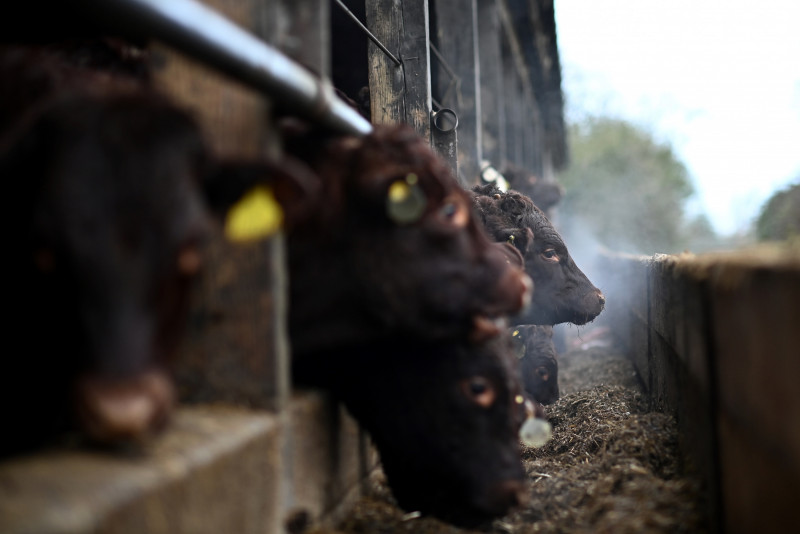
LONDON – David Exwood’s glossy, chestnut-brown Sussex cattle are brought in during the winter months, and apart from the bellowing that comes from their barns, his 1,000ha farm is quiet.
But while the inaction on his farm, near Horsham, southeast England, is typical of many in the colder months, it belies tensions across British agriculture as the sector braces for the new year.
“Brexit is just all about damage limitation, really,” Exwood told AFP, just days away from Britain’s departure from the European Union single market and customs union on December 31.
“It’s damaging our reputation as a country, our economy. Now, I’ve just got to try and prevent it damaging my business.”
Since Britons voted to leave the EU in 2016, farmers have had to contend with four years of uncertainty.
Would tariffs be placed on goods exported to the bloc? What changes might be made to farming subsidies previously decided by Brussels through the Common Agricultural Policy (CAP)?
Britain’s Environment, Food and Rural Affairs Department answered some of those questions on Thursday, as the country’s trade deal with the EU was being finalised.
The United Kingdom’s £5 billion (RM27.17 billion) in animal exports to the continent will continue after Brussels said it has met the necessary animal health standards.
Certainty and unknowns
Exwood, whose farm holds 600 cattle and 800ha of arable crops, has been better insulated against the prospect of a no-deal Brexit and the tariffs on livestock exports that would follow. His beef is sold in the UK.
British sheep farmers, who sell almost a third of their meat to the EU, had warned that the market would evaporate overnight if 50% tariffs were imposed in the event of a “no-deal”.
Despite greater certainty, there are still many unknowns.
Britain has been granted “national listed status”, allowing the continued export of meat, fish and dairy.
That means exporters will require a health certificate signed by a recognised vet to continue trade after December 31.
“We’ve prepared as much as we can,” said Exwood.
“We know about the paperwork, we know about the extra cost, we know about the delays at the ports, but it’s the things we don’t know about that will probably do the most damage.”
Closer to home, UK farmers are grappling with changes to subsidies that have been laid out in the Environment Land Management Scheme.
The government has called the change the most fundamental shift in UK farming policy for 50 years.
Under the scheme, CAP subsidies for areas of land farmed or numbers of livestock will be phased out – halved by 2024 and removed completely in 2028 – in favour of more environmentally friendly payments.
Farmers will be rewarded for restoring natural wildlife habitats to their farms, improving animal welfare and cutting pesticides, among other conservation efforts.
Richard Benwell, a former government adviser on environmental policy, and chief executive of the Wildlife and Countryside Link coalition, said the decision to use the money from subsidies for land management is “entirely the right one”.
The new policy is aimed at “rewarding the farmers who do the most for nature”, he said.
Across England, changes to farms, like lower stocking of cows and sheep, and more trees and hedgerows grown alongside crops, are expected post-Brexit.
“The overall impression will be one where, instead of intensifying production in farmed areas, we integrate nature better in the farmed environment,” said Benwell.
Lack of clarity
While he has said the policy is not about “penny-pinching and trying to do everything at least costs”, and that the government will be on the side of farmers who “want to be good stewards of the land”, there are still misgivings.
Claire Robinson, an adviser on agriculture and environment schemes at the National Farmers’ Union, said the plans are light on detail.
“We don’t know what the new schemes are. So, businesses are basically being told to change and get ready for a new scheme, and we don’t know what a new scheme is.
“It’s warm words, saying they’ll support you to do environmental good, but actually, you still don’t know if it’s a viable business.”
For Exwood, the lack of clarity is a problem.
“We’re still not clear, really, what government policy is. They’ve given us a signpost, but not a road map to what our future and future support looks like.”
He is hopeful the policies will be beneficial, but more environmentally friendly change is going to have to happen anyway.
“If they get it right, they will help us, and we will deliver a better countryside for everybody. They get it wrong, we will have to do it anyway. It’ll just be harder and slower.” – AFP, December 26, 2020